
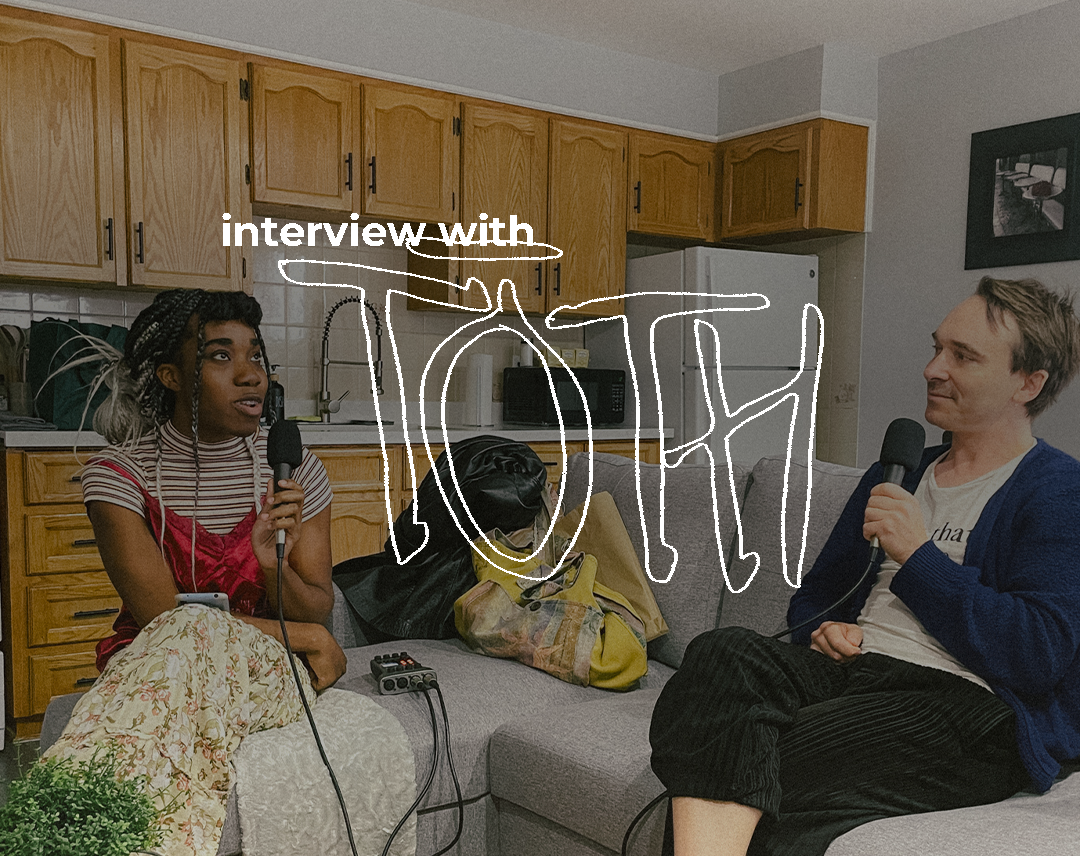
 Header photo taken by Allegra
In today's episode of Absent Sounds, we sit with Alex and the world he built as Tōth. His latest record, "And the Voice Said" has been a compass for me these past few months- it imposes no answers on listeners, but pulls you into the space needed to hear truth behind the noise. Almost like a mirror.
Also! Tucked in the episode: a live rendition of a surprise song from the record, performed by Alex and Allegra Heart. It's a small gift for those who stay until the end. We're grateful for Alex's openness and for you. As always, keep the conversation going, and be well.Weajue: Thanks so much Alex, for doing this. I've really loved your music — I was specifically introduced to it through "You and Me and Everything" in 2021. I really love how that record transitions into where you are now, and specifically the past five years where there haven't been any releases. What's been holding you back from putting things out in between?
Alex: Yeah, so since 2021 — I released the record in April, the second album, and then I did Dr. Dog's last quote-unquote final tour in the fall of 2021. And then not long after that, my other band Rubblebucket got back into action. Right around 2022, we started making an album called Earth Worship, which we released at the end of 2022. Toured that. Then we made another album called Year of the Banana and toured that. So it's really just — I made two Rubblebucket records and toured them. But at the same time I was writing and working behind the scenes on Tōth, such that I just released the third Tōth record — And the Voice Said — last month, and I have LP four finished. LP four's gonna come out within a year from now. I learned the hard way about trying to release my own music at the same time as Rubblebucket music. I didn't want to do that. I wanted to make sure when I was releasing this music, it fully had its own —
Weajue: Its own life.
Alex: Yeah.
Weajue: I do appreciate that, because I feel like a lot of your music comes from a place of — even though it doesn't sound like you're proclaiming something — the uncertainty that you let live within it is because of things you're going through at the time. I wonder if there's a part of you that feels reflected now that wouldn't have existed if you'd released it immediately, maybe during the time you were also putting out the Rubblebucket stuff.
Alex: Yeah, that's a good point. I do think it needed to take the time. All the steps that happened were important to how it ended up being. For example, there was a point where I had reached out to Caroline Rose to produce the record, and they weren't available. I was like, oh, I guess I'm doing it without Caroline. But things kept getting more delayed, and then all of a sudden I get a message from Caroline — actually, if you still haven't gotten into it, I can do it now. And I was like, let's do it. That was a game changer. Caroline really impacted the record so much. Certain songs that were written at a certain point became the anchors of the record. I'm glad for the time it took.
Weajue: There was a part somewhere online where you mentioned there were like 150 songs living before this record came out. I want to know why those ones didn't land in the final thing — what were they saying that wasn't fitting?
Alex: I don't know. I was able to on my own whittle the 150 down to like 75. I'm such a prolific songwriter, and there's just so much of my writing that doesn't fit into Rubblebucket. And I really do think there's something to be said about all of the stuff that doesn't make it in being part of what does make it in. I recently heard James Blake talk about how for every 30 minutes of music you hear him publish, there's like six hours of unpublished work. I'm just always kind of cooking. Caroline helped select — I think I got it down to probably 30 or 40 that I was like, these are all strong, and then it really naturally found its way into a collection of songs that told a story together. Maybe someday I will release more of those other tunes, but I'm still at a point where I want to be making clear, concise, intentional statements.
Weajue: I think the intentional statement comes right at the start of the album with "Not Broken." Because it answers the question of the title — or maybe it's not even a question, but the statement: "And the Voice Said." You wonder what the voice is saying, and you don't make us posture for the question or search too far to find it. It feels like the hinge of the album. I wanted to start with — what is the voice for you? It can be the internal voice, or a sort of deity.
Alex: I've been a meditator, a practitioner of dharma, for twelve years now. It kind of saved my life. Going on meditation retreats — I'm also in recovery, and you're encouraged to find a higher power. Some people call it God, some people call it the great outdoors, or Gift of Despair — there are different things. But I think when I'm quieting down and calming, really taking my time — meditating, journaling — I can hear more subtle, higher-self intuition. For songs, the ideas just arrive. It's not something I'm thinking of. I really want the music I write to be channeled, not thought of. And a lot of that just comes from the body. I think there's a tuning required to be open to that. And a lot of times the voice comes out of struggle — out of pain, out of discomfort, out of anxiety that's compelling me to meditate, exercise, do therapy, go to meditation groups, talk to friends. And it's interesting because the negative voices are part of the story too. That's part of what the voice is. A lot of growth and evolution can come from the negative voices.
Weajue: There's such a play in the album that feels like it's also tying into a lot of the negative voices, but specifically on the part where you say the voice asks, "Are you done with this?" And I kept questioning what the "this" is for you. Sometimes for me it's like, am I done with this life, these stories I'm holding onto so tightly. What is the "this" for you?
Alex: That's too spicy. Okay. Yeah, I don't know. There is an aspect of giving up as far as being a sober alcoholic — that could mean I just wanna use, it's too painful, I just wanna give up. People in recovery or in active addiction, and not just addiction but any number of mental health struggles, might find themselves at a point of like, I don't wanna do this anymore. This being life.
Weajue: Very true.
Alex: And you hear lots of stories too where people are so at their bottoms that they're having near-death experiences just from using. People often have their white-light experiences where a voice from beyond is asking them if they want to die or live. A little light fare right there.
Weajue: Yeah. I think the reason it felt so pertinent was because right before you released this, I'd spent a few months — I wasn't there for rehab, but for recovery for mental health issues. And I did a lot of meditation with a guy named Sean who was talking about mantra, talking about a lot of the themes you touched upon in the record. So it felt like, wow — I love the serendipity, how it's coalescing with things that were happening in my life. That's why I was really pulled by the questions you were raising. I also wanted to mention the video you put out for the first track — I loved it, especially how you had other people letting the words come not only from you but from them too. What was the decision to include them?
Alex: Yeah, I was on tour in North Carolina and two filmmaker friends of mine — we had dinner before the show, and they were asking me what I was up to. I sent them the record, and they do all sorts of journeys — they're documentary filmmakers. They were making one in Coney Island already, so they were very familiar with the landscape there. They were friends with these people because they'd spent a lot of time there — like the snake guy and the parrot guy, there's just characters there they knew by name. They felt like it was such a universal message, it should be sung by lots of different people. So we went around asking people if they wanted to sing it.
Weajue: It's a great video — it feels so playful. Which is a nice segue to track number two: Spiraling. To me it feels like your music lives in two spheres — the question of oneself and the question of yourself in relation to others. This one feels like a relational song, or at least more relational than just your own internal spiral. Do you find it easier to work within your own mess or the mess you have with others?
Alex: What's easier for you? [Laughing]
Weajue: For me, I feel like I have a preference for working on my own. I don't want to touch the mess I have with other people — it feels like too much.
Alex: I think there are things that come up much more strongly when in relation to another. And so sometimes there's this mentality of like, I don't want to be in a relationship until I'm healed —
Weajue: You're calling me out.
Alex: But healing is a lifelong process. You're not healed, you know, for us. And there is a lot of healing that happens in the relational dynamic. The spirals and the messes, the difficulties I've been faced with — I feel like I've grown so much, even in a relationship that may not have ultimately worked. I'm forever indebted to it for what that relationship taught me about future relationships and about myself. Things I bottomed out on in myself — I've learned things about talking to my inner child through the pain of a relationship that, even when I'm currently single, I'm still doing these practices only because of having bottomed out in that relationship. So I do think there's something to that. There's also something to: if you're really not doing well, maybe hold off. But I don't think it's a fixed thing.
Weajue: Was the spiral happening during the song, or from afar, looking back?
Alex: I think maybe a relationship or two really got me. They brought me to my knees in certain ways. I think I might be channeling that a bit. They are about relationships, but they also come down to how I'm relating to it myself. The song even confesses about that — saying, "Can you save me from the abyss?" Which is an absurd question. No, you can't. I'm joking when I'm asking that.
Weajue: I wrote that down because the abyss feels like there are so many different pockets of it that we're asking people to save us from — and they come up so many times in the album. What does the abyss look like for you?
Alex: I like that as a merch item — pockets of abyss, like different abyss options at the merch table. So there's sort of like... hexagonal, translucent, ethereal floaties that go into a negative vortex and take me —
Weajue: Take you to the clouds?
Alex: No. Take me to the dirt. And then from there, to the clouds.
Weajue: Which is my segue for track number three: Thoughts Are Like Clouds.
Alex: There you go.
Weajue: This one I kept coming back to. I wanted to ask about the line "the world is not my enemy" — tell me about coming to that realization.
Alex: A recovering alcoholic, without their drug of choice, without their medicine — the default is that the world is against you. You can wake up in different levels of paranoia about people in your life, or the world at large, feeling like they don't like you or they're trying to mess with you somehow. It's a huge part of recovery to see that that's essentially a dirty lens. That's not fact — it's just a muddy lens. And it was such a relief to know there's internal work I can do to clear that off, that that perspective need not be the one I carry into my day. And in fact, if I am confronted with an actual enemy or somebody trying to hurt me, I'll have much clearer eyes. I can navigate that from a more grounded place. But yeah, without my daily meditations and journals and daily reflections and talking to other people in recovery and on spiritual paths — without all of that, my default does tend back toward: oh my God, everything's bad, that person doesn't like me. So I need to do things every day to prevent that. I'm kind of poking fun at that with "the world is not my enemy... or whatever."
Weajue: The "or whatever" is so funny. It's such an interesting qualifier.
Alex: Because it's a little sarcastic. It's showing you that I kind of do think the world's my enemy.
Weajue: Yeah, exactly.
Weajue: I think the comedy of the record feels like it comes to a head with Easy, which I also love — when you saw the music video and you included the bug. I immediately knew- Kafka. I wanted to ask about it. Is it easy to come back to yourself? It feels like one of the hardest things you can do in life. What is that process for you?
Alex: Over the years I've developed a daily practice, and the morning and night routines have become something I look forward to. They're almost like a creative act. When I'm home especially, I go to my roof with a cup of coffee before getting into my phone, and I'm reading some kind of daily reflection, having some sort of commune with the birds, doing walking meditation, journaling. Sometimes I'll write some poetry, just stuff things down. Then I do a sitting meditation. It really brings me into my body. I also do a nightly mantra — for myself, for all beings, for different people in my life. One of the lines is "may I live with ease," "may you live with ease," "may all beings live with ease," and I really try to feel it. That nighttime practice is called mettā, or loving-kindness.
Weajue: I've done those.
Alex: Yeah. Even if you can't generate warm feelings, it's like a magnet — you become aware: oh, I can't generate warmth, I'm against myself right now. But yeah, that said — Allegra can tell you that even with all these practices, I can still get kind of ahead of myself. I have to just bring it back.
Weajue: It's one of those things where no matter how often you try to sit in that seat of awareness, it's really hard. So the fact that you've reached a point where it feels natural to come back there is hopeful.
Alex: Yeah. And the joke of the song though is that in this relationship — which may be fictional, may be inspired by reality — I might be regularly triggered because the person is avoidant, or we're not on the same page with love expressions, and my need for verbal affirmation is too high for that person. And the message I'm getting is that I'm not easy — that I'm difficult.
Weajue: I really resonate with that.
Alex: May we all find people where we feel safe and at home and can be whatever quantity of emotion we are.
Weajue: The whole version of ourselves.
Alex: Yeah, exactly.
Weajue: I saw that you mentioned your neighbor came while you were screaming.
Alex: Yes.
Weajue: What was your reaction? How did you reply?
Alex: I just said, I'm just recording. I opened the door and you could see — Caroline was in the other room and we had different mic distances, doing some room takes — so he could see the mics. I was like, hey, I'm only doing a few more things. He laughed and was cool about it. He just wanted to make sure everything was okay. I'll play trumpet and nobody ever complains. I've been making music in my apartment for years. But that's apparently the top of my registered scream and they're like, is everything cool?
Weajue: Now we're at track number five: Ageless Moon. I really love this track sonically. The title as well — the idea of an ageless moon, there's a sort of indifference there, like it's witnessing what happens but not being impacted. Was that comfort, indifference, or something painful?
Alex: I'll be honest — this will be my first time thinking about what the song means. Some of my favorite songs are ones where I discern what they're about after. I just trust that they feel right.
Weajue: I want to hear your fresh thoughts.
Alex: Well, it says "I don't want to face the face of the ageless moon." What was your interpretation?
Weajue: I was looking into a lot of mystical sides of Christianity, and one person I was researching was talking about his idea of God as — not indifferent to our suffering, but witnessing it without interfering. That idea bounced back to the ageless moon for me, like it's just witnessing what's happening and it doesn't —
Alex: I love that. That's what it is. That's what I meant.
Weajue: And even the part where you say "how to love me" — I kept asking: are you asking the other person how to love you, or asking yourself?
Alex: Thank you. "I worship the space your absence created — but I don't want to face the face of the ageless moon." The space is liberating, especially if the thing clearly wasn't working. Yet there's the inverse of the absence, which is that now I have to face essentially the —
Weajue: Abyss again.
Alex: There we go.
Weajue: How many times can we bring it back to the abyss?
Weajue: The most ultimate abyss, which is death, kind of comes up with the next track: Ice Cream. This one feels like it carries such a fun itinerary of everything we do in our lives, yet it comes to this final point — "I don't wanna die alone." I felt really struck by how plain and open you are with that. Is that a hard thing for you to say?
Alex: No, I don't wanna die alone. [laughing]
Weajue: Being so open and plain in your work — is that easy for you?
Alex: You guys hang out with me till I die. Maybe I —
Weajue: It's funny, I signed up to do hospice volunteering because I don't want people to die alone. The sentiment is real.
Alex: Yeah. If you take some common trigger to its furthest extreme, it's that: nobody likes me, everyone's gonna leave, and I'm gonna die alone. That's what it is. The way the song was originally presented was as a one-minute piece — basically the diary entry part, the mountains that don't have names, and then "I don't wanna die alone." And every time I played it, I laughed out loud. It's an absurd, funny thing to just put all that out there, even though it's really sad and true.
Weajue: The mountains without names part — when I first heard it, it reminded me of Alexander Supertramp, the guy who went into the wild in Alaska. He quoted Confucius: to know things by their rightful name is to pay them respect. Even though there are mountains without names, I feel like I owe them something by knowing them.
Alex: Mountains that don't have names — I'm sort of thinking about the struggles that we face collectively and individually, especially in the mental health realm. There's something noble about the Western medicine thing of trying to diagnose, figure it out, find treatments. But it gets confused with pharmaceuticals, and a lot of times you're just guessing — especially in like bipolar and personality disorder realms. Very few things fall squarely into clear categories. I think a lot of what I was getting at is that there are obstacles we face that, no matter how hard you try to sort out why they are the way they are, sometimes it's futile to name them. A waste of energy.
Weajue: I've been through that. It feels helpful to a certain point and then you just dig yourself into a —
Alex: I think seeking professional help is crucial. And having something, even if it's an approximation, being diligent about experimenting with how you're responding to certain things — I think that's a great approach, especially if you can maintain some lightheartedness about it through the trials and tribulations.
Weajue: Especially because the pain is often in not knowing, the uncertainty of what's wrong.
Alex: Yes.
Weajue: Maybe that's just what you've gotta sit with.
Weajue: I think the negative voices come up most intensely in Triangle People. I want to start with the Judee Sill quote, which arrests you when you first hear it. Reading her story, it felt like — wow. The line: "the lower down you go to gain your momentum, the higher up it'll propel you." And she also said, this was either the song or suicide.
Alex: Yeah, she said that before playing "Jesus Was a Cross Maker."
Weajue: That floor — I keep coming back to it for my own life. How low do I have to go before it propels me? Is there a floor for you?
Alex: I don't know how to measure that, but my tolerance — I catch things pretty quickly now. I have all these tools and ways of responding to things. And I do feel so lucky to have music, to have the expression of art and song. It's cathartic for whatever I'm feeling. It's helped me a lot get through things. So that's why it had not been suicide. But I — I don't take that lightly. And I wasn't saying she was right. I was saying she said it.
Weajue: Yeah. And some people were like, you okay, man?
Alex: I'm like, no, I'm fine. I take care of myself. I don't know.
Weajue: It's a good quote. The part of the song where you say "I thought I was a free man" — what does freedom look like for you?
Alex: Free from difficult patterns, difficult tendencies I might have around frustration or anxiety or other things. Free to choose ease and peace when in fact things can still be triggering. I'm nowhere near enlightened. It's frustrating when you're in a life situation where something makes you feel really upset or really sad or anxious, and maybe you lose your cool. That can feel really damning — like, I thought I was free from that. But I'm not. And I'm engaging every day, doing self work, trying. It can be frustrating.
Weajue: It's very frustrating. I almost feel like that comes back to the suicide-or-song part for me — the main question I keep returning to is, do I even want to live? And so it feels like I'm trying to be free of everything else but I can't shake that one fundamental question.
Alex: Right.
Weajue: Anyway — tell me about Goo. What was the magnet pulling you toward including it?
Alex: Caroline was like, that track's gotta be on the record. That was one of the things — that song's actually from 2017. It was originally something I was maybe writing for my punk band. But I'd separately gotten excited about it, wanting to develop it. And I just really love what Caroline did with it. They wrote that bassline. And I think my favorite thing in any song I've ever done is the really haunting, ghostly background vocals Caroline ended up singing — this huge wall of sound in the second verse into the chorus. I just love it.
Weajue: The collaborations on the record feel like they really did bring it. Sometimes collaborations can feel like they're not adding anything. Even the next track, Touching — you included Kimra, co-developing that track. What do those collaborations include that would have been gone otherwise?
Alex: On a really basic sonic level, just having different vocal textures is so important to telling the story of the song and lifting it up. Different voices singing different parts just add so much more color. I've been friends with Kimra for a really long time. She's just an incredible singer, and we've really been on the path together — all the stuff you and I have been talking about — for all these years. So it felt really beautiful to bring her in and make a music video with her.
Weajue: I was really moved by it. And I read your Talkhouse piece where you two were talking about kissing trees. Did you end up kissing a tree?
Alex: We did kiss a tree. We've kissed and hugged a couple of trees.
Weajue: Lovely. ---
Weajue: Let's go to No Umbrella. The line that I wanted to ask about specifically is "our heart can hold everything, including the memory of your eyes." To me there's a dissonance often between letting things go and holding onto emotions and memories to release them creatively — versus letting them pass because they can't just sit there. What has the equation balanced out to for you?
Alex: I think the line is: "I've been foolish and forever young, may I grow open wise, with a heart that can hold everything, including the memory of your eyes." And I think there are certain losses in life that you're never going to get over. Certain things that happen to you — trauma from childhood, losses when a parent or loved one dies, or a heartbreaking love — you can't erase them. They're going to be with you till you die. But there's a way to hold those things that enriches the experience of life — that makes new experiences even richer. Just a totally present moment with a nice breeze, a bird, a new smile, a new interaction. All of that has that much more power and richness because of what you're carrying. The losses you're carrying. And if you can be present to the new things, it gives you more capacity to hold the rest. A lot of what the practices I do are aimed at is just being as present as possible, able to hold the losses I've experienced and the losses to come, and also welcome — because along with losses, there are just as many joys as there are sorrows. Just to be with that. That's where I'm coming from.
Weajue: For me, the reason I was struggling with that is because someone recommended The Untethered Soul to me, and it's largely about — everything that happens, you have to let go immediately, otherwise it'll sit within you. And I had this experience recently where I saw somebody crying on the street, and I felt like, I want to be touched by that. I want to remember it, I want to be impacted — not have it be like a ghost thing that just passes through. It was really bothering me.
Alex: To clarify — I'm not suggesting I want to repeat or loop the lost experience or the lost person in my head. I'm not advocating for attachment or clinging in any way. I just feel like, unavoidably, our psyches, our nervous systems, our bodies are holding things. Some grief does get less painful over time. But certain things will never fully —
Weajue: It'll always hurt.
Alex: It'll always kind of be there. And you can find a way to live with that in a peaceful way. You can find a way to experience the beauty and sorrow you just described without clinging to it. Your heart's just open to it and present for it. Open to the pain that might be coming up from the past — in a way that's also open to new experiences. That's non-clinging.
Weajue: Yeah. ---
Weajue: That brings us beautifully to the last track: Light as Feathers. It feels like reaching the end of some sort of journey. Can you tell me about where the track ends?
Alex: This is the most comprehensive interview I've experienced for any of my work.
Weajue: It's so lovely to go through your stuff.
Alex: I'm enjoying it. "Can we please stay together, we'll be as light as feathers" — there is a little bit of clinging there, a little bit of pleading. But also a mantra: we can make it better, we'll be light as feathers. There's hopefulness, but at the same time a sense of the narrator pleading with somebody. And I think it is that — but it's also a positive affirmation for the future. And it culminates in the full ripping guitar solo and tons of vocals in and out. It just felt like a really uplifting way to end the record.
Weajue: I almost want to leave it there and not touch it. What do you want us to feel when you hand it off to listeners?
Alex: I don't have a clear thing I need or want you to feel. I just hope that it opens your heart, and lightens the load for you somehow. Helps you feel less alone in whatever you have to carry. Brings you joy and laughter and the ability to move through your sadness in a way that — yeah. We're doing it together.
Weajue: That's beautiful.
