
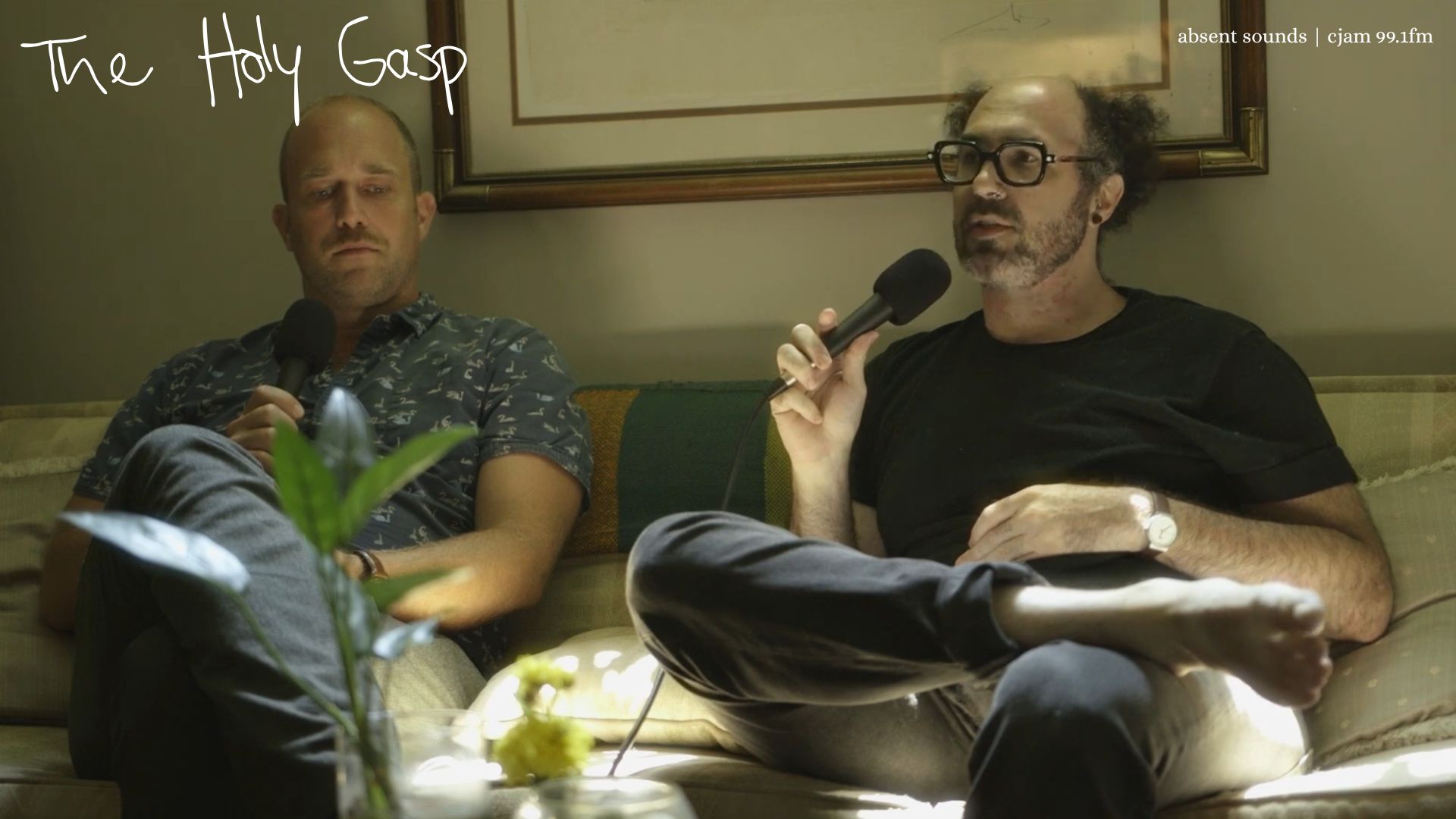

In this episode of Absent Sounds, we head to Kensington Market (Toronto) to revisit The Love Songs of Oedipus Rex (2018) by The Holy Gasp, alongside the re-release of the documentary that captured its creation.
The Holy Gasp is the songwriting and performance project of Benjamin Hackman, who wrote this thirteen-track work of theatrical, devastating, and often darkly funny storytelling. Filmmaker Luke Sargent brought his lens to the project, shaping 85 hours of raw footage into a 22-minute film that mirrors the record's themes with nuance and care.
Together, we trace how the record grew out of grief, divorce, therapy, and community, and what it means to parent yourself through endings. The conversation is woven through a playthrough of The Love Songs of Oedipus Rex, so tune in to experience both the music and the story behind it.
🎬 Watch the documentaryBenjamin Hackman: Hi, I'm Benjamin Hackman from The Holy Gasp. Hello, Radio World.
Absent Sounds: Along with —
Luke Sargent: Hi, I am Luke Sargent, director of The Love Songs of Oedipus Rex, the documentary.
Absent Sounds: The documentary, yes. That is crucial information because we are going to not only dive into the record itself, but talk about the making, the process, and everything behind the documentary that accompanies it. Before we get started, we usually like to give our listeners a little introduction into who you guys are. But today, I want to start by diving into the first conversation or the intersection of both of your lives. So where did you both begin, and do you remember the first conversation?
Benjamin Hackman: Well, the two of us met as co-founders of the Christie Pits Community Garden, and that would've been in 2008 or so. So we've been friends for a long time, and we always sort of wanted to work together. Luke works in film editing predominantly, and has been moving into film directing as well. And in 2016, I moved to Toronto Island and Luke came to visit me. I was just about to begin pre-production on The Love Songs of Oedipus Rex, the album. And I thought, this would be a good documentary.
Luke Sargent: Can I jump in here?
Benjamin Hackman: I know we disagree on our memories of this.
Luke Sargent: Well, you said, "I want you to shoot some behind-the-scenes footage."
Benjamin Hackman: That's probably true.
Luke Sargent: And I was like, I have zero interest in shooting behind-the-scenes.
Benjamin Hackman: But I remember presenting it to you in a very ceremonial package. We were bobbing up and down in Lake Ontario and I said to you, "Listen, this is gonna be a great documentary. This album's gonna change the world. Somebody's gotta document it. And in exchange for your creativity, time, and labor, I can offer you —"
Luke Sargent: Exposure.
Benjamin Hackman: Exposure, yes.
Luke Sargent: Which is another word for absolutely nothing.
Benjamin Hackman: But you called me like the next day and you're like, "I thought about it and I've got the summer off and yes, I want to do it." And then you showered me with praise and haven't stopped doing that since.
Luke Sargent: I think what kind of happened was, it started as like a BTS — "Hey, can you shoot some stuff, we're making this album" — and then we started talking about, why are you making this album? And I thought, oh wow, this is a bigger story. There's a lot of grief going on, there's a lot of loss. You were talking about how your dad had passed and you'd written songs about that, but you were also in the middle of a messy divorce. And concurrently to all of these events, your therapist had died. And that was a big part of your life — psychology and therapy, talk therapy, it's a huge part of your life. My mom's a psychologist, so for me it was like, oh yeah, this isn't just "Hey, the band wants something for YouTube." It was like, no, there's something going on here that's special and unique. So that's what kind of got me. And then we also had a young baby at home, Sigmund. And I had to ask my wife, like, "Hey, is it okay if I buzz off to Toronto Island on a bike with a sleeping bag and some film gear for two or three weeks?" And she was kind of like, "Yeah, go for it," which was awesome.
Absent Sounds: That's one of the questions I was thinking about too — even watching the documentary, there are some conversations that felt a little heavy. I was wondering if that was a typical part of your relationship beforehand.
Luke Sargent: In discussing the broad strokes of the project, we laid down some ground rules. And one that Benjamin offered up was, "You can ask me absolutely anything. You can record me anytime." And that was a real gift in terms of vulnerability and access — speaking in documentary terms. So that was really bold on your part. And then yes — like, we recorded 85 hours of footage for a 22-minute documentary. So yes, we sat and talked and talked and talked. The transcripts are huge.
Absent Sounds: Luke, did you see yourself more as a fly on the wall, or more as a very involved presence when they were recording?
Luke Sargent: Well, that's a great question. I think every person who aspires to make a documentary wants to be just an observer, but there's an impossible dynamic there where you're pointing cameras in people's faces. In some cases, in the doc, I'm inside the recording booth with the bass player — his bass is huge, he's a big, tall guy, James — and you're a part of it. So I think the way that I sort of accepted that role was just to be as chill and observational and friendly as I could with everybody. I sat down with a bunch of people beyond Benjamin and asked for permission to interview them, and I would always start with just easy getting-to-know-you questions — stuff that I knew wouldn't make the final cut, but just to build that rapport. And by the end of it, a lot of the people had said, "We don't even know you're there." So that was a real compliment.
Benjamin Hackman: I felt like you were a part of the band during that process as well.
Luke Sargent: Yeah. I mean, I watched every recording — I was there in the booth, kind of, or in the room watching every recording, trying to be quiet.
Benjamin Hackman: And that's the thing also: when you're making a record, it's not like it's a solo thing anyway, and not everybody there is a musician — there are crew members there. So it's not that different to see a person with a camera than it is to see somebody setting up a mic. It all sort of feels like the same thing. And also, musicians are used to performing, so in some ways it's actually easier to have someone there — because it's the difference between having a conversation and leaving a voicemail. When you're leaving a voicemail, you have no feedback.
Luke Sargent: Yeah, there were takes where you're like, "How was that?" And I was the closest person. This is always the danger in a film situation — actors sometimes ask the gaffer, "How was my take?" and then the director's like, "Hey, I was behind the monitor, what the hell?" But yeah, there was a lot of camaraderie.
Benjamin Hackman: But you also — you blended everything. I never felt like I was working with a, quote-unquote, "professional." I felt like I was working with my friend and a fellow collaborator. There wasn't that clinical, stale "I'm coming to work" kind of feeling ever. So when I asked you, "Was that good?" I wasn't asking you as the subject of your documentary. I was asking you as my friend.
Luke Sargent: And a fan of the music.
Absent Sounds: Yeah. I think that's also a really interesting thing you brought up about the performance aspect. Because even though I know lots of musicians spend time performing, I think there is a weird tension that goes on between filmmaking and music when it's brought together — there's a sort of permanence of film, the footage will live on. And even though music that is recorded does live on too, I think it carries a certain impermanence of the feelings or the energy that people put in. And I'm curious how you see the change for yourself — how was it in the moment, and how is it looking back now? And do you feel like having it filmed also contributed to a difference over time?
Benjamin Hackman: Oh wow, okay. You know, when I look back on the documentary now, I really see how deeply sad I was and how painful that period of time was. But I also — like, I got divorced perfectly. You know, I surrounded myself with friends. I gave myself a creative outlet. I went somewhere kind of exotic that would foster artistry and creativity and respite. I picked a very beautiful place on a very beautiful summer and simplified my life and filled it with nothing but art. So yes, I was dealing with really painful things, but when I look back on it now, I just look back with a lot of joy, and I feel this sense of like, I'm the victor: I had a difficult time and I came out on the other end stronger and happier and with a better life and with a cool art project. So it's kind of nice to look back on it. It doesn't sort of bum me out like other memories might.
Absent Sounds: That's really interesting, because sometimes I feel really sad when I'm looking back on certain parts of my life. I'm able to see it from this side, but it's like there's this other person that I see that's really hurting, and I can't access them and I can't help them. So I guess for yourself —
Luke Sargent: Missing that old self a little bit?
Absent Sounds: Yeah, yeah. And it's like, I don't really know what to do to comfort that person, even if it's right there.
Benjamin Hackman: But I guess the difference is — 'cause I can relate to what you're saying: if I see a version of myself in the past that's wounded and didn't get the help it needed, then I have to retroactively mourn and heal. But I can see myself, when I look back on The Love Songs of Oedipus Rex, giving myself exactly what I needed to get through it. So when I look back, there's no part of me that's like, "Oh, I want to help that younger version of myself." That younger version of myself is being helped on screen. I can see it happening.
Absent Sounds: That reminds me of another parallel — just then, you reminded me of something where he had mentioned that the sad part about grieving people is that eventually people can just let go, and then they'll be okay with it eventually. Which — I don't know if that softens or waters down the love that you feel in that moment — but how has the process of the divorce you were going through changed your view on love and other ephemeral things now?
Benjamin Hackman: It didn't change my view on love at all. You know, grief is the necessary byproduct of having loved. And when we love people, we open doors in our hearts. And when we open doors widely, we let in a lot of love, and we risk letting in all the dust and bugs and horrible things too. And if we open the door of love just a crack, we let in very little love and we protect ourselves. So everything is commensurate. And we live in a culture that very quickly determines that a successful marriage is one that doesn't end. But — and maybe this is a crude metaphor — if you're playing a video game and you beat the game, the game's over; you can go do something else. A relationship doesn't have to last a lifetime for it to be successful and rewarding. And in fact, recognizing the end of something is a sign of success as well. So no, it hasn't changed my perspective on love. And even at the moment, I never felt embittered or jaded or felt like "marriage is a sham." I'm engaged right now — I'm getting married again. Like, it has a happy ending, so to speak.
Absent Sounds: This is a question to you both. I really struggle to let go of things, or recognizing when it's time to just move on to something else. Is that something you notice in other aspects of your life? Or are you pretty good at recognizing when it's time to keep moving to the next thing?
Benjamin Hackman: I think everybody struggles with that.
Luke Sargent: I'm kind of struggling, actually, to find a point where I have consciously let go. I suppose there's a friendship that I had to make a conscious effort to say, "Yeah, okay, that's — it is what it is." Which is a term that comes up in every project I work on all the time, which is always like the moment you accept defeat. Everyone's like, "Well, I guess it just is what it is," and you're like, "No, it can't just — not this early. I'm not ready." So yeah, it happens. I think — and I sound like an old man here — but it gets easier the older you get. Maybe the intensity of emotions is different, or maybe it's just you've got more experience letting things go or having things run their course. Like, I like to look back on my own life in terms of decades. My twenties, looking back, was a time when it was all expansion — reading voraciously, listening to all kinds of lectures, really interested in people and kind of letting anyone in who was willing to play. And then my thirties was learning that not all friends are equal, and sometimes friendships run their course, and accepting that is okay. And so there was a bit of a contraction in my thirties. And now I'm into my forties, and it seems like it's more about longevity. Different phases, and you can give yourself permission to accept that about yourself.
Benjamin Hackman: Maybe it takes time to learn about endings. You tell a kid, "It's bedtime, get into your pajamas," and they freak out. They don't want the day to be over. And I think there's a real built-in mortality aspect to it all, where we just fundamentally resist endings, because all things that move towards their end — including a day, a relationship, an ice cream cone — they're gone forever. The day doesn't come back. The ice cream doesn't reform in the cone. I don't think that's an intuitive thing to accept. What is intuitive is to rage against the dying of the light and to resist things moving towards their end. And yeah, we have to parent ourselves to accept and adjust to things ending. Necessary. We're not gonna change it.
Absent Sounds: I think, to me, when I think about my resistance towards endings, it brings up something of a little fear of giving up or letting go, but also with the idea that I'm just releasing myself into maybe more of a depression or a darker place. And I know that's another thing you talk about a lot in your music — what's that process been like for you, Benjamin, of getting through periods of darkness?
Benjamin Hackman: That's a huge question. I suppose the important thing to note is: we do get through darkness whether we try to or not. Whether we're conscious of how we did it, in some respects, is irrelevant. We do do it and have done it. And perhaps it's the simple fact that time heals all wounds, or perhaps we really are survivors and, just as a species, are incredibly endurable and know how to get through these things. You know, in the same way that there's this pronounced death drive, there's also a very strong evolutionary pull to keep living. And — I think about this quite a bit — creation and destruction are not equal. It's a really big problem. If you give me a hammer and I build a house and shelter the homeless, they're sheltered until a tornado destroys the house. But if I use the same hammer to bludgeon somebody's head and kill them, they're dead forever. So the things that we build and create last as long as they last. There's nothing humans can create that will last forever. And because of that, the things in this world that are precious to us — we feel wounded when they go away, because we know they can never come back. But it does nothing to alter the creative drive.
Luke Sargent: Oh, I disagree — I think it inspires us to create.
Benjamin Hackman: Well — yes, yes — if anything, it's the opposite. It's the motivation.
Luke Sargent: This previous question reminded me — have you guys read In the Skin of a Lion by Michael Ondaatje? This is a book that was given to me when I moved to Toronto from the West Coast, and they were like, "Read this — you'll understand the city." It's all about the building of the Bloor Viaduct and the foresight that city planners had. But there was this character — he was Macedonian and he was the bravest bridge-builder. He would swing from ropes across great distances, A to B, bringing something from one place to another. But he was terrified of going to sleep at night, and he would drink himself to sleep at this bar every night. Here's this big, strong, tough leader in the day who was sad and lonely at night because he was afraid of the unknown. And I think what we're circling around here is this idea of: you want to hold onto things because they're tangible, and it's terrifying to let go because you don't know what will be next. What will I feel next? Who will the next person be in my life? Will I have to sit with my own thoughts in the dark? And I can relate to that. But there's a certain kind of FOMO because it's tangible. And if you can't know, you have to just be brave and accept not knowing.
Absent Sounds: I think along with that, there's a certain sense of vulnerability of letting go, but also vulnerability of being seen — which I think a lot of us fear. And I think that's so interesting compared to the idea that you are seen not only through the camera, but also within such a large arrangement of people being part of your records and live performances — the grief and intimacy of your performances is not just shared internally, but with the collective. Is that a natural state for you as well — to be seen, to be open like that?
Benjamin Hackman: Yeah, I would say that's just natural to my temperament and demeanor. I want to be in dialogue with people, and I want to be in relationship. And art is one of many ways that we can cultivate a very curated type of communication. I'm not singing to people; I'm responding to them with song.
Absent Sounds: What is their response to that? Do you hear responses?
Benjamin Hackman: They're subtler, you know. But there are a lot of facial expressions that are made in a performance, and people verbalize their feelings to a performer afterwards. It tends to be that if you don't like the performance, you keep it to yourself. So we get a skewed notion of who likes what. But that's the risk: we put ourselves out there artistically, and we strive to connect with those with whom our art resonates.
Absent Sounds: I am also curious how that affects you, Luke, as a filmmaker, when you're taking other people's grief or pain or whatever story they're willing to share with you.
Luke Sargent: It's a precious thing. Yeah. Handle with care — don't drop it. I think — I've always, you know, I started making films as an editor, and some things to me will still always be magical. Like a performance — an actor can be in the middle of a set which is big and messy and chaotic with hundreds of people, producers breathing down their neck about the time they've got, directors working on the shot, and all the people in makeup saying, "This is how you look right now and you need to look better" — all this pressure — and then the actor stands there and just goes there. How could you do that? To me that is so precious. And so for editing, it took me a long time to cut performances — which is literally the job, right? You have to cut and paste, put things together, throw things away that will never be seen — and I was always really timid about doing that, because who am I to say "this is better than that"? Of course, you read books and you learn from mentorship and experience; it becomes second nature. But I still have that sense of, "Don't break it." We're trying to elevate — filmmakers, I think, are always trying to elevate the performance. And that's a responsibility that I really do take. I'm the first audience as the director or as the editor, and I try to put aside "What is the audience gonna enjoy about this?" and change my perspective a little bit. But yeah — I think it's a precious thing and something not to be tampered with too much. But then, on the flip side, you've got 85 hours of footage — I could have made this into ten different stories. Watch any reality TV show and it's all very deeply manipulative. But, you know, you just kind of hope that you've got the right thread and that you're not trying to change things too much. Also, I should mention that CBC was involved with this, and they have very rigorous journalistic standards. And so early on they were like, "We can't get into all that other stuff — we gotta focus on the one and only sort of main character." And so that was constraining, but I think it also focused the story and made for a better film. They said, "How long can this be?" I was wanting an hour. They were like, "22 minutes is the top." So I was like, "Alrighty, that's what you've got."
Absent Sounds: I think it kind of feels like that, at least when you have trust in the person — both ways, you trust the filmmaker and you trust Benjamin as a musician.
Luke Sargent: Yeah — huge trust. Trust fall going on there.
Absent Sounds: The question I wanted to come back to — 85 hours of footage. How did you decide what story to follow? What were you chasing?
Luke Sargent: This is such a great example of why documentary, to me, is the best thing to learn as a filmmaker — and especially as an editor — because this is where you go back to those little story graphs. You need a roadmap. You're swimming in the ocean and you need a chart. For me, I would build scenes around pace, and the songs actually really helped, because it's sort of about a record — so that was a bit of a roadmap. And then with CBC getting involved in the post process, they also really helped in terms of focusing the story. And so, yeah — that's, I think… It was interesting though. I remember just looking at the naked footage and going, "Okay, I need Act Two rising-action montage moment" — what can I take that is exciting, that feeling of climbing to the climax moment? And so you've got scenes of beat-wave and the violin/cello guys trying to hit the notes. And so it's kind of cool — deeply constructive and artistic out of just the moldable clay. And some scenes I cut together and showed to people, and they were like, "I don't want to see that." "Okay, thanks for the perspective," and it's gone.
Absent Sounds: And I think, for the last question — because it's been so many years since the actual filming took place and since the record was even put out — 2018 to 2025, that's seven years. I guess this is like a message to anybody that watches it from now. Is there a resounding statement you'd like to say? Or is it more like, "I leave it alone; it's out in the world and I don't touch it"? And part B — if there's a final conversation or line from the film or the record that still sticks with you now, what is it?
Luke Sargent: There are so many aspects to the record that stick with me, but one — about the daily affirmation, and just how self-effacing you are in that song. There's just so many — I mean, that's such a fun record to listen to. It's so cool and dynamic and big, and it just kind of leaves nothing out. Like there's the big, sort of victorious wedding march that descends into this chaotic falling-apart beginning to a really funky, cool song. It's just like nothing else. But — going back to sum it up — I think this is a movie about grief and loss and depression. And it's interesting how active Benjamin was in that process. There are no shots of him lying, wallowing in bed. The guy is running around Toronto Island making stuff and doing stuff the whole time, even though there's so much pain in his heart. And I think that grief is really common, but he dealt with it in a really smart way. And if anything, that's maybe the message of the movie: everyone's gonna go through this at one point or another, but here is an example of someone who's really taking it on — bull by the horns — and actively processing it, actively surrounding himself with people who are supporting him. We talk to a lot of other musicians throughout the process and they're all like, "I don't know how he's doing it, man — this guy's kind of crazy, but we're here for him." And that's the byline: your community is really important throughout these times. And if you don't have a community, you build one.
Benjamin Hackman: Yeah, it does sum it up. It's really about art and community, and art is an exquisite way to build community. And strong communities will wish to be creative together.
Absent Sounds: So, last — my last note is that it reminds me of the quote: "Depression is not — you're not struggling with depression; depression is struggling with you if you're still here." So — there you go.
Luke Sargent: I need, like, two weeks to think about that in bed.
Absent Sounds: Thank you. Yeah, thank you guys so much. It's just been a pleasure to talk about the record and the documentary together.
