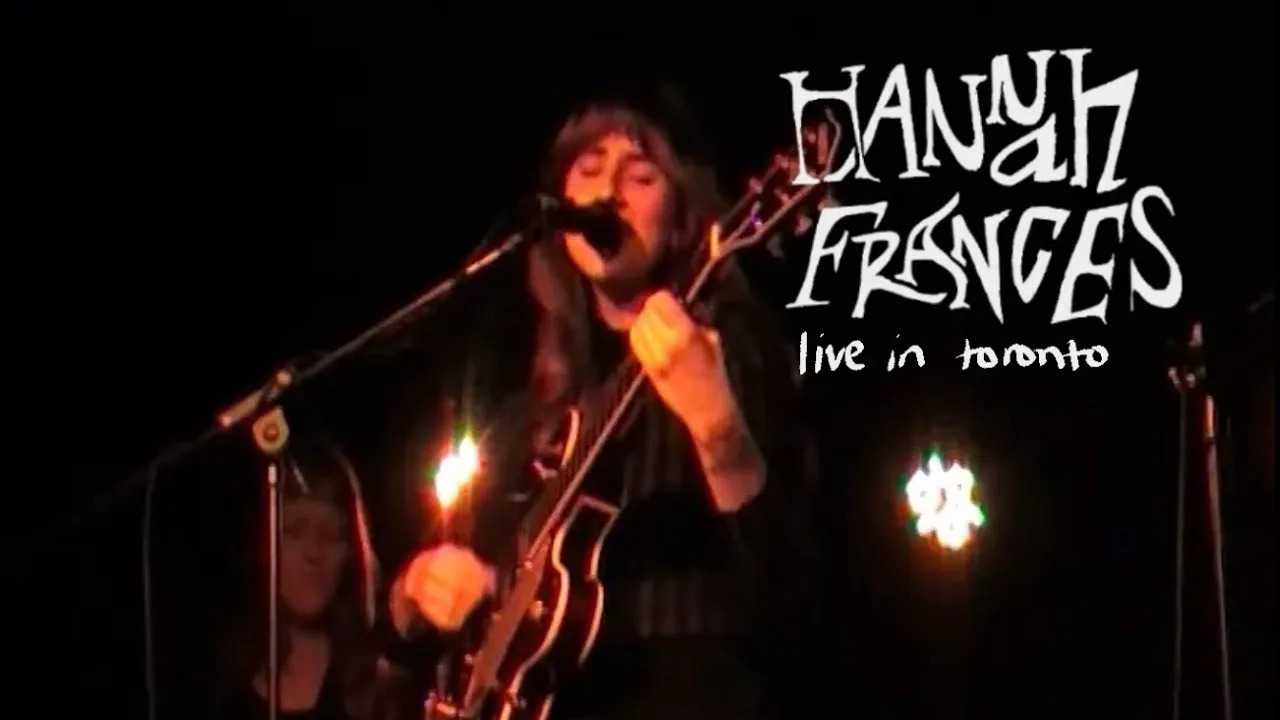
[Transcript is an abridged version of the direct interview]
Absent Sounds:
Thank you so much Hannah, for doing this with me.
Hannah Frances:
Of course. Thank you so much for reaching out.
Absent Sounds:
I've kind of been sitting with is this idea of a map of trauma, or the body as a map. My assumption as a listener is that every time you play the album, or you play shows, you must be entering it from a different point on that map. Tonight — where do you feel like you're going to be entering from? What does that look like for you today?
Hannah Frances:
Yeah. I do feel like music and songwriting are like time capsules. And so every time I'm playing music live that I've written, even years ago, it does always feel kind of like I'm revisiting experiences — but then, like you're saying, it's meeting me now, in time. Which is always interesting. But I'm feeling pretty light today. I'm feeling pretty peaceful in my body. I think this is the last show of our six-show tour, so I'm on the sleepier side, but yeah, I feel happy to be here.
Absent Sounds:
I love that. And taking off of that — because of the title of the album, Nested in Tangles — it feels to me like there's a bit of comfort there, but also a little tension. Tell me about that.
Hannah Frances:
Yeah. I think the title invokes that juxtaposition that I think the music is unpacking and trying to strike within each song, but then as the album as a whole. The concept behind it is very much holding the nuance of difficult experiences and dissonant experiences, while also holding a lot of grace and hope and — yeah, the healing that requires a lot of lightness and honouring the heaviness, but never losing sight of the light. Holding the both-and of everything. I think Nested in Tangles as a title encapsulates that.
Absent Sounds:
Absolutely. I think a lot of the tracks on this record feel like they're able to catch on both sides of that. Specifically, there's one — Life's Work — that stood out to me a lot, because it felt almost like a declaration. A defiance, in a way. But how much of it do you feel like you're convincing yourself at the same time? Or how much of it is already a past thing?
Hannah Frances:
The sentiment in Life's Work — "learning to trust in spite of it" — is something I truly do believe. So not even convincing myself, it's almost like a declaration reminding myself of that when I feel like I've forgotten. Healing is long and ugly. Learning is hard and it takes a long time. I think healing is like a spiral — you think you've learned a lesson, and then you round the bend and you're learning it again. I've gone through that a lot in relationships, where I'm like, ah, I'm back here. There's this pattern.
Absent Sounds:
And the fact that the song feels so defiant — it made me wonder if that was convincing you, or if you were just taking the song out and saying it as you felt it.
Hannah Frances:
I feel like a lot of my music is declaring something for my present self but also my future self. Something I can grow into, that feels true. And I think Life's Work is one of those — it's like a mantra. Keeper of the Shepherd on my last album is in a similar vein: this is what I believe, this is what I need, this is how I feel. And that's something I can always return to, to remember.
Absent Sounds:
Yeah. I'll say — when you mentioned the spiral earlier, it made me think of this concept I started coming up with earlier this year about a circle. I kept calling it the fullness of the circle — this feeling that every round of mastery, every round of knowing yourself, gets you a little further into whoever you're becoming. I think that's interesting in the context of letting go of grief and anger, because sometimes it feels like you have to shed whatever old self you had to become something new. But in that process, how do you decide what you want to hold onto, and what you want to move away from?
Hannah Frances:
I feel like my music is that process — the shedding process, clearing away things that don't feel true for me and getting to the clear centre of who I am. My musical process does that for me. That's where I turn to get more clear about everything. I think I just learn what I don't need through that process, and it kind of presents itself in the writing.
Absent Sounds:
I get that. I think the reason it stuck out to me is because of your relationship with music and because of your family background — music is so deeply embedded in where you come from.
Hannah Frances:
Yeah. Yeah. And growing up with that, there's an ease in it too. [we break for the show and return later]
Absent Sounds:
And you just played an amazing set tonight, honestly. So beautiful to hear. You had mentioned earlier that listening to the record is one thing, but listening to it live is a whole other experience. It's a different —
Hannah Frances:
— experience, yeah.
Absent Sounds:
It feels like such a full-body thing. And the one thing I was thinking about while watching you up there is the way that moving your body while processing music is supposed to help clear up whatever's knotted inside you. Is that what you feel when you're up there?
Hannah Frances:
Yeah, I think so. I moved through a lot. Depending on the song, there's a lot of tension — and then other songs are more of a release, more of an ease. Emotionally, I definitely feel like I clear out a lot, untangle a lot. I always feel a catharsis after a show, which is how I feel now. I kind of rode a lot of waves. And my music is pretty challenging mentally too. So yeah, it clears out cobwebs and untangles brainwaves. You know what I mean?
Absent Sounds:
Yeah. In that sense — if you had to pick — would your music be more of a container for processing, or the vehicle through which you process things?
Hannah Frances:
It's both. I am the container, and my music is the vehicle.
Absent Sounds:
Okay.
Hannah Frances:
Does that make sense? Like, I'm the vessel of what's going on. I'm holding it, but then I'm also moving through it with my music.
Absent Sounds:
I feel like sometimes that space is so uninhabitable. And hearing you say that your body is the container and the music is what moves you through — does that let you find a safe space within that space between? Because for me, it feels like a really impossible place to be in.
Hannah Frances:
Are you asking whether I can ever truly land there and find —
Absent Sounds:
Yeah, like what does "the space between" mean for you, through your music?
Hannah Frances:
It's interesting, because a lot of my songs don't have a lot of space in them — they can be very dense. But the song The Space Between has a lot of space in it. I think that is like a very conceptual exploration of space, sonically, but also metaphorically — living in that in-between, liminal place. And I think those in-betweens are inherent. Even in the context of a live set, there are moments in between songs —
Absent Sounds:
The anticipation for the next one.
Hannah Frances:
Exactly. There's this space, this transition, and then you're into the next emotional journey. Which feels like a condensed metaphor for life — what we are processing and moving through on a daily basis.
Absent Sounds:
That brings me to the next thing I wanted to ask. Looking at the whole picture — you're moving towards processing things, but I think a lot of psychiatrists and therapists will say you need to make meaning out of something in order to process it properly, for it to dissipate in the body. Do you feel like that's an accurate need?
Hannah Frances:
I think when I was younger, I was so much more intellectual about what I was feeling — always thinking about my feelings rather than feeling them. And I think that's a really common and natural place to be. We feel such intense emotions, and that can be really scary, so we go up into the mind to try to find meaning, to make sense of things. That makes a lot of sense as a way to cope and protect ourselves. But I think this album in particular is an exploration of sitting with difficult feelings — learning to really feel them, validate deep feelings that I'm not thinking about but just letting live. And The Space Between specifically is like: how can I live with discomfort? How can I not try to make sense of it or make meaning of it, but just let it be? Let it exist, and see that as natural.
Absent Sounds:
Yeah — bearing witness to it can be its own thing.
Hannah Frances:
Exactly. Not trying to jump out of it, but being in it. Somatic therapy has been a huge part of my life in the last few years, meaning not just intellectually processing, but physically moving through emotions. Letting myself feel them. And that's a much more uncomfortable process than I think most people really practice.
Absent Sounds:
It does sound like a scary place to be.
Hannah Frances:
It's scary. Especially with really intense emotions like anger, like rage. You're just like — where is this coming from? And I'm not trying to make sense of it, I'm just letting myself feel it to validate it.
Absent Sounds:
I appreciated that about Surviving You — the language feels almost violent. And necessarily so.
Hannah Frances:
Yeah.
Absent Sounds:
The fact that you express it that directly feels — I really connected with that track. I'm curious how you allow yourself to be that upfront with that kind of anger and rage.
Hannah Frances:
Surviving You was definitely a new practice for me — finding the courage in real life to name abusive dynamics, things that I never felt validated in by anyone else. It was something I really had to go deep with in myself and name, and that takes a lot of bravery. I think I'm inspired by artists who do the same — people like Fiona Apple, or even Alanis Morissette. Just watching them name things and thinking: that kind of bravery gives me wings to name my own hard things, as my lived experience.
Absent Sounds:
I want to bring that down to one other track — Falling From and Further — because it feels like another verb, another movement happening. I just want to know: how far down do you have to go to find the floor of whatever emotion you're feeling? Or is it necessary to go all the way to the dregs?
Hannah Frances:
Yeah, I think so. I go as deep as my spirit will allow, my heart will allow, whatever's coming up — but I do try to just go into it all the way. I don't like to half-ass anything. It's important to me to clear it out. That's kind of my process. If you're gonna write about heartbreak, really write about it. Let yourself feel it so deeply so that your music is authentic. Otherwise, what are we doing?
Absent Sounds:
Okay. Last question — jumping off of the clearing. Let's say hypothetically there's a clearing here in your musical space, leading into whatever comes next. What are you building from here?
Hannah Frances:
That's an interesting question. I have been working on a lot of new music, and there was some music from the Nested in Tangles recording sessions that we moved away from because we felt like there was something there, but it didn't fit yet. Moving forward, there's this energy of slowing down. Nested in Tangles feels accelerated — there's a lot of clearing, a lot of energy, a lot of chaos. And it almost feels like in the wake of that, my body and everything in me just wants to slow down, even musically. I want to make something deeper, maybe more droney. I just want to sit.
Absent Sounds:
Yeah.
Hannah Frances:
And rest this winter. I feel like that's the energy my music is going to have for the next project, at least. Probably still some level of turbulence, because that's who I am — but I think sitting in some peace a little bit more. Because I do feel, in many ways, more peaceful. I'm in a steady relationship, things feel calmer, I've done some reparative work with some family. Things are settling.
Absent Sounds:
That's really exciting.
Hannah Frances:
Yeah. Things are settling. So that's where I'm at.
Absent Sounds:
Thank you so much for talking to me.
Hannah Frances:
Thank you so much for this interview.