
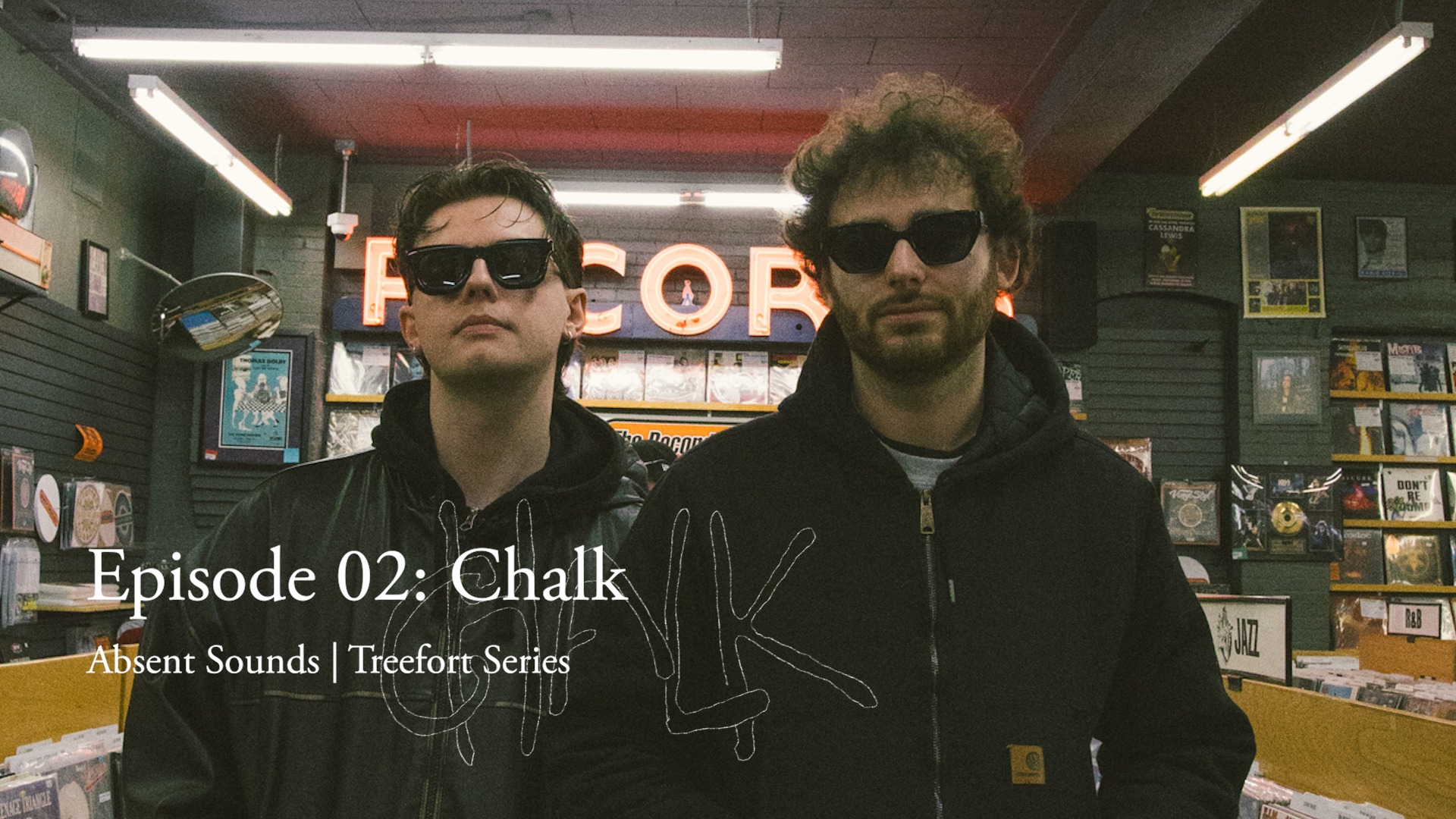
Ross Cullen and Ben Goddard got on a plane from Dublin the day after their album came out. How do you sit with a record while you're already in motion? We wanted to know what crystalpunk was still figuring out. The answer was tangled up with Belfast: a complicated history, an identity split between heritage and religion, the question of where you belong when two traditions both claim you.
This is episode two of our Treefort Docuseries featuring Chalk, Footballhead, and Still Depths
Ross Cullen: I'm Ross. I sing and produce in the band Chalk.
Ben Goddard: I'm Ben. I play guitar in Chalk.
Ross Cullen: Album just came out two weeks ago. How are you feeling about it, Ben?
Ben Goddard: Feeling really good. A little tired, a bit under the weather — we've been touring the States for a couple weeks now. We got on a plane from Dublin the day after the album came out, which was actually good because it didn't let us stew on it or think about it too much. Now, maybe after some reviews have come out and playing the shows, it's all catching up with us. Feeling spent in a good way. It's been kind of a cathartic experience even in that way.
Ross Cullen: Had some chicken noodle soup. Feeling better.
Weajue Mombo: The record is still pretty new, so it hasn't had a lot of time to settle into itself. What feels like the thing you've been scratching at with it — now that you have a little bit of retrospect?
Ben Goddard: It's been very interesting even to play a lot of the songs live for the first time. That's a different way to figure out a song. We have an eight-minute song on the record called Béal Feirste, near the end — we've only really played it four or five times, and I'm still figuring it out myself. It's kind of like learning a dance routine, getting the moves. We have it toward the end of our set, so it offers this kind of big, euphoric moment. But I'm still figuring out what I do on stage with it, how I feel, the audience reaction. And because the record's only been out a couple weeks, even the people who say they've listened to it five or ten times — I know that's still a short amount of time to really wrap your hands around something.
Weajue Mombo: When you're writing a song, then recording it, then performing it live and hearing feedback — has the meaning changed through that process? Have the songs stayed consistent for you?
Ross Cullen: When we started doing press a couple months ago, we started looking into ourselves a bit more — what we were actually trying to say. Because we didn't really know what we were going to say or how we were going to get there. Trying to explain the songs to different outlets was kind of intimidating, but actually quite helpful. It was a whole world we explored — our identity, growing up where we grew up, dealing with that. And learning along the way that other people across the world might feel something similar. Some sort of identity crisis, or just a split between having a mix of religion or heritage in your family and not knowing where you belong.
Weajue Mombo: I noticed you prefer that people make their own interpretations. Why is that important to you?
Ross Cullen: I think it's beautiful for someone to have their own interpretation. People have asked me about songs and told me what they thought they were about — and it was so not it. Which I love. That's the magic of it. And I know I've invented meanings for songs I love without going searching for the actual lyrics. It's my personal connection to that song. So I think it's cool to leave space. You can tell the story if the story's there — but it's okay to not necessarily know exactly what you're trying to say initially. Sometimes you figure out what it is for you as the songwriter later.
Weajue Mombo: Mentioning identity as a core theme — what does your relationship to identity look like after the record? After doing that work?
Ben Goddard: I might need another couple of tours to figure out my identity, I think. Maybe it's always a searching process. The record wasn't really a search for answers — more a reflection. Putting down something we've been feeling maybe our whole lives. We didn't have the answers, and I don't even know if we were searching for them. We just wanted to put that down because we thought maybe other people might feel this way too. It's our statement of intent. Art doesn't fix everything, but it does offer more questions that can be helpful.
Weadee Mombo: When you're a band and one person might feel more certain about something than another — how do you navigate that?
Ross Cullen: If someone feels strongly about something, we open up the floor. Trust each other, make it a healthy conversation. We've learned to go with our guts and take risks, because there was never a hundred percent certainty during the making of the album — there were things we were unsure about. Which I think is a good thing. There's that famous David Bowie quote: you should be uncomfortable when you're making your art. That was sort of the main thing going in. But it wasn't really a lot of bashing of heads.
Ben Goddard: It all felt quite democratic. And it's also — there is a purity in a singular voice. You're trying to capture something very singular and personal and then connect with a lot of different people on that level. Even though we work on it together, we are trying to capture a very intimate feeling or thought. Maybe not everyone is feeling that at the exact same time, but we've all felt it at some point. And I think that's hopefully what translates best in music.
Weajue Mombo: Crystalpunk gives me more insight into Belfast — a place I've never been. There was a line you mentioned in another interview, about how choosing love can be a radical act in Belfast. What does that look like in day-to-day life there?
Ben Goddard: Belfast is a very beautiful place. It has a very rich history and a very complicated history — and you can still feel that complicated history today. There's still division. There are a lot of great people there and we've been able to find community. But with the history it's had, sometimes the harder thing was to choose love. And sometimes — and this is the sad part — the easier thing is to put up boundaries, divide people, hate people. It's a shame that the simpler option is often the one that's put in front of you. So love is the complicated one. It's actually harder to push through. And I guess there's a burden to a place, to where you're from and how people feel. But it's also the best place in the world for us — because we were able to express ourselves, make this music, find people. We also went there for university, so it really was a place where we came into our own. It's a coming-of-age record in that way too.
Weajue Mombo: Is there something you're still wrestling with — not just in the music, but in your life?
Ben Goddard: A big thing on the record was our identity — how it can be complicated to figure out what your identity is. In the last year, the album did confirm something for me: feeling Irish. But I have a father who's English, I grew up in the south of Ireland, and I went to school in the north of Ireland. So it's a mixed bag. The record helped get a little closer to something, but I still feel quite fluid in a lot of ways.
Weadee Mombo: It’s like how the Irish became white in America.
Weajue Mombo: Yeah — and how the Irish in the US were actually closer to Black people than to white people. Identity gets even more complicated across diaspora. But the last thing I wanted to ask: back to the beginning, because this is kind of the thesis of our series. What are you sitting with right now, as the interview closes? What's your relationship to time?
Ross Cullen: The relationship to time.
Ben Goddard: Start thinking like Christopher Nolan. You've got the past, the present, the future...
Ben Goddard: We're quite nostalgic people. We've been asked before — do you think about the future or the past? And we are quite nostalgic.
Ross Cullen: They say don't focus on the past, just be present. But —
Ben Goddard: Very hard. Very hard. So — time. We're trying to stay in the world of Crystalpunk. It took nine months to make the record and now we're touring it, so you want to stay inside it. But you can't help thinking about the future too. I'm trying quite aggressively to stay in the moment, because this is only going to happen once — but I know that in five years I'll be very nostalgic about it regardless.
Weajue Mombo: And that's it. Thank you so much, guys.
Ben Goddard: Thank you so much.
Ross Cullen: Hopefully it recorded.
Weajue Mombo: Oh yeah. We got it.
