
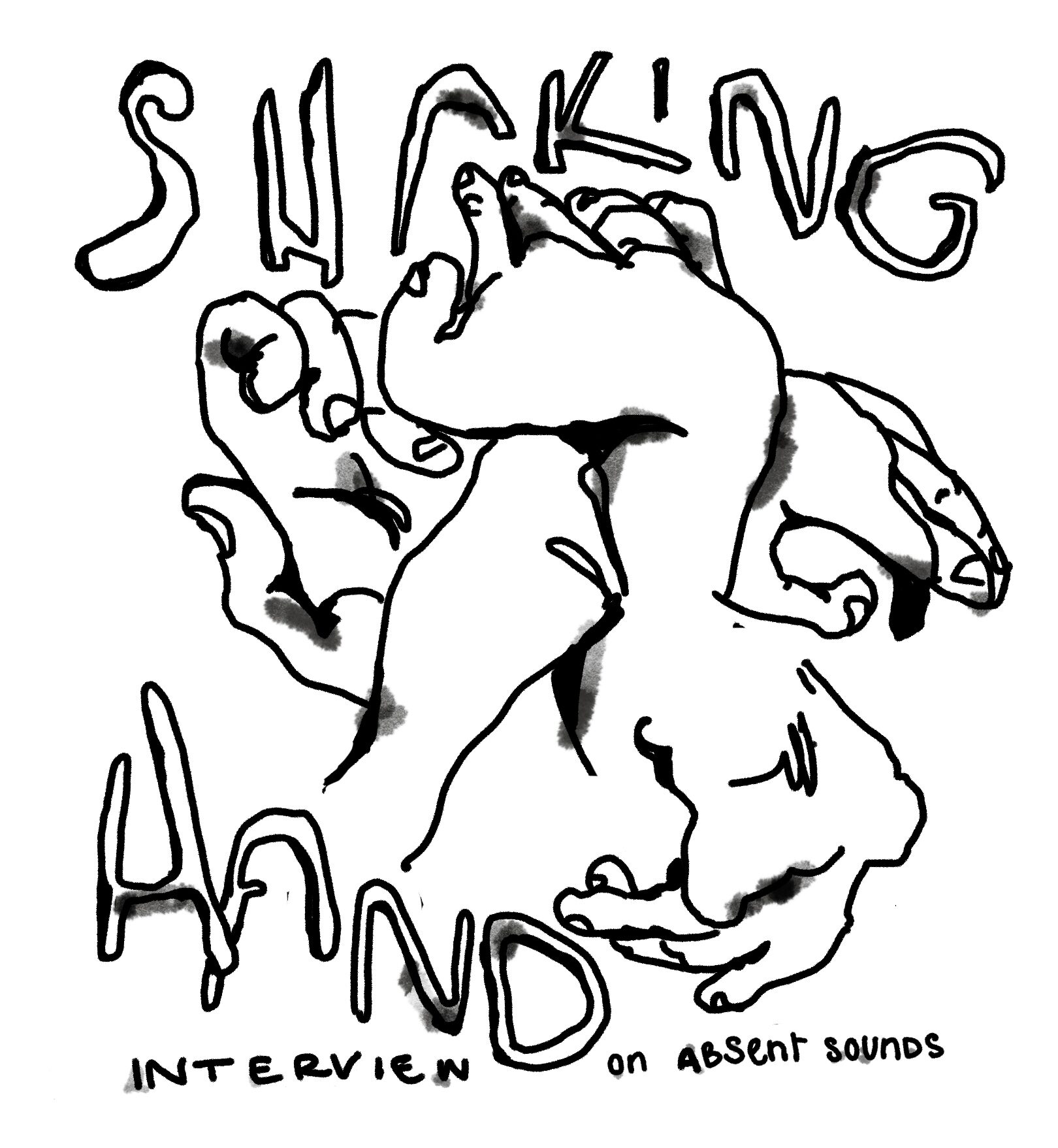


In today's episode of Absent Sounds, we sit down with Fred and Ellis of Shaking Hand, the Manchester trio whose new record has held the top spot on our list since the first listen. Built out of jams and improvisation, the album moves through songs that arrived almost too easily alongside ones the band wrestled with for weeks, and always with George, the band's lyricist, somewhere just out of frame. We talk about writing with a shaking hand, the anticipation that outpaces the actual event, a comfortable paranoia born out of lockdown, and the flicker of optimism running underneath a fairly cold-sounding record.
Absent Sounds: Welcome, Shaking Hand, to Absent Sounds. Each week we dive into our favorite bands, and this record has arrested us since we first heard it. It's been hard to top on our list of favorite things we've heard this year. So congratulations on holding the top spot for 2026 so far, because it hasn't been beat yet.
Fred: Well, thank you very much.
Ellis: Yeah, we really appreciate it. It's pretty surreal, because we live in Manchester and we don't know that people listen to us much outside of there. It's nice that you're enjoying it.
Absent Sounds: We wanted to start with the idea of a shaking hand, because that's such an interesting image, especially within the idea of architecture, housing, or building things. What have you guys been building in your life that you might not be doing with a very steady or conscious hand? Something uncertain or shaky. Can be music or unrelated.
Ellis: We've been working on the second album, and certainly my hands are shaking with some of the chord shapes I'm having to do on the bass. There's quite a lot of uncertainty with that because we write a lot with improvisation, so we never really know what's going to come up until we're playing it.
Fred: There's ups and downs with writing too. Some weeks we're really productive and come up with three good ideas, and some weeks not much. But it's just keeping on going, keeping positive, and keeping ourselves excited about the songs we're making.
Absent Sounds: It's fascinating when people work in a more improvisational manner. But the fact that you're already working on your second LP, wow. Do you just keep going, or was there a big pause?
Ellis: The album was actually recorded back in February last year, so we sat on it for quite a while. In rehearsals we tend to just jam a lot and play around. It's like the other day, I was tuning my guitar and accidentally started messing around with something, and the other two started playing around it, and we built a song out of that. It's sort of organic, just having fun in the rehearsal room. We've got folders on our Google Drive full of recordings we've done on our phones, and a lot of the time it's working out which ones are worth looking into again.
Fred: We haven't done a massive tour yet, so if we did we'd rehearse a lot. But since we've just had a gig or two a month, we've mostly been spending time writing, which is quite fun.
Absent Sounds: In the writing process, I want to know how much of yourselves you put into the lyrics. I'll first note I think the way you guys write is like enjambment, where the words are tumbling and the next phrase continues from the last one. I adore that. But we were curious whether you actually care about the lyrics.
Ellis: Unfortunately the guy who writes the lyrics, George, is in Italy, so he's not on this call. But he tends to improvise the lyrics as much as any other part of the music. He'll be singing a vocal melody over the top in rehearsal, then listen back and decode what he sang himself, and make little tweaks here and there. He doesn't really mind what people interpret from the lyrics, because they're quite abstract. Since the record's been out, it's been really interesting hearing other people's interpretations, because that's affected my own, from the inside of the band looking out. The lyrics are still just as much part of the improvisation as the rest of it.
Absent Sounds: What interpretation has changed the most for you, either of you?
Ellis: Partly because of the album artwork, people have connected the album a lot to the changing landscape of Manchester, which is the city we're based in. It's going through a lot of regeneration, from a working class town to a lot of new buildings. I don't know if that was a particularly conscious decision in the writing, but I can see how people hear it, and it did resonate with me a little when people started saying that. I've contextualized the songs more against the location they were written in than I did before the album came out.
Absent Sounds: We'll go into some of the tracks now, starting with Sundance, which drops you into the middle of a sentence rather than easing you in. I kept coming back to the "some dance I flew" line. Dancing to me feels more like an escape than flying. What does escape look like for you?
Ellis: I guess performing. That's when I'm most naturally moving my body, at my freest, eyes closed, rocking out. Not really thinking about anything else.
Fred: I'd say that combined with jamming, because I'm not really thinking of much else apart from the jam. I've recently discovered, I live in an area with lots of rolling hills, kind of looks like Lord of the Rings, and I love just walking around without much of a plan. Makes me feel really good.
Absent Sounds: Would you say you feel more free actually playing a show, or when you're just jamming and noodling?
Fred: Good question. Maybe playing live, because jamming can be hard, you have to read what the next section is going into, so you have to think or listen a lot more. When you're playing live you know exactly what you're playing, so you can just enjoy it.
Ellis: It's the first track where Freddy started doing backing vocals for the band. Freddy and George are brothers, and if you listen in the verses you'll hear that dual vocal, the first time Freddy plucked up the courage to pick up the microphone. We've got that blood harmony thing where their voices meld really well together. I think it was Sundance where we discovered that, and it's helped out with other tracks on the album too.
Absent Sounds: I didn't know it was both of your voices, I thought it was just George. Very cool. And I always hear people say singing and drumming together is an insane feat. Is it insane for you?
Fred: George wrote both the harmonies, but I learned the higher one, that's the one I sing live. And yeah, it is weird. I had to break it down bar by bar and match the rhythm of the singing with the rhythm of the drums. Once you get it, it's fine, you don't have to think about it that much.
Absent Sounds: Once you break that barrier, you can accomplish so many great things, which takes us into track two. There's a part in Mantras about letting go, and the etiquette of barriers. Do you have any personal mantras or things that help you get over barriers in your life?
Ellis: These are some of the deepest questions we've been asked, it's really cool. In terms of getting over barriers, I've got a mindset that if there's something in the way, something stopping you, you've just got to try and do it. If you're scared of something, if fear's a barrier, I think it's important to confront that. I find I'm often scared of embarrassment, when actually it's usually not going to be very embarrassing. Pulling it back to the music side of things, if there's a song we're not sure about, sometimes saying we're going to play it at a gig means we have to get it ready. In terms of personal mantras, I don't really have any. When I'm stressed I'll talk to myself, "Come on, Ellis, come on, Ellis." I don't think that's a mantra so much as a weird self-help thing.
Fred: I haven't really got any personal mantras either, but similar to Ellis, when there's something I'm struggling with on the drum set and I'm getting really annoyed that I can't play it, it's literally just because I haven't practiced it. Really you've just got to spend a bit of time on it and it'll be fine. I should probably apply that mode of thinking to the rest of my life.
Absent Sounds: There's another line on this track, before it talks about questions and answers, that gets at something we've talked about a lot: how you can wait and wait for something, and then when it comes, it still feels like you're waiting. You don't get any reward for the waiting. Since the band's been bubbling for a while, do you feel like right now is the answer to that waiting, or is it still, okay, what else is there?
Ellis: I think certainly the latter. This sounds sad and morbid, but I think the older you get, sometimes the anticipation and excitement about something is way better than the actual event occurring. It's like being excited for Christmas, then once you've got the present and built the toy, it's just there. The day the LP came out, we had all this anticipation and build up, so exciting, and then it came out and I was at work that day, all three of us sending WhatsApp messages. You're proud of it, but life just carries on. Especially now, information moves so quickly on a global scale that it affects you personally too, where the next thing comes so fast you get a minute to stand in the river appreciating your success before the next stream comes past.
Absent Sounds: I think you spend most of your life in anticipation, between things. If you can't enjoy the in-between moments, that's a large majority of your life you're not enjoying.
Absent Sounds: Down to In for a Pound. One of my favorite songs for sure. I love how it immediately starts in this very commanding way, no easing in like the other tracks. Why is that?
Fred: The idea for this song came from a jam from ages ago, just the bass, a drum beat, and George's weird guitar. George had a lot of an idea of how he wanted it structured. Was it him, Ellis, who came up with starting off with the bass? Because the bass is the main part of the song, it just keeps repeating.
Ellis: Yeah, George came in and said, "Just start it with the bass." It came together really quickly, faster than pretty much every other tune on the record. We wanted to make it dissonant sounding but unsettlingly groovy as well. I don't know if that's because it was written in the coldest months of the year.
Absent Sounds: Sometimes I feel like if I'm not struggling to write something, I didn't earn it. Is it still satisfying when you don't have to really wrestle a song into place?
Fred: The song we've been writing recently is similar. Only took us two weeks, and a little after it was finished I was like, do we need to add more sections? But because we're all so happy with how it sounded, it's hard to just say, that's it, finished. We have struggled in the past, going over the same songs for weeks and ending up back at one of the first versions. It's a struggle sometimes, but it feels equally as good, I think.
Ellis: I prefer it when we jam one and it's just there. Feels like it's come from another world, and I'm just a conduit for it.
Absent Sounds: There's a part in this track that keeps looping and looping. A lot of your tracks feel like they're cycling. How do you know when to pull off and go to the next thing?
Ellis: That's pretty much the intangible thing about playing together as much as we do. I think we can just feel where a section has to end. Generally everything's about the length it feels it should be.
Fred: Yeah, I'd say that too. Listening back to the recordings a couple days after is helpful, you can be like, this section goes on too long, next practice let's trim it. It's trusting each other and trusting the process.
Absent Sounds: I know George and Fred, you're brothers, but I wonder about the thread that ties all three of you together, in music or in life.
Ellis: I think we're all quite settled people right now. We're all at a good part in our lives, not a lot of rock and roll chaos around us. I've just got a pet cat, Fred's got a pet dog. We're quite calm people, and there's not a lot of ego between any of us.
Fred: No. And football as well, I guess.
Absent Sounds: Night Owl.
Fred: This is a very old song, so my memory of it isn't great, honestly. Over lockdown me and George lived together, and I remember him jamming it a lot, and I jammed it with him. I think he built it up while bored in lockdown and got me to record some drums for it. So that song is probably three or four years old. When we needed songs for this album, George was looking through old songs he'd finished, and that was one of them.
Ellis: Going into recording the album, it was probably the one we struggled with the most, despite the fact that on my end it's one of the more simple basslines on the record. You've got to play it quickly but quite soft, and naturally when you play faster you tend to play a bit heavier. It's quite a delicate song. Tough one to record, but we got it, and now we play it better than we used to.
Absent Sounds: Mentioning the fragility of it, I'm curious what it looks like when you bring something to the band. Do you feel like it's this very fragile thing you're still trying to protect?
Fred: Most of the time George will just show us a riff he might have come up with four days earlier. It's more of an excitement thing, "I've come up with this riff, let's see what the boys come up with."
Ellis: I do know from talking to George that the way Night Owl was written, he looks back on that time quite fondly, creatively. I think it gave him time to not have to do anything and just focus on writing, and you can hear that in the lyrics. I've always felt there's a comfortable paranoia to them, which I guess is a good description of where we were during COVID.
Absent Sounds: Definitely tell George I love how almost delusional the lyrics are. "I'm not lost, it's on again, I'll wait for the night owl," et cetera. Really cool stuff.
Absent Sounds: Down to Up the Ante(lope). What brings you instant panic?
Ellis: If I hit a joint now I'm instantly anxious, but I'm not going to be doing that. I'm quite a nervous guy, I get scared crossing the road.
Fred: When you get hot sauce in your eye. And yeah, I'm pretty anxious as well. I think as a whole we're pretty quiet on the performance side of playing live, we don't really say much.
Absent Sounds: I actually appreciate when bands don't talk between their sets, I want them to just play.
Ellis: You can get a bit of an ick sometimes when you watch a band introduce all the members. Sometimes it's a bit like, just play the songs.
Absent Sounds: Let's say you're on stage introducing this song, what would you say?
Fred: We open with it, so we don't say anything. We've come up with this intro, so we play that and go straight into it, with a little drumbeat.
Ellis: It's a really good one to open the set with, because live it's got so much energy at the start, which sets up the rest of the set nicely. If you start on a slower song you've got to work into that energy.
Absent Sounds: Finally brings us down to Italics, which I found, as the album goes down the tracklist, gets more esoteric and interesting. Do you find you enjoy beating around the bush with things, or are you more of a straight shooter?
Fred: I'm definitely a beat around the bush sort of guy. But I'm slowly becoming a straight shooter. Maybe in ten years.
Ellis: Freddy's more of a straight shooter than he's giving himself credit for. If he thinks something's wrong with a tune in rehearsal, he's got a very polite way of saying, "That's a bit rubbish." He's good at it, and always right, just very polite about it. I beat around the bush, I just talk and talk.
Absent Sounds: That feels like such a UK thing, being direct.
Ellis: I think the British stereotype is that we sort of all hate each other, but in the nicest way possible.
Absent Sounds: I wanted to keep asking about the italicized nature of communication you're touching on in this track. Personally I have a habit of using a lot of semicolons. Are there things you typically use when writing or communicating that's a habit, or your trademark way of doing it?
Fred: Don't have a trademark, but as I've gotten older I've started using more full stops in messages, which is kind of a mood. Em dashes as well, I don't know why. When we do posts on Instagram I find it hard to come up with captions, so I've been using exclamation marks just because otherwise it sounds really blunt.
Ellis: Written communication's harder than ever, because you can accidentally cause an argument without meaning to. I've got friends I'll send a message to and they won't speak to me for two days, "you're being really blunt with me." I'm so bad with emojis, which I think a lot of people put way more stock in than I ever realized. Sometimes people think I'm grumpier than I am, and then I read my own message back and think, oh, I did read quite blunt. I guess I'm a little bit rude, that's my signature.
Absent Sounds: Down to Cable Ties, the closer.
Fred: I think with the ending of Cable Ties, because it's so nice, it's a bit reflective, it sums up the mood of the album. We like weird music, mathy music, but underlying that there's some emotional quality we're trying to get across. Maybe the ending reveals that.
Ellis: I'd agree. Cable Ties captures the whole album in having that humanness at the end against the quite cold rest of the song. The rest is quite cold and metallic sounding, but then the ending's so warm, and I think that's what the record's like in general. It's a cold record, but there are definitely elements of warmth that come through. It sums that up structurally, the contrast of music against lyrics.
Absent Sounds: On the Bandcamp page, it's mentioned the album feels like walking through an empty city late at night, but catching a flicker of life in the buildings as you pass. What's the flicker you want us to catch within the album, maybe even not for a listener, just something you enjoy catching when you're listening back to it?
Ellis: I guess George's lyrics have got some optimism to them, which I think is sorely needed. It's an album that isn't looking back on stuff, he's looking forward to things. I guess that's the flicker I was looking for in it.
Absent Sounds: Today, this week, over the months, is there that flicker for you? What would it be?
Ellis: I finish work at 5:00. I'm looking forward to that.
Fred: Man, sports. I've realized sports are really good. I'm playing tennis tomorrow and I'm really looking forward to it. Man, I'm getting old, I'm using full stops.
Absent Sounds: This album honestly is my flicker in life. When I'm looking for something to play that I like from this year, I come back to it so many times. Such an honor and a treat to talk to you guys about it. Can't wait to hear what you put out next.
Ellis: Oh, thank you so much. That was such a nice interview, we really appreciate it. Go Canada.
