
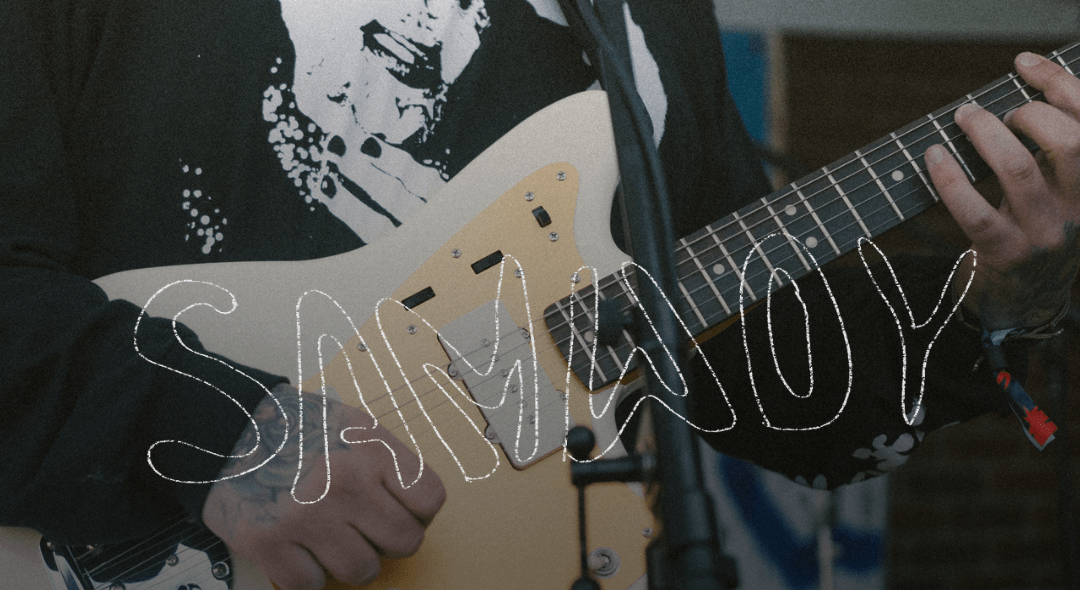
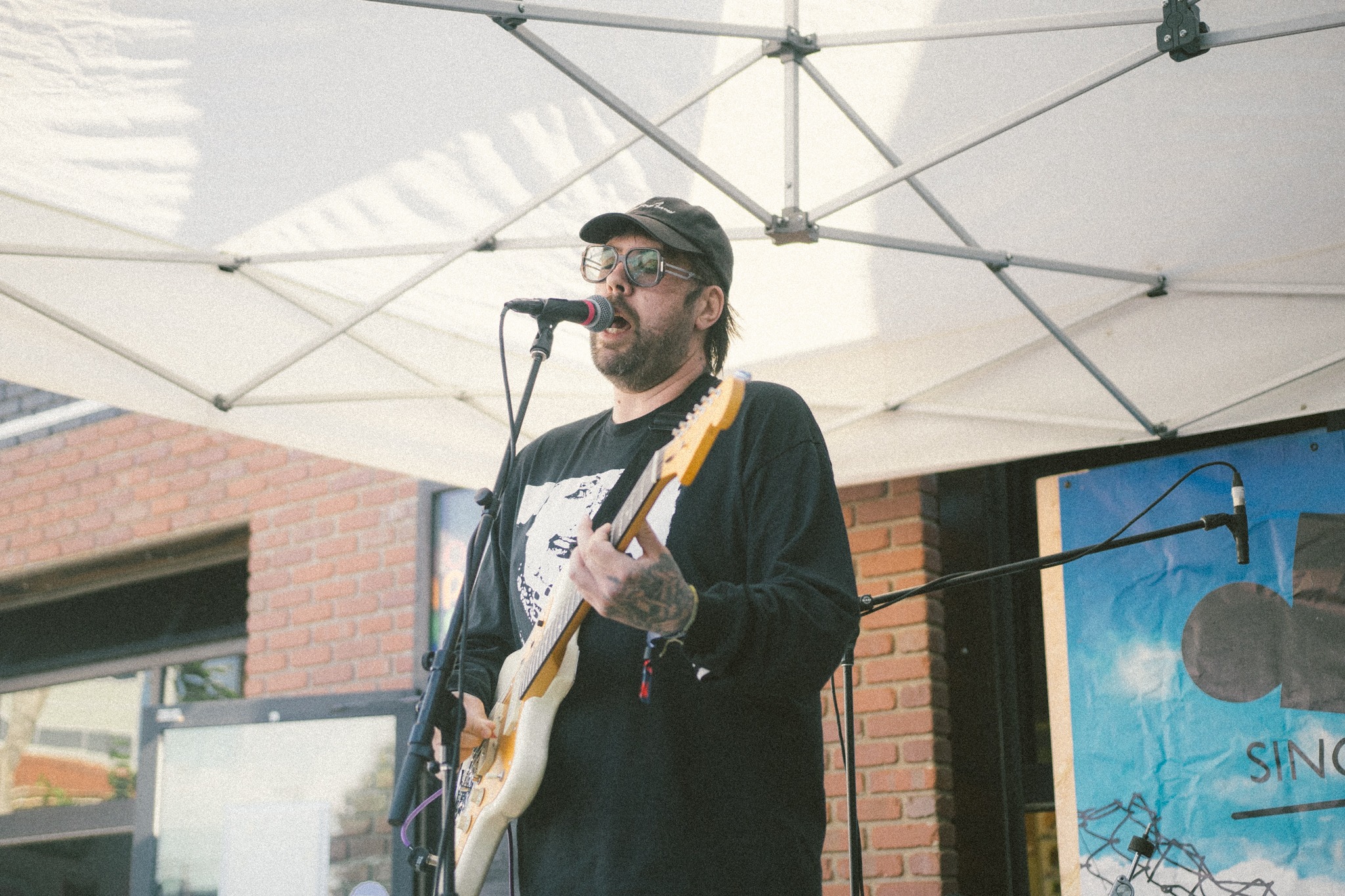
Photo of SamWoy at Sled Island 2026 by Weajue Mombo
We caught up with SamWoy — the project of Juno-winning musician and producer Sam Woywitka (Half Moon Run, Patrick Watson, Teke Teke, Luca Fogale) — at Sled Island in Calgary, where he was in town for two sets — one at Dandy Brewing, one at midnight at the Legion — off the back of his sophomore album, Even Sad Boys Like To Have Fun. SamWoy is an enigma, that became more layered with each minute spent unravveling. We talked about chaos as a way of life, the strange grief of looking at your past self, a debt collector rap battle, and what it means to actually believe in the thing you've given your life to.
Absent Sounds: Welcome to Sled Island. We're out here in Calgary, live with SamWoy.
Sam Woywitka: SamWoy, baby. Playing Sled Island — tomorrow at Dandy Brewing at 6pm, and Saturday night at midnight at the Royal Canadian Legion.
Absent Sounds: When you're playing, what are you preparing for? How do you get ready for a live set, or a session like this?
Sam Woywitka: A session like this, I'm kind of just winging it — luckily I'm a bit of a blabber and I like talking, so it's fine. Shows are different every time, because it depends who's playing with me. I have a core group, but I also play solo and as a duo. Every single show we kind of redo the whole set. Nothing's super practiced — I'm lucky to play with musicians who I'm into no matter what they're doing, and I'm kind of just leading the ship while everyone else does their thing. At the core it's mostly me with samplers and a sample track. Originally I thought this would be more electronics-based, but at the start it turned into a punk band. Then I got booked to play South By alone and had to figure out a solo set — more sampler-based, taking what we'd recorded and making it hip-hop, reprogramming the drums. That evolved into the solo and duo set. Now I've done that for about a year and I'm excited — the next show's going back to a stripped-down punk band vibe.
Absent Sounds: I think the fluidity is really sick. One thing I wondered — on the record itself, there's at least three people featured. I find it interesting when independent artists bring in that many collaborators, because it feels so intuitive to hip-hop but sometimes rare on the indie side. And the second part — with so many people involved, how have you gotten comfortable with the chaos? Is that your natural state?
Sam Woywitka: My life is very chaotic, and my whole childhood and upbringing was chaotic too. I always think I hate how chaotic it is, but I don't think it'd be this chaotic if I didn't actually like it — because whenever I'm chilling, I get bored. As for the people — I'm very much a family-dinner, team-sport kind of guy. I always want crazy personalities around me. I'm not precious about my music — I know what I like, but I let everyone try their thing. I'm usually working with people whose musical voice I already like, and I'm honest fast about whether something works or not.
Absent Sounds: That reminds me of a conversation I had with my sister recently, walking through a parking lot — about how sometimes you look back and realize you've walked the same path since you were five, no big upheaval. I'm grateful for that, but it makes me feel like I need a ten-step plan to chaotify my life. Any tips?
Sam Woywitka: Honestly, chaos and challenges have been constant since I was a kid — it feels like something in the universe just follows me. I'm grateful I'm resilient and keep moving forward, but there's a lot of "why am I getting another test." Injuries, sickness, friends and people dying, family trouble, people taking advantage of me — it's made me a pretty anxious person, some sort of PTSD kind of stuff. But I still move forward with a smile. I don't really know how to make your life chaotic — I guess it's just following your own path. I've barely ever made a decision for security. It's always been "here's another risk, I'm gonna do it" — and it always works out, which is kind of awesome.
Absent Sounds: You mentioned a chaotic childhood — and I remember reading somewhere that you've described your past self almost like a stranger. I always want to find a way back to that person, to help that grieving part of me. Is that something you're working through in your music too?
Sam Woywitka: I'd say all of my music is an ode to my past self, to me as a teenager and a kid. I was in a car accident at seventeen — a bad brain injury — and from seventeen to twenty-five I was really working through getting my brain to function properly again. My self before that injury was a genuinely different person — angrier, more confused. It happened right at the point I would've been becoming an adult, so it was a strange time. When I look at pictures of myself from before, it feels like grieving — like I was a different person, and I'm trying to connect with a ghost of someone I used to love, or still love. All this music is a reflection, a self-deprecation, but also a spirit and an ode to my past self — I'm always trying to hug that person and heal him, because he still lives inside me. At the core I have a real pit of despair, even though people who meet me think I'm always happy and upbeat. I'm always trying to patch that up.
Absent Sounds: I think I can use that as a way into the album itself — Even Sad Boys Like To Have Fun. The title speaks directly to what you're talking about. Let's say we're walking into the room of this record — what are we seeing, smelling?
Sam Woywitka: Nag Champa incense, trying to cover up empty beer cans and old weed smell soaked into a velvet couch. Chunky soup. And poison. I grew up trailer-park style — canned tuna, chunky soup, ramen, Kraft Dinner. Sitting in the trailer watching The Matrix for the twentieth time, that kind of vibe. That's the childhood and the past self I'm channeling on this album — and it'd all be shot on a shitty 1997 VHS home-video lens.
Absent Sounds: The record opens with you saying "I think I can," and it loops back at the end — a really cool structure. Do you doubt yourself often?
Sam Woywitka: Oh, damn, yeah. I've always been really mean to myself. I feel like I have to prove my worth to everyone, like I can't be proud of myself unless I'm being super productive, completing tasks, reaching goals — and even then there's zero celebration. Everything I think is going to change how I feel about myself never actually solidifies. I hit the goal, and by the time I get there the goalpost's already moved, and I've forgotten I ever said "this is all I need, I'm gonna feel so good when I finish this." Now that I'm a bit older I'm really trying to celebrate the little victories and be kinder to myself. I know I have good intentions, I try to be a good friend and a good partner, I act from a place of love with other people — but with myself it's a lot of... I don't want to say self-hate, because I don't fully hate myself, but I'm really hard on myself. What version of a person do I need to be before I can say "good job, man"? I don't know if that's about the love I got as a kid or just how tough things have been, but I'm trying to figure it out before I die. I used to think, "when I get older this stuff will change" — I thought that at eighteen, at twenty-five, at thirty. Now I'm thirty-five and I'm like, okay, I actually need to work on this inner dialogue.
Absent Sounds: I'm twenty-five, and I've genuinely thought — I don't know how many more decades I can spend under that same blanket. The idea of death comes up a lot on this record, and in your life too. There's a line, "today is a good day to die a little on the inside" — is there a specific day of the week that's a good day to die? Or is every day a good day?
Sam Woywitka: I don't know, that line is just — a lot of this music is self-deprecation. I was pretty depressed making both this record and the last one. I like a lot of juxtaposition — the album starts with "I think I can, I think I can," but then there's the other side of me going, "no, this is time for me to just die." The song Poison is about that. I'm also a person who carries a lot of guilt. When I was younger — mad, sad, mostly on my own — I did stuff I look back on now and think, "holy crap, I can't believe I did that." I can still teleport back to those exact moments. Like the first line of that verse: "my dead best friend's dad asked me for some weed, but I pinched a little bit." I remember that exact moment. One of my best friends had passed away, and his dad — who'd had a stroke, who wasn't doing well — asked me for some weed. I said sure, give me some money and I'll go get you some, and I just pinched a joint out of the bag instead. I was about eighteen. This was fifteen years ago, and I still remember the guilt of doing it — "I feel so guilty about this, this is awful, but I'm gonna smoke this joint." I still feel sadness and deep regret about it, even though he genuinely wouldn't have cared — he probably would've just handed me one. I don't know why I can't let some of these things go.
Absent Sounds: You'd never hold someone else to that standard. There's a book I think you'd like — The Wind Won't Blow It All Away, where the main character's life changes and he's left with all this regret, watching people march toward their own deaths and unable to do anything about it. And another one, Twelve Stories, by a Canadian author — you end up rooting for the characters even when they're doing wild things. So maybe we're rooting for you in the background too.
Sam Woywitka: No, it's all good — I just get it out in the songs. It's funny, because where I'm at in my life now, I'm pretty good across the board other than some of this personal self-deprecation and self-image stuff. But if you listen to my lyrics you'd think, "damn, this guy's a skid." There's a lot of irony in it. It's fun.
Absent Sounds: My favourite track is Stub in the Trunk. Tell me where that one came from.
Sam Woywitka: Me and my buddy Everett made the beat. Our first tour stopped in my hometown, Cumberland, BC, and we drove past the place I used to jam with my band at fifteen. I used to sell weed for a guy and owed him money — he showed up at band practice with a collector while we were mid-song, playing Metallica's Master of Puppets, right at "dun, dun, dun, dun." These two full-grown men walk in with this collector guy, and I'm thinking he's gonna come here and beat me up. He says, "Yo, I got something to say to Sam," walks over to me at the drum kit, and goes into this whole rap — "I'm mad at you, sick and tired of your attitude, all you had to do was show me a bit of gratitude" — then a longer verse I can only half remember. They didn't beat me up, they just left. My guitar player turns to me like, "Dude, did you just get rap-beefed?" I told the story to Everett and we wrote the whole song around it — the entire second verse is literally his lyrics, rapped back at me word for word. I probably owe him publishing on it.
Absent Sounds: It's a crazy bar, it goes hard. Real Trailer Park Boys energy.
Sam Woywitka: Totally — picture Canadian trailer park skid kids driving a beat-up Honda Accord, flat-brimmed hats, selling dime bags, drinking OEs on the weekend, listening to Mickey Avalon and Andre Nickatina. That's who I imagined this song resonating with. The music video's hilarious too.
Absent Sounds: How many times in your life have people seemed like they were about to beat you up? Is that a frequent thing?
Sam Woywitka: Oh yeah, growing up in my hometown you got in fights for sure, and later in Calgary too — haven't been in one in a long time now, but as a kid there was a lot of fighting, a lot of bad stuff. Whenever I go back to Calgary I still think, "oh yeah, I remember this guy tried to fight me here." Every corner's haunted by a near-fight memory.
Absent Sounds: And the next song on the record is literally called Beat Up.
Sam Woywitka: Yeah, you're hitting everything. That one's the moment of peak storytelling for me. I feel like so many people from my hometown would relate — you're passing a joint around a circle at the start of the night, everything's fine, kind of friends with this guy, and then he turns on you, classic pissed-off-redneck-about-to-kick-your-ass energy. It's funny because some of the kids I grew up with have told me, "you were that guy too, you know" — and I'm like, no I wasn't — and they're like, "yeah, and I'm pretty sure you've been the other guy as well." I was always more punk than redneck, but our town was rednecks versus skateboard kids, and every party ended up too crazy, people breaking stuff and fighting. That was just the vibe.
Absent Sounds: I grew up in Toronto — quiet kid, no fights, nothing crazy. I've always been almost jealous of that small-town chaos.
Sam Woywitka: Did you ever read The Outsiders? That was the vibe. My hometown, Cumberland — now it's the most gentrified, hip place, everyone wants to live there — but growing up it was rough. Nobody had two parents, there were crack heads around, the streets were all potholes. You'd hang out outside the church, outside the shop, at the abandoned gas station, and if kids two or three years older than you showed up you'd run, because they'd shoot you with a pellet gun or make you fight your friend. We called it Scumberland — the joke was, "how do you count the whole population of Cumberland? You throw a penny down Main Street." And we'd always beat them in sports, which was so funny.
Absent Sounds: Do you ever miss it, or wish it was still like that?
Sam Woywitka: No, not as an adult. But there's something about the old-school of it — I still get guys in town now going, "welcome to Cumberland" trying to be tough, and I'm like, bro, I'm from here, stop. There's a really good music festival there now called Woodstove — you should go.
Absent Sounds: Let's go to Si Vous Trouvez Cela, Je Suis Au Ciel. When I first heard the title I thought it felt like a plea for help — like it's too late, "if you find this, call me."
Sam Woywitka: So I bought this guitar off Kijiji — an old '70s Japanese guitar from someone in rural Quebec — and there was a dumb switch on it killing the pickups, so I brought it to a guitar guy to get it fixed. I always felt like this song had a Serge Gainsbourg thing going on, and I wanted it in French even though I can't really speak French — I'm not French, but I live in Montreal, I have an amazing Quebecoise girlfriend, and I'm trying to connect more with her and her family, so I've been putting in the effort to learn. Anyway, the guitar guy takes the pickup apart and goes, "dude, check this out" — there's a note hidden underneath it. It said, "Si vous trouvez cela, je suis au ciel — je t'aime, Hélène." Signed and dated, sometime around 2004, with an address on it. So I used that as the chorus — "if you find this, I am in the sky" — and wrote a kind of dark, weird love story about these two people I'll never know. It felt like the universe handing me the lyrics.
Absent Sounds: There's also the redone version you mentioned — where does that sit in the story?
Sam Woywitka: Me and Jeff, as the duo, just started playing it live more and made this new synth version of it that felt worth tracking properly — redid the choral parts too. I really like it.
Absent Sounds: Let's go to A Chameleon Erupts — what happens when a chameleon erupts?
Sam Woywitka: It dies, basically. I'd already made the song, and then this Instagram reel came up of a chameleon dying — changing through all these colours, this rainbow explosion right before death — and it fit the music perfectly, so I named it A Chameleon Erupts in Color Before Its Death. There's also a string sample in there from a crazy arrangement my friend Dylan Phillips wrote for a song that didn't make this album but'll come out in the next few months — you won't recognize it in this context, but you'll hear it eventually.
Absent Sounds: Last two — My Body and I Can't. In my head there are two kinds of people: those who love having a physical body, walking around, feeling things, and those who'd rather not. Where do you fall?
Sam Woywitka: My body's filled with a lot of pain from injuries, but it's resilient, and I'm trying to give it more respect for that — it's been through so much and it's still going. But I've always had body shame. I was a chubby kid, got made fun of, never liked how I looked. Even being loved by other people, having a partner, I still have to remind myself, "okay, I can still attract someone, I'm grateful." I love being alive and I love having a body, but I haven't been nice to it — I don't treat it like a temple, and I wish I did more.
Absent Sounds: You mentioned your dad earlier too — how does that fit into the record?
Sam Woywitka: There's a song, My Body, about times my body hasn't served me — the brain injury, my legs not working. My dad wasn't really there during my recovery, and he recently got dementia. Now he talks to me about things and I fully understand what he's going through, because the same thing happened to me. I feel more sorry for him than angry, because I can relate — and I don't think his stuff is going to get better the way mine did. I have a ton of unresolved stuff with my father, but now that I'm older we've reconnected, and I try to just let it go instead of holding onto it forever. Talking with him about that is actually where this song came from — you better do the stuff in life before your body gives out. It's a finite amount of time, and it's not as long as you think. I can't believe I'm thirty-five. I feel like I just turned ten.
Absent Sounds: Do you feel like you're doing things now because you have a goal in mind — for your six-year-old self, or your ninety-nine-year-old self?
Sam Woywitka: I don't project that far out. But I want to be on my deathbed and be able to say I didn't give my life to anything I didn't believe in. It's hard to believe in what I'm doing sometimes — it can feel stupid — but I wouldn't keep doing it if I didn't believe in it. I hope everyone can feel the satisfaction of pursuing something they actually believe in, because you will die, and most of it doesn't matter. Connect with people, do what you like, do what makes you happy — even if that means never having a job, or going to live in the woods, or working really hard to become an investor if that's what you love. Just do it from a place of love, not fear, and don't hurt other people. Understand people are different, and you can't convince anyone of anything — they're going to decide on their own.
Absent Sounds: I want to end there, but one last question. Let's say we're exiting the Sad Boy House — what's the last thing we're reading on the lawn before we get in the car and drive away?
Sam Woywitka: You walk out. It's just been raining — a spring day, warm but a little cold still, the sun starting to peek through, one bird singing. You get in the car, look back at the sign, and it says: "Be happy, live your life, and have more compassion for other people." And that's it.
Absent Sounds: And then you drive away into the sunset. Thank you so much, Sam.
