
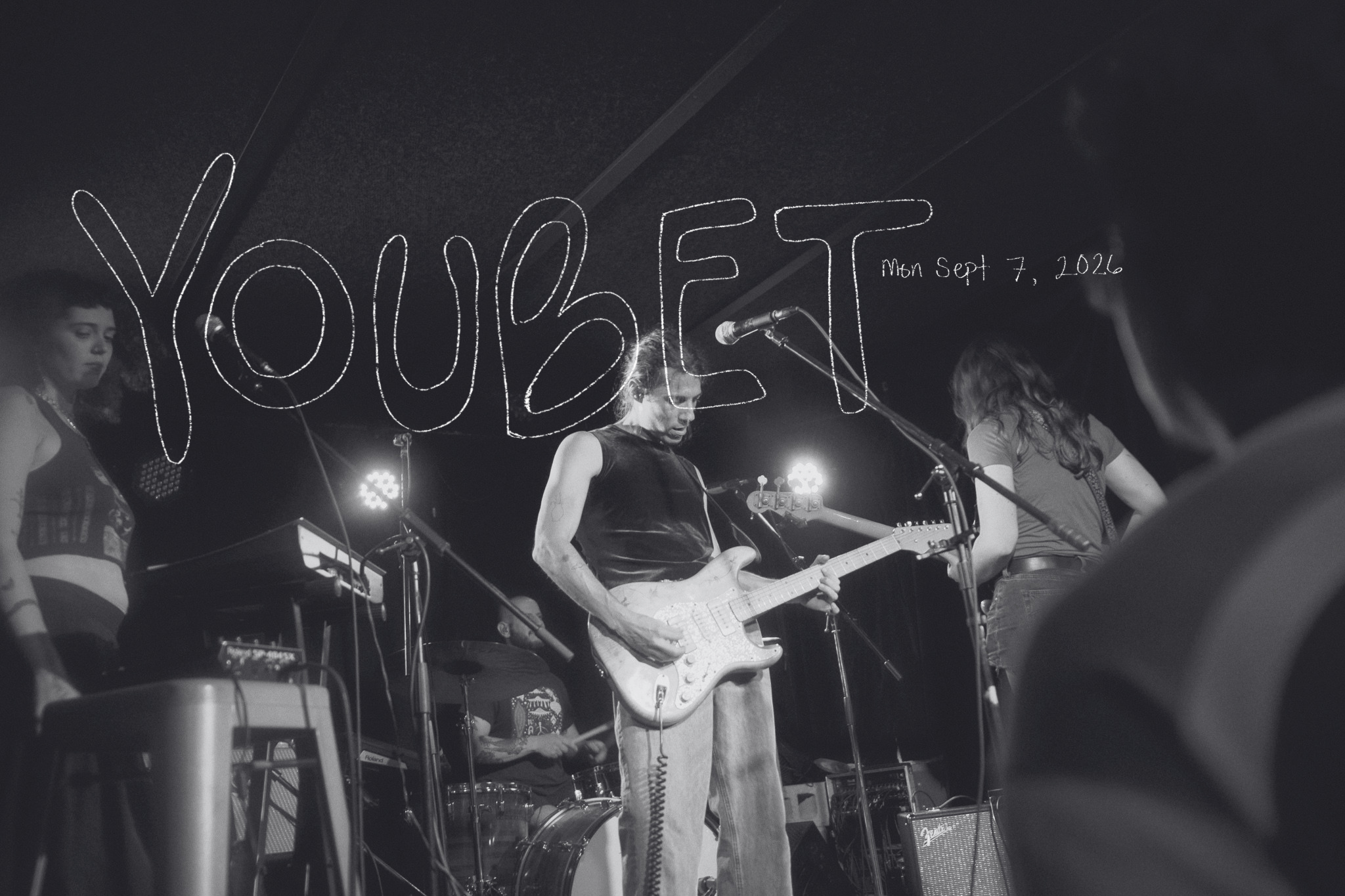
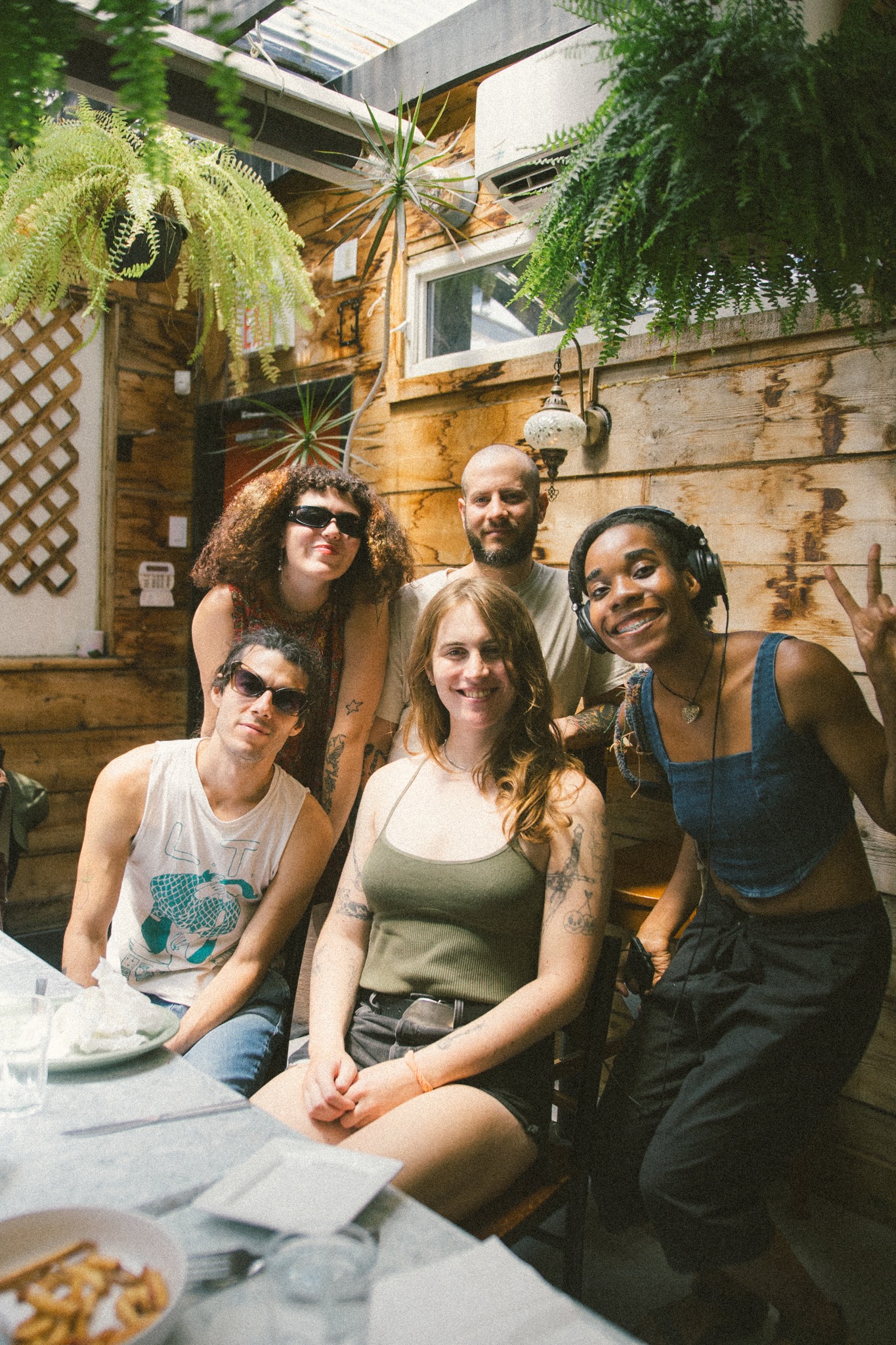
youbet: Nick Llobet, Micah Prussack, Jolie Gordon, Adam Berkowitz
We sat down with youbet — Nick Llobet and Micah Prussack, joined by Jolie Gordon and Adam Berkowitz — mid-tour to walk through their self-titled record from top to bottom.
Over brunch, they talk about the year of touring that reshaped and untangled them while writing the record, living "Undefined," and the riff they stole from a cut track to close the whole thing out.
Catch youbet again in Toronto for the Second Summer Festival!~~~> Sept 24 @ Drake Underground
Absent Sounds: Absent Sounds is pretty much an album play-through show where we go through our favorite records top to bottom, and the self-titled is one of the favorites from this year so far. So I'm excited to get into the nitty-gritty behind it.
To start — since you're on tour right now playing these songs live — has anything changed for you between the recording process and being on stage? Or did you learn something about the songs you didn't know when you first wrote them?
Micah: That's a great question. A bunch of the songs were developed to be played live before we ever went into the studio. So there was a level of reinvention that happened while we were recording, and then the songs had to be reinvented again to figure out how to play the studio versions live. Undefined is probably the one that's changed the most — we added tempo changes.
Nick: Basically every recording process gets arranged completely differently than how we do it in rehearsal. We'll take a lot of the elements from the recording, but then we'll play it live and go, "Wow, this isn't translating. How do we build something new from this?" On Undefined, we ended up adding tempo changes — slowing down dramatically in the heavy sections, then playing the main part a lot faster. We couldn't get that song to sound good live until we cracked that. It's a lot of getting in a room, bouncing ideas off each other until it feels right, making a voice memo, and meticulously listening back together. Adam records the shows on his phone and we see what we can learn from that.
Micah: Another addition — youbet has historically used drum machines in the studio for percussive textures, but it wasn't until this tour that we brought some of those sounds live. Our drummer Adam has a sample pad, and we programmed some of the drum machine loops into it. It's been a nice level-up. Every tour we try something new and get better at translating what we do with multi-tracking into a live environment.
Absent Sounds: I love that idea of learning — even the way the band came together was based on learning. Was there a song that was pivotal to figuring out how you wanted to express yourselves as youbet? Doesn't have to be from this record — I know this is your third.
Nick: Around 2015, before I made youbet or figured out how I write songs now, I had this goal to learn a bunch of songs because I was hitting a wall songwriting-wise. I built my repertoire by learning other people's songs by hand — old country songs, folk songs, Bob Dylan, George Harrison, the Beatles, Elliott Smith, Pixies. Elliott Smith's "Speed Trials" is a good example — I wrote it out in my book, and it has such interesting chord changes. Learning how to get into his mind, how he mixed weird chords with beautiful ones, informed my ability to have a pop sensibility but stay weird. That's an example of a song that really opened my brain to how to write this way.
Micah: In general, when we're listening to music in the car, we're always breaking songs down to their essential elements and asking, "Wouldn't it be cool to try something like this?" We were listening to Swans' "Oxygen" and I said, "Nick, how cool would it be to write a song with a bass and drum groove that doesn't change for six minutes and just gets more cacophonous?" We haven't tried that yet — that's something for the future.
Nick: A really important thing for me is to look at other inspirations as a template — figure out how to extract something and make it your own. That's what made me feel confident in what I do: I was able to extract a template from everything I like and put my own twist on it.
Absent Sounds: Something I noticed in your bio was pairing Hitchcock's Vertigo with flamenco — which feels like a representation of how your minds work. What's going through your head when you're piecing together things that don't obviously connect?
Nick: I spend a lot of time trial-and-erroring. I'll come up with one piece of music — that's the verse — and I'm looking for a chorus or bridge that connects to it. I go through the different chords in the key, and once I exhaust those, I look for chords outside the key. It always yields a result eventually; it's a matter of patience. Don't be afraid to explore every option, even when it's tedious — take a break, come back, and you'll find what you're looking for.
Ground Kiss
Absent Sounds: That idea of searching leads into the first track. When songs get vulnerable like this, is there a version that's more private for you early on, that changes into something that connects with other people? What does that process look like?
Nick: Lyrically I have a stream-of-consciousness style — I let the words come out as I'm improvising the melody. I try not to be too meaningful.
Micah: The meaning comes out through the impressionistic gestalt of it.
Nick: Impressionistic is a good way to describe my process. I went through a breakup on this album — not a horrible one, a 13-year relationship that ended on good terms, very drawn-out. I think a lot of the lyrics are subconsciously in that world of transforming into a new person after leaving a codependency I'd only known my entire adult life.
I just like playing with words. There's a lot of adventure in the words you choose.
Micah: Every song is like a painting, and words are accents that help you notice various parts of it.
See Through
Absent Sounds: I think of albums as theatrical events that live in different acts, and See Through feels like it moves through several — the tone shifts, the music shifts, the lyrics shift. There's a tug-of-war, and it feels like it's traveled a long distance sonically. What was crossing that distance like for you?
Micah: We like keeping people guessing about what to expect from a youbet album. We've heard people describe us in certain genre terms, and in the studio there was a conscious effort to buck those expectations — especially with track order, spreading out songs that live in the same world so the listener feels the genre whiplash more. See Through is a heavy song, but the melody is straight out of a classical piano piece.
Nick: I'm influenced by a wide range of things, and sometimes I just love fitting it all into one song. See Through's a great example.
Absent Sounds: One last thing on this track — "Hold on, I can get up." I kept coming back to that line.
Nick: I think it's about perpetually fighting to survive. I feel defeated by so many facets of living — paying rent, the popularity-contest feeling of the industry. It's basically an ode to resilience. "Wait, hold on — I'm not done. Don't throw me out just yet." Mostly it's me talking to myself, reminding myself I can survive the hard moment.
Absent Sounds: Is there a mantra you come back to?
Nick: Not a specific one, but there's a moment every day where I have to snap out of a dark place. I'll say "you got this" quietly, in my mind. No one hears it but me.
Micah: In a musician's lifestyle there's a lot of uncertainty, and one thing I tell myself is that I never went wrong in life betting on myself.
Undefined
Absent Sounds: This feels like the softer spot in the record — the riffs felt like spider fingers crawling up my back. Tender and a little weird. What was this track like for you?
Nick: Similar to See Through and Embryonic — two very different parts stitched together. The intro is haunting, the chorus is heavy and shifts key. I was writing it at my job teaching guitar, between lessons or when a student didn't show. The verse came out in about five minutes; the chorus took a few months. I wanted it to be super melodic vocally, then wanted the chorus to counteract that pop sensibility with something heavy and messed-up chord-wise.
Micah: We worked on that song for a long time in practice. Its placeholder name was "the Katy Kirby song" — even though, in hindsight, it sounds nothing like Katy Kirby.
Nick: We tried it out on tour with Palehound and Ratboys and were never really happy with it until this tour.
Micah: After we did the initial rough bounces, I was listening in my headphones while we packed up the car and just yelled, "Undefined is a single." When it came time to decide singles with the team, Nick wanted it — everyone shot him down, including me, initially. Then our publicist independently landed on the same pick.
Absent Sounds: I'm curious about the dynamic — in a band there's a shared instinct, but also places you diverge. Where are those places for you?
Nick: Honestly, playing with Jolie and Adam has been a lot of that — Micah and I made this album before we played with them, and they bring a ton of divergence. We did a lot of synth on the album, and Jolie will design and sculpt tones, come up with harmonies I wouldn't have thought of.
Jolie: I was a big youbet fan before I joined the band, so it was fun to learn all the songs. Nick and I met up a lot, just the two of us, and came up with a lot of the keyboard parts and harmonies — some straight off the album, some we created together. I'm Jolie Gordon, I play keys and sing in the band.
Nick: I'm just really thankful to play with them both — they've added so much of their own personality. It's taking the album to the next level live.
Micah: To get back to the original question — Nick and I are actually extremely different people, but ultimately we want the same things, and that's what we discovered early in our friendship. The differences emerged over time, but the shared goal is what brought us together. We had to learn how to play to each other's strengths — musically, socially, logistically, in a business way. The biggest disagreement is probably that Nick wanted to cut a bunch of songs from the album.
Nick: I'm glad I did.
Micah: And I push back on your decisions sometimes. I think you make decisions from a place of feeling down about yourself sometimes, and I want to lift you back up.
Absent Sounds: Last thing on Undefined — do you feel most at home in undefined spaces, given how much of this was written in the in-between of teaching, between classes?
Nick: A little bit of both. I'm a very routine-driven person — I write every day, it's just part of my life. But a song could seep in while I'm waiting for the shower water to heat up. I don't designate "writing days," but recording and rehearsing are a lot more locked in.
Micah: I don't want to be presumptuous, but I think you're very resistant to being boxed into any kind of definition. We got a lot of "you guys sound like Nirvana" comments on tour during the The Way to Be era, and Nick was like, "I don't want to sound like that" —
Nick: But I do want to sound like Nirvana, they're amazing —
Micah: That's hilarious, because you're always saying you don't want to sound like anything. Undefined — it's undefined.
Nick: Something about me that isn't easy to grasp is that I can change a lot about my interests and goals. I'm a blank slate going into things. I'll have an opinion, but it evolves. Undefined is a great topic here, because I do feel a bit undefined. It's hard for people who work with me to see me go back and forth, but that's just how I am.
Worship
Absent Sounds: This is my favorite shift in the record — halfway through it takes a really dark turn. There are a few places on this record where it feels like kneeling down, crawling, getting low. I want to know where that posture comes from, and why it shows up here.
Nick: With Worship I was trying to balance — back to contradicting myself — I set up this happy-go-lucky, cute scene, and then ask myself, "How do I completely change it so people go, 'whoa, what the hell was that?'" I take it into a dark place. The song is playful, but the undertones are about the devil — not seriously heavy or sad, more evil-cute.
Absent Sounds: It's got teeth.
Nick: It grabs you.
Absent Sounds: Any other things you'd classify as evil-cute?
Nick: Us.
Micah: That's the youbet combo — evil laughter coming from an adorable chipmunk. That's the youbet aesthetic distilled down.
Receive
Absent Sounds: I really like the video for this one — I felt like I was drowning watching it. When you were thinking about the video in relation to the words and music, what did you want to tie together?
Micah: This was Callan Thomas's vision, not ours.
Nick: I told Callan the song has an aquatic, watery feeling to me — I don't know why, I just envisioned water.
Micah: We showed up to Callan's apartment and he had a whole water tank set up on a table. Through the camera it looked bigger than it was. He shook it and filmed us singing — one take each, and we were done. Callan's someone we've worked with before and really trust — he also did Undefined and Seeds of Evil. Brittany did Peel and Ground Kiss. We're lucky to work with the same people again and again.
Absent Sounds: Zooming out — you're from New York, one of the biggest creative centers in the world, which contrasts with Colorado, which comes up on the next track. Are there other places, physical or otherwise, dropped into the record that matter to you?
Nick: New York City is where I write all this music, where we work everything out and build the whole vision. I live a very New York life — I go out a lot, go to shows, have a lot of friends I work with. I don't really have a "real" job — I teach guitar for a living, but my whole life is this craft, this community, these working relationships. This album is a culmination of that lifestyle, and all the touring we've done. Colorado comes up on one song because I lived there for two years and had a very transformative experience — that's when I learned to sing and write songs, before moving to New York. It was intimidating — I had to hide in my room for four or five years before I could really get into the Brooklyn music scene.
Absent Sounds: When did a place start to feel like home for each of you?
Micah: I've only ever really lived in New York.
Jolie: I've lived in Boston, LA, and New York — I'm from New York. I'd say it takes about two years to feel like a new place is home. But the more you go back to a city on tour, the homier it feels. When we played Toronto, people remembered Nick, came up to him on the street, and the people running the show were tuned into what we needed.
Adam: I'm Adam Berkowitz, I play drums with youbet. I stayed in my hometown, Tallahassee, for about 25 years, and that always felt like home — but every time I visit now, it feels less like it. The city keeps changing, friends and family leave. I've been in New York three years and love it, though I'm not sure it feels like home yet. At the end of this month I won't have a home — I'll be couch-surfing, living the nomad life for the foreseeable future. Scary and somewhat exciting. What I'm learning is that home is really within yourself.
Nadia
Absent Sounds: I think home can be a person — old adage, home is the place you love. Within a record that's abstract at points, this one comes to a head with an actual name. What makes a track need a proper name like that?
Nick: It's really hard for me to name songs — almost all of them keep the placeholder name we use in rehearsal. This riff took me a long time to write — it's rhythmic, incorporates a flamenco thing. For years I'd post it on Instagram, "looking for guitar students," and my friend Nadia would always reach out every time — "I love that." So I started calling it Nadia, because she was the one person who always responded to it. I didn't want to name the song that; I just couldn't come up with anything else, so at the end I gave in.
Jolie: It's even cooler when someone names a song after you and it's not about you.
Nick: The song has a romantic thing going on, but it isn't about her.
Absent Sounds: It also has a self-erasure moment near the end — "I am nothing."
Nick: Those lyrics come from how I make demos — I improvise a vocal take, a scratch take, mostly gibberish. My original take there was "I am nothing," and I asked myself, do I really want to sound this miserable and self-deprecating? But sometimes you just go with what you have, and you don't look back. You look forward.
Bad Moon / Bad Choice
Absent Sounds: I want to tie these last two together, since the names live between each other. They're very different, but they're back to back like couplets.
Nick: They're quite different — I was trying to take a new turn with the songwriting and arrangement on both. Bad Moon was very inspired by Katie and Julian, who produced and recorded the album with us. They built a lot of the sonic production on that one.
Micah: Julian grabbed the drum machine, Katie added all the synth sounds. It ended up being their favorite — they wanted it to open the album, but we said no.
Nick: I was trying to write something hooky and pop, outside my normal range. Bad Choice is more of a folky song with heavy spurts throughout — the ending riff was actually pulled from another song we cut. I do that sometimes: a song doesn't make the cut, but the riff was good, so we steal it and put it somewhere else.
Micah: I remember when you brought that riff back — I was so excited.
Nick: As a songwriter it means a lot when you bring something to the band and everyone's excited. That was one of those moments.
Micah: I almost wish we'd let it run longer at the end — it's so fun. Maybe we'll stretch it out live.
Nick: We're lucky. Lucky to be doing this at all.
Absent Sounds: And that's youbet.
