
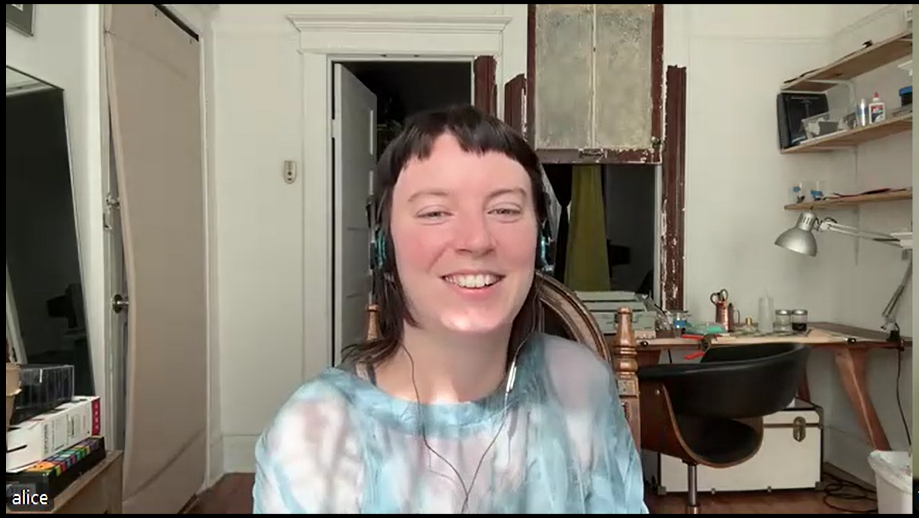
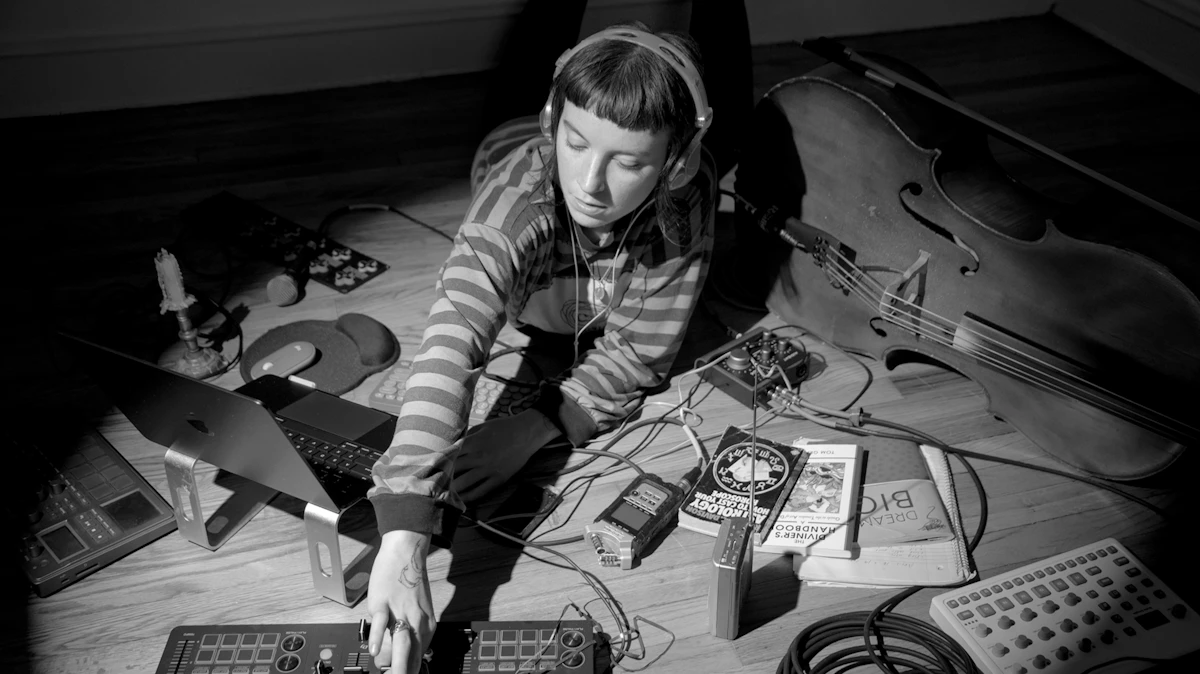
In today's episode of Absent Sounds, we sit with Alice Gerlach: also known as alice does computer music. Her latest record, Bliss, is four ten-minute electroacoustic compositions assembled from cello improvisations, field recordings, and mementos of a life being lived. The record places you in a lush disorienting world full of frog ponds and wind chimes, chopped vocals, leftover audio from tour stops, solar eclipses and more. We cover a range of thoughts, from the terror of the blank page, being connected to your creative center, Hildegard von Bingen's secret language, the KLF setting a million pounds on fire, and why bliss, by Alice's definition, is the fleeting kind.
The episode ends with a few tracks from Vancouver based musician, hydra:bad. Their latest EP, No Diving is a stripped-back but evocative form of electronic club music that sits in a similar register to Bliss. We're grateful for her art and for you. As always, thanks for listening, and be well.
Weajue: We have none other than alice does computer music, who has been making electronic cello experimental works of art for a bit of time here, and we just really wanna get into Bliss. So the first thing I will start off with is the idea of cello being not only an instrument you play for yourself, but for others as well. Do you find that you're playing in a different emotional register when you're working through it on your own?
Alice: For me, I've been playing cello my whole life. I started off playing classical music as a kid, and then kind of entered this very improvisational, off-the-rails, self-expression kind of zone. So when I'm just playing my own music, it feels like I'm able to get something out — it's cathartic. But when I'm playing in other people's projects, I'm trying to place myself in someone else's artistic vision and channel my own expressiveness through that. I've played in this post-punk band where they wanted basically just screeching noises on the cello — which was a great time, although I was shredding through bows constantly. So I guess it's expression versus stretching my playing in one direction or the other.
Weajue: Does it feel like you're coming back to a home base when you're recording for yourself?
Alice: Totally — in both a good way and a scary way. When you're playing in someone else's project, you have their vision to work with. But your own project is that blank page, which can be so terrifying. To me it always feels like a reflection of who I am on a really deep level. Myself feels inextricable from my art. So coming back to your own project can be daunting and scary, but it's also really beautiful and exploratory and helps you understand yourself.
Weajue: I read that you described yourself as not being a quick thinker — needing the fragments to digest before you can move on. What was that like for this record?
Alice: That was a really big thing I learned about myself in the process of making this record. Not just with music — just as a person, I'm such a slow thinker. I need a lot of time to digest things and let them process. And I have such eclectic curiosity and so many different interests, so I'm always taking in all this different information, but then I need to just sit with it for so long. The record took a long time — sitting there by myself in a room, in the dark, trying to piece together millions of little details. Especially with the structure of four ten-minute songs. I gave myself this ten-minute canvas for each song in Ableton, and I kind of knew the broad strokes, but then it was a lot of time just re-listening to the whole ten minutes so many times, letting it sink in enough that I could understand where the music wanted to go next.
Weajue: It feels like you trust yourself to know you'll be able to guide wherever it's supposed to go. Or maybe you're not even guiding — you're allowing the music to work itself out.
Alice: Totally. It is so much trust — in yourself and in kind of the universe, that the beauty of creativity always keeps existing and there's always more generativity out there.
Weajue: I wanted to bring up the Wikipedia articles you had on your website — I thought they were so funny. What made them so fascinating?
Alice: So the website, I made it myself. I wanted it to be this other facet of the world of the album that you could go into and find these little rabbit holes of information. I often find that my inspiration for making music is getting these random interests where I just feel drawn to something so specific, and I can never really figure out what it is — and the making of the music is kind of an expression of that feeling of being inexplicably drawn to something and never quite understanding why. I think that ineffability is only able to be expressed in art. The Wikipedia pages all represented that feeling. Like, one is about Shelta — this language of Irish travelers, a mixture of multiple languages from the region spoken only by a small group of nomadic people in Ireland. And then there's the KLF page. The KLF is this crazy group of British dudes from the '80s who made it as musicians and then went off the rails. They took all their earnings — a million Great British pounds — to an island in Scotland in cash, and just set it all on fire. Then they made a rule that they couldn't talk about it in the press for twenty years. They gave an interview in 2014 and the first thing they said was, "Yeah, we should not have set a million dollars on fire. That was bad."
Weajue: As a musician, there's so much fear in taking that leap — the fear of exiling the side of you that has to reach out to press, or put things on Spotify and participate in whatever capitalist scheme. How do you live between those extremities?
Alice: I feel like the whole world is pushing you towards being super visible and having all your art easily accessible on platforms like Spotify, constantly present on Instagram. So to me, having forces in my life that are actively pulling me in the other direction makes me rest at a good balancing point in the middle. I have a flip phone. I can't get on Instagram whenever I want. I don't put my music on Spotify anymore, but I still have a laptop, and I haven't seen any detrimental effects to being in a nice middle point. I think our perspective of what is available and unavailable is very skewed right now. The benefit I get in terms of my connection to the rhythms of the day, to nature, to my creative process — it's not even a question. And with music marketing, there's this idea that you need to be at the top of people's minds at all times. That's exhausting for people. I would rather just work on my stuff, and when I actually have something I want people to know about, tell them. You kinda know when it's your moment.
Weajue: I'm gonna use that as a tipping point into the album. The first track — The Candle of Eternity Burns For All. It always feels like you're falling down into something dark that's accelerating. What was your process of exploring how the candle burns for all?
Alice: The beginning of that track does feel like descending into some kind of dark cave. I kept having this image — you're in a forest, lost, late fall transitioning into winter. Really the last of everything is dying, and all you have is this campfire. But the beauty of it is that the wind keeps blowing in, threatening to take it out, and it just doesn't. It keeps coming back. It really resonated with this feeling I was having of life force and spirit — the unbreakable spirit of humanity and of life, and this newfound connection to everyone, to the collective. It's both dark and extremely beautiful.
Weajue: Some of the voices on the record feel deconstructed and compressed. Where is the voice coming from when you put that out?
Alice: On that track, my voice shows up in so many different ways. There's that compressed, chopped-up loop in the middle. And then there are other voices in the more orchestral passages that are also me — things I just happened to have my microphone recording in the other room while I was taking a break, just singing to myself. It feels related to the song — the far away and the close. Almost like field recording my own voice on accident. All these different floating entities. You're so alone in that moment, but also so aware of the expanse of everything.
Weajue: Does it matter what the voices are saying?
Alice: On that track, there's nothing intelligible being said. But in later tracks, there are actually recordings of my friends talking. I don't expect listeners to be able to pick out what they're saying, but they're very important to me — what they're saying is very specifically evocative of certain memories and moments that feel very close to my heart.
Weajue: I want to go to Keepsake. What does a keepsake mean or stand for?
Alice: The album itself is really a keepsake to me. It's my way of documenting and remembering this very specific time in my life — from when I released my previous album to when I finished this one was this chapter that was just so unique. And a keepsake is these kind of seemingly random, arbitrary little things that you can hold onto that become so meaningful. Like, recently I found this old box of my dad's stuff — my dad passed away a couple years ago — and it was just really random. A to-do list from 1990 saying "I have to buy light bulbs." And I was like, wow, I'm so happy to have that. It's just this little thing that becomes so big because of what it represents.
Weajue: Is clinging the right action with those things, or just letting it be?
Alice: I do kind of believe that time as linear is an illusion — just a way our brains have to operate and synthesize everything for things to make sense. I believe on some level that time is more like a flat circle where every moment is kind of always happening. So when I have this feeling of something being in the past and getting further away and wanting to hold onto it, I also have this larger deeper feeling that it's just always the present and the past and the future in one. That really changes my relationship to feeling like I might be clinging. It's just leaning into the idea of non-linear time.
Weajue: Your Bandcamp mentioned voices echoing through a Syracuse train yard on the day of the solar eclipse. Was that intentional or happenstance?
Alice: So that was in 2024 — there was a solar eclipse, and I live in New York City, which was like two hours south of the totality zone. A lot of friends were like, "Oh, it's gonna be like 98%, we'll just stay in the city." And I was like, "You don't understand. We have to drive two hours north." It ended up being eleven or twelve of us. We found this spot next to a river, totally peaceful and silent. And as soon as the actual moment of totality happened, it was just life-changing for all of us — it's one of those things that's just impossible to explain unless you've been in it. On the way home, we stopped in this train yard in Syracuse. I was really into freight trains when I was making this album — something about them was just very majestic. I took those recordings kind of randomly, trying to take a video of something, and got those voices by happenstance. Something about them just really spoke to me and represented that day. My mixing engineer kept being like, "Are you sure you want these voices to be that loud?" And I was like, "Yeah, that's the main thing."
Weajue: Sigil sounds like you're in a forest or an enchanted space. Let's talk about the field recordings.
Alice: The main recordings are from my friend Sophia who moved to a cabin in the woods — there's a few weeks every year where there's just a bazillion frogs at the pond by her house. Some wind chimes from a road trip somewhere in New England on the coast. And more recordings of my friends talking, a little more buried. I like what you said — it is supposed to be this enchanted, eerie terrain you're traversing through the album.
Weajue: I never knew Lingua Ignota was a medieval thing — I only knew the musician. What was your fascination there?
Alice: I got really into Hildegard von Bingen when I was making this record. She was a 12th-century German nun who made really beautiful, at the time very experimental choral music — it still sounds unearthly and gorgeous today. She created this written language called the Lingua Ignota — the idea being that there's a language that could be perfect, so sacred and truly representative of the concepts it's describing that it could more readily communicate with God. When I was making this album, I had this really impactful dream that Sigil kind of came from. I was walking along a beautiful clear stream by myself, and I saw glimmering metal in the water — very old coins, each with Hildegard's symbols from the Lingua Ignota on them. I picked them up, looked at one, and then saw the same symbol was on my hand. This recognition of finding something in the world and realizing it's in you. That's another of Hildegard's ideas — the microcosm of the macrocosm. You are a mini version of the universe, and what is contained within you is contained in the universe. And then I thought — might as well get the tattoo of it on my hand, 'cause that's what happened in the dream.
Weajue: Is that dream your picture of bliss?
Alice: I think bliss in this context is this joy that's extremely fleeting. When you're in this moment in your life where there's a lot of upheaval, everything is changing, and you're not quite sure where your feet are — if you can just be so present and let go of things, you can feel this bliss of just being there. It feels so different from when you're grounded and settled and feel contentedness. Bliss is just flying away in the wind, and so are you. It's the snap of a finger, and then you're in a different place.
Weajue: The final track, Train Yard — I want to know more about the other voices included. How much of those were just archiving, leaving traces for you to find later?
Alice: So the first thing you hear is a little recording of me talking to my friend. I was on tour, visiting Portland, Oregon where I used to live. I was trying to take field recordings, and I was recording this little autoharp my friend had. At the beginning I was telling my friend, "Oh, I'm getting sound souvenirs from my trip." And I was like, oh, I should keep that in there — I also want to put this in the mind of the listener. Also just the meta-ness of it, explaining to myself what I'm doing. Train Yard is the craziest track on the album, but it's also kind of the thesis — this is where I'm most going for this idea of weaving a through line through so many different ideas and going on this really epic journey over the course of ten minutes.
Weajue: How did you decide which field recordings to keep and which to let go?
Alice: I actually found that all the field recordings that made it onto the album, I took before I really knew what I was doing. As soon as I had a clearer idea of what was going on and was aware of it, all the recordings I tried to take after that were garbage — too self-conscious. I think it needed to be an accident. The random audio of my friends talking from a video I was trying to take of something else, or the clip of me explaining to my friend what I was doing. It's all these accidental recordings.
Weajue: Where on the path do you want the listener to end up?
Alice: The end of the journey is gaining a trust and a belief that whenever I see a dead end, there's something beyond it that is not a dead end. Believing in what I don't know. This process of life is so much about thinking you understand everything, and then getting older and being like, "Wow, I didn't understand anything then. Now I understand everything." And constantly going through that process — realizing that's an illusion and you'll never know anything really, except just a little bit more than you used to. For the listener, my desire is more to open up that journey and say, "This is the path I was walking on — you could jump in for a little bit and see where it takes you." My approach to music is that it's an experiment, a question, an exploration. I want that to take everyone to where they're supposed to go. Never to a specific place.
Weajue: Forevermore the unraveling, forevermore the question, and forevermore the searching of whatever destination it'll bring us to. So that is Bliss. I truly appreciate your time diving through this with me.
Alice: Thank you so much for the beautiful questions.
