

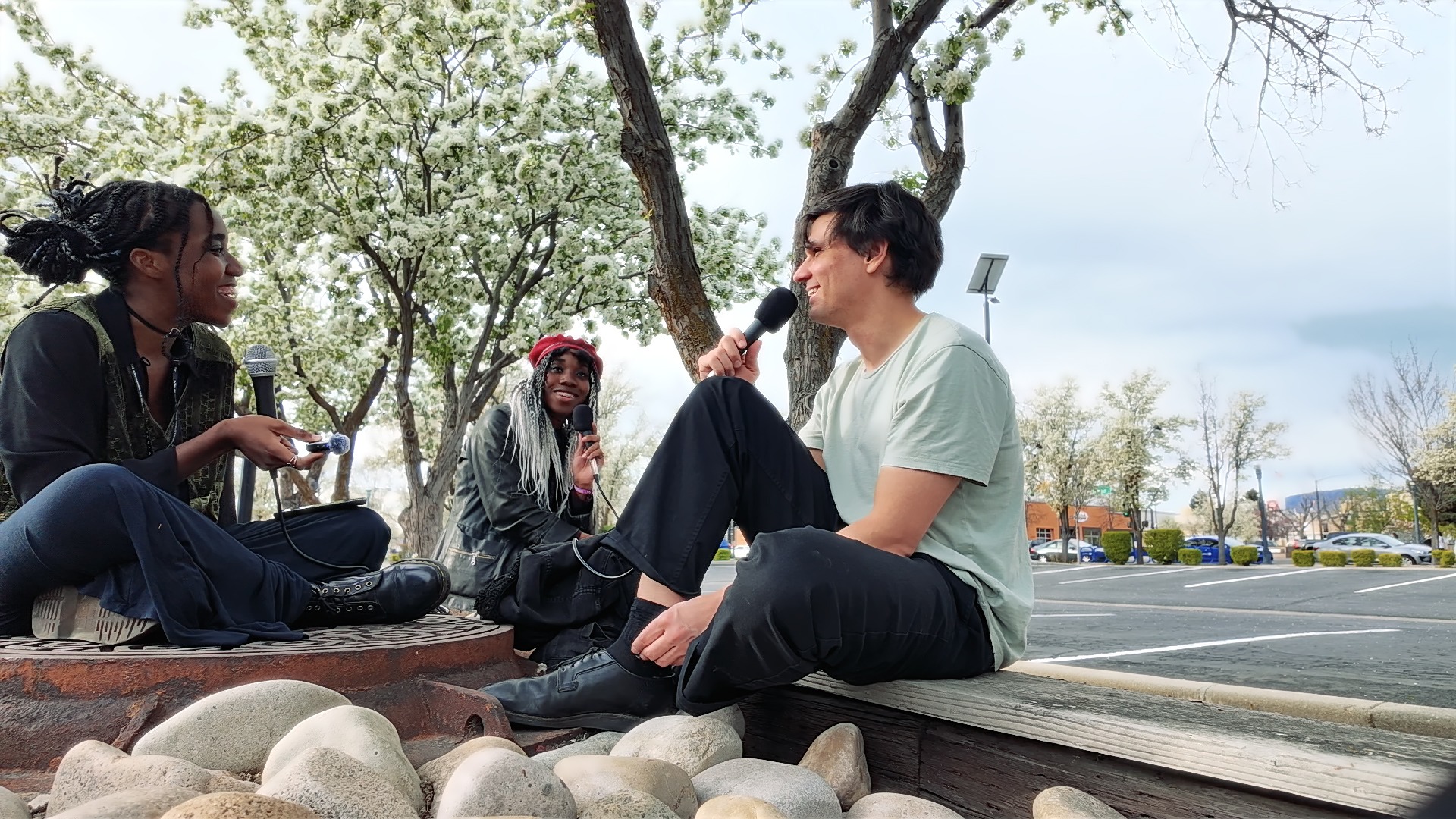
For the video interview, click here
Jo Hirabayashi has not released a record in eight years - well, until now in 2026. We wanted to know what it feels like to come back from the proverbial dead. The answer turns out to be tangled up with everything else: the total collapse of the world and the real question of whether the energy should go to activism instead of songs.
The record (Away) is about the voice of anxiety, about cloth and judgment and the rules we mistake for our hardlines, with one song, "Ico," stepping outside his head.
This is episode one of our Treefort Docuseries featuring Dan English, Jo Passed, and VERTTIGO. To watch the full interview with Jo, click here (in like 2 weeks).
Absent Sounds: Welcome, Jo. Thank you for joining us and doing this. The main thing we've been itching at with a lot of people was a question I sent you before, earlier in the conversation online: to get a little bit into what you're sitting with right now. I know you gave a good answer, which I'll include as a little interlude before this. But just tell us a little about what you're sitting with right now.
Jo Hirabayashi: Yeah. I think my answer is the total collapse of the world, which feels almost banal, which is horrible to say in a way. But it's not to say I am just sitting with that. Obviously we're all sitting with it, especially coming down to the States, and down to Idaho, which is a pretty red state too. I know Treefort is pretty progressive as a festival, and it seems like Boise and a lot of cities are a little more progressive. But I do know they just passed an anti-trans bathroom law here on the state side, which is bad news. So coming into that climate and really negotiating doing music at all, it's a big part of my thinking a lot of the time. I took a lot of time before doing this record, and part of the time away was processing some of that stuff, around whether, if I'm going to put so much energy into something, it should be just direct activism instead of music. But I think shutting down, closing up, reinforcing borders on a cultural sense too, and no longer sharing down here from Canada, and ceasing to play music out of some kind of solidarity, it just feels like it's going to make the world a little worse. It's already pretty bad, right?
Absent Sounds: Yeah. The whole isolationist kind of thing.
Jo Hirabayashi: Yeah, yeah. So that's the big thing. Although that comes in waves, right? But I am just down here, so... some days are good.
Absent Sounds: Some days are good. It's interesting that you mentioned the gap between now and the record you released earlier, the 2018 one, because that was actually our first introduction to Jo Passed. I remember it was in the bin at CJAM and we pulled it out. And then it was kind of like, not to say you disappeared, but especially when that's the first intro to you, I was excited to see what else you came out with or had coming up next. Does it feel like, when you return to music, like stretching your limbs after a long nap? Or do you feel completely dead and now you're just injected with life? What is it like coming back to music?
Jo Hirabayashi: I'm feeling pretty good about it. And honestly, eight years in music is basically forever. There are parts where it feels familiar, and then parts where it just feels interdimensional a little bit. Instagram was around in 2018, a lot of things are the same, but things are different around how people even do that now. There's more video. I was also struggling with the idea of the mysterious-artist thing of the 20th century, where you basically just had the press photo and the album, and then you had to go see the show. That's kind of gone now. You have to show everything. Some bands do it really well, that have pretty serious or darker music. Health is a band I think of that's extremely funny and candid online but has pretty heavy music, and can still keep a mysteriousness in a way. So it's a different climate for sure. But I think it's such a privilege. My attitude is that doing it at all is making it, in any capacity. So I feel pretty grateful. I did this tour in January and there were people who had my first record, who were waiting on a second record, who came to the show and bought a record. So it was cool.
Absent Sounds: Yeah.
Jo Hirabayashi: They didn't all disappear in eight years. Thank goodness all these people remained alive. [laughs]
Absent Sounds: You claimed to have passed away.
Jo Hirabayashi: Only I have passed away. No, it's cool. It's good to be back.
Absent Sounds: Because the title of your music, the record plus your name, is so humorous, right? Jo Passed Away. But do you feel like the record has answered what it was looking for, if it was even looking for an answer in that sense?
Jo Hirabayashi: Yeah, I think so. A lot of the themes of the record are about internal voice, kind of judgment stuff, and a little bit of law and order, but not in a social sense, more in terms of your own internal life. And how someone composes themselves. There are a lot of lyrics and themes around cloth and clothing. It's basically naming what the voice of anxiety actually is. Completing and putting out the record was very much completing that processing in itself. There's a big thing about actually releasing music. A lot of people make very introverted music, and then putting it out completes that cycle. So I do feel like there are a lot of answers in there for me. And it's nice to have felt that I was making something that didn't have a time limit for a while. It did for the first half, and that was kind of bad vibes, and that's something that had to be unpacked, where I just had to let it go. The pandemic was good in a way for that, because the whole world slowed down for a bit, and that gave me permission to take a little more time. And then I just kept taking more time after that, to be honest. It's a little bit of a pandemic-delayed record, but five years of that was the pandemic and then three years was just my own stuff. I'll take accountability for that.
Absent Sounds: I love how you mentioned Kierkegaard, because I was reading some of the stuff about the album. There's such a parallelism happening between your record and our lives, because the past few months have been very much littered with hospital stays, but on the mental side of things. And being there, I was spending a lot of time reading lectures on Kierkegaard and a lot of other things I thought were interesting. It felt like it was nurturing something. But I want to know what that was for you. What was the thing that was pulling you into that world?
Jo Hirabayashi: Specifically, that's the song "Ico," which is the... God, I'm totally mind-blanking. Anyway, you can edit it in. Kierkegaard is this noticing of being, this thing that doesn't share so much of the human concerns we have. That was my own observation of just my cat, and it was the foil to the rest of the record, the contrast, which is very deeply introverted, more psychological, in your head. And then suddenly there's this one song that's entirely out of my head, just observing my cat's day. That was also pandemic-inspired, because the whole world's crazy and my cat literally has no idea what's going on, and is fine, has this routine, and it's just amazing. Human beings, when we're just observing each other, seemingly have that going on, but there's so much else in there.
Absent Sounds: We're cat lovers too. We have two cats.
Jo Hirabayashi: Aw. What are their names?
Absent Sounds: I was going to ask if your cat had passed away.
Jo Hirabayashi: Oh, Ico is alive still. It's actually Taya, who sings that song, who's my ex-partner and now my friend, who takes care of her. Ico is very old and a little grumpy, but has a good life. Still alive.
Absent Sounds: Our two cats are Alexander Bo Peep and Odette. Alexander Bo Peep is like five, six, and Odette is like two and a half. They're pretty young still. And one of the fears we have as cat mothers is them getting older, what it would look like to take care of them. Is there something you've unexpectedly found joy in, having an older cat, that maybe people with kittens or young cats might not get to experience?
Jo Hirabayashi: Yeah. Ico is such a chill cat, and always has been. Taya and I were co-parenting the cat after we split, and we lived in the same apartment building. And then I made the choice to move to Toronto. Taya ended up getting a younger cat with Ico, which was really cute, to see them start to be like cats to each other, and then gradually start to clean each other. And I think Umay, the younger cat, is learning stuff from Ico, which is sweet. So probably as your cats get older, getting younger cats, they do impart some sort of vibe, some cat knowledge.
Absent Sounds: Something that I cannot teach them. When I say stop doing something, or that hurts, you're not supposed to do that.
Jo Hirabayashi: Yeah. Oh my gosh, totally.
Absent Sounds: Thinking about the world and the state we're in, I think a lot of people sometimes feel very rigid, like you're not supposed to change your mind on things. But especially when so much time passes, from when you started working on this until it came out, are there things you felt one way about when you first started, and then changed your mind on? It doesn't even have to be music, it could be anything.
Jo Hirabayashi: Absolutely. There were so many things. That was part of the delay of the record too, that there were so many rules I'd created around what I had to do with music. There were periods where I wrote songs thinking, "I'm going to write this as if I'm doing a three-piece live." And I started writing some songs thinking that, and then later it was like, the song isn't done, I'm adding a fourth member. Or there were songs where I'd think, why am I thinking that I have to be so strict? It used to be a freeing thing to think about how it was going to be played live, and then I realized it was starting to constrain. So I had to really challenge some of those rules. And that's also part of asking who is actually saying that rule. Sometimes you infer that voice, that you've discovered this rule of how to do something, and it's really coming from somewhere else, but really it's just a part of yourself. And it's not always a bad thing, obviously those things keep us... there's a song called "J Walking" that's supposed to be specifically about that. They keep us not walking into traffic. But a lot of unpacking what those rules are was a huge part of this record.
Absent Sounds: What made you realize? Was there a moment that caused you to break free from that?
Jo Hirabayashi: Yeah. My first record was on Sub Pop, and there was a lot of work that had to go in to facilitate that relationship happening. And then it really felt like there were things outside of my control. One of them was the pandemic itself, which really affected the ability to tour, so it affected my ability to keep promoting that record. And then I had a live band that, independently of me, was starting to have their own interpersonal issues. I had a band that was in my band, and their band had issues, and then I had to be involved in that. But there was not a lot I could do. So there's a lot of relaxing, just being like, well, you have to accept things as they come. And putting out music too... I actually really like this record. It took a lot of time, and I can listen to it, unlike some of my other stuff, which has all sorts of weird things, I'll be perfectly candid. But taking a lot of the time made it really comfortable for myself. I also like, with music, when musicians are kind of done with their own work and put it out, the selflessness of that, where they're like, "I can't stand it, but I'm still going to promote it because there could be something there for someone else." I think that's nice. And a little egoless, which is cool.
Absent Sounds: There's the other side of it, like Mac DeMarco putting out 500 things at once and letting us find it ourselves.
Jo Hirabayashi: Yeah, that's cool too.
Absent Sounds: I was going to ask about your relationship to time. Being here kind of feels like you're on its own time, like nothing outside of this place exists right now. Which is not true, I know all the emails of people asking me to do things. But I'm curious, is your relationship to time right now shifting in any way?
Jo Hirabayashi: Yeah, for sure. I'm pretty old now in music.
Absent Sounds: Never. You're still jumping up with Gen Alpha.
Jo Hirabayashi: Yeah, totally. [Laughs] I think there's stuff to do with my own internalized ageism, from when I was younger. As a 25-year-old I didn't have a concept of what it would be. It's really weird, because that stuff happened for me personally at 25. But when I was 18 and 19 I was really into DIY punk bands and legendary indie bands from the eighties. When I'd go see them, like Mission of Burma...
Absent Sounds: Yeah, I know them.
Jo Hirabayashi: When I saw them they were in their fifties. And I loved Blonde Redhead back then, who were all in their mid-thirties at that point, and they're still going. Fugazi too. So something happened in my twenties that affected this, weirdly. There was a brief period where that crisis-and-maturity stuff happened around that time. But now there's some kind of freedom in how crazy the world is right now, where it really is pretty incomparable to other points in time. I make this really dark joke...
Absent Sounds: Please, tell it.
Jo Hirabayashi: It's like, whatever age you are, I'm like, "39 is the new... oh, the world's totally ending from climate change and everything's super fucked." Like, where are we going? The idea of these ages being a new benchmark for something. And with all the chaos and the job market, it's like, gosh, we're all in the same chaos. But my music also has weird math-rocky elements, and I do have a weird relationship to time in music too.
Absent Sounds: Time signatures.
Jo Hirabayashi: Time signatures and stuff. So time's cool.
Absent Sounds: Time's cool. I was going to say, briefly, because we're 25 now, but I think a lot of people that are our age but also, anyone that's our age, when they turned 19, it was the pandemic, 2020, 2021. So you didn't really get the chance to go to shows, because you're too young before to get into a lot of small venues, and then by the time you can, everything was shut down. So it was kind of like everyone's trying to get their first experiences in a small venue, but you're 20, 25. So that was always kind of weird.
Jo Hirabayashi: Yeah, it sucks. It's sad. That's really hard to compare to another generation. I guess the Spanish flu...
Absent Sounds: I was going to say.
Jo Hirabayashi: Some people missed out on shows then, but I don't know, it's so hard. Do you even compare that?
Absent Sounds: I was reading something you said about feeling like you were unspooling to write the record. When I think about unspooling a thread, when you do that, you're stitching something together. So what's the thing that stitches the songs together, or even the thing that stitches everything to get you to the point of the cloth that is the album?
Jo Hirabayashi: Probably just my voice, the obvious answer. It's the consistent through line through songs that are pretty varied. It goes to a bunch of different places. But like I said, there is literally the mention of cloth and stitching itself as a recurring theme, and judges and stuff like that. The record was recorded at two different studios with two different drummers over eight years, and then three different home studios. And I don't think it sounds like it was recorded in a bunch of different places. It sounds cohesive. It was all mixed by the same person. So there's a sound through it.
Absent Sounds: If you took everything away and only had to leave one thing, other than your voice, if there were only the bare bones, what would you still keep in the Jo Passed that would make it Jo Passed?
Jo Hirabayashi: Musically? I think if the songs were reduced down to just someone else singing them and playing them on a guitar, there would still be similar things going on, or complementary things going on, with the forms of the songs.
Absent Sounds: That we'd still know it's you.
Jo Hirabayashi: Yeah.
Absent Sounds: I want to end with something very time-and-place, because we're currently in the US right now. Speaking as a Canadian, if you had to declare some kind of resolution you want to see to improve the world. This is your one check, like you're a pageant queen. How would you save the world? Do you get what I'm saying?
Jo Hirabayashi: Yeah. Abolish capitalism, right? That's it. And colonial nation-state borders and stuff. It's getting real bad, and we're seeing it. I hope we see more of a changing tide, and I am optimistic about it.
Absent Sounds: What makes you optimistic?
Jo Hirabayashi: Zohran Mamdani makes me optimistic. That is a pretty big deal, to see an outwardly Muslim socialist, a Muslim person of color, in New York. The last Trump presidency was really bad, this is way worse, but on the smaller level... I did a lot of touring, my last record was all touring, and I didn't tour during the Biden presidency in the US for some reason, it's just been in the Trump presidency.
Absent Sounds: The through line is Trump.
Jo Hirabayashi: The through line is Trump. No, no. But what I noticed touring through the states is the smaller resiliency and sense of determination within the music communities around the states really strengthened. That's not giving Trump credit. That's just...
Absent Sounds: The people power.
Jo Hirabayashi: To the people. And seeing that happen on a municipal level. The materiality of that for people in cities is a lot more than some of the broader things a federal government can do. Like rent freezes and public grocery stores, speaking of our own deficits, are going to be much more impactful for us on the day-to-day than other things.
Absent Sounds: Absolutely, I agree. I'd say when things get hot, people press together.
Jo Hirabayashi: Yeah, I'd say both.
Absent Sounds: Vote for your local trustees, school board stuff. If you don't want to vote in a big election, then go vote for those ones. But still vote either way.
Jo Hirabayashi: Yeah, totally.
Absent Sounds: That's it. Thank you, Jo.
Jo Hirabayashi: Thank you so much.
