
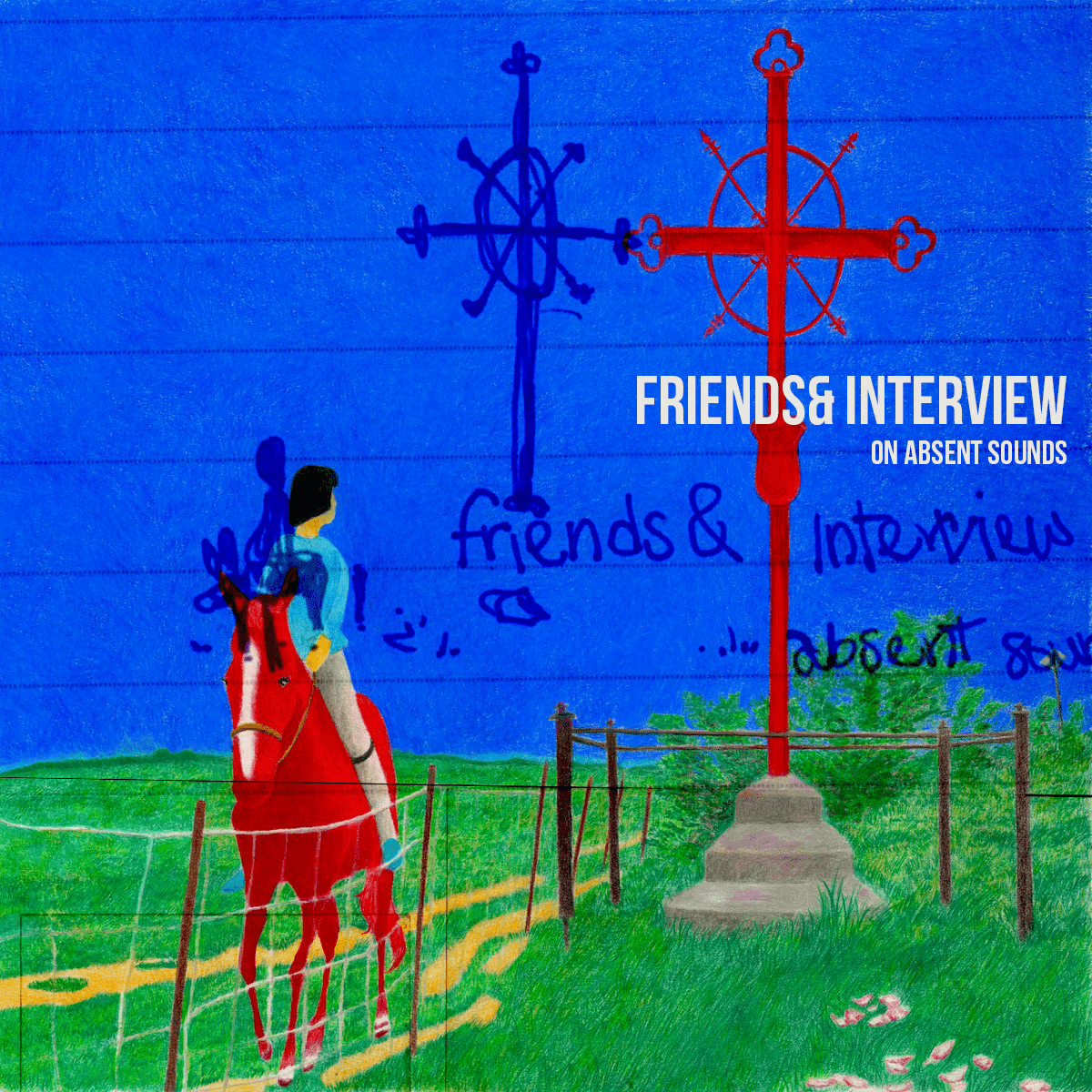
In today's episode of Absent Sounds, we sit down with jc, the brain behind the beast that is friends&, to talk through folx. It's the 2026 record from the Toronto collective sprawling 112-tracks, and eight years in the making. We get into the terminally-online roots of the project, the genre term "laptop twee," what it means to let a track live it's full absurdity, the file-management discipline it takes to survive a record with this many discarded versions a cappella and all.
Weajue: I want to get a bit of an overview before we go further into the record, because the band feels so terminally online, especially around communities like RateYourMusic and Discord — which I use too, so I know that world. At what point did making your own music start to feel inevitable?
JC: I've been making music since I was 17, I'm 31 now. I think the reason we ended up so deep in Discord and RateYourMusic is just that we were really into music. Certain artists you can talk about with friends in real life, but if you get deep enough into something niche, you end up looking for a community that wants to talk about it. So I'd say we started as pretty normal musicians, and it was the specificity of our interests that pushed us online.
Weajue: I think being in online communities can also push you toward going more esoteric, seeing how far down one path you can go. Was that intentional for you, or more of a natural evolution of your interests?
JC: That's really a question about genre. It starts with chasing newness — if you get deep enough into a niche, it becomes hard to explain to people what you're going for artistically. For me that was a lot of things, but one thread was glitch pop. Once you're deep enough down a rabbit hole, you start needing a way to name it — both to explain the artists you love to your friends, and eventually to explain your own music. Last summer I coined the term "laptop twee" for a kind of electronic, laptop-inflected twee pop and indie rock inspired by 2000s music — I loved the sound and needed a way to describe it to friends, so I made a playlist and a name for it. But folx isn't always doing that. Sometimes it is, sometimes it isn't.
Weajue: Genre can help pin down what you're seeing in other people's work, but people also say it's limiting. I'm interested in how bands navigate that — and I think friends& does it well.
JC: I hear the "genre is limiting" argument a lot. But being deep in music fandom, genre can be a great entry point into a lot of music you don't know. Historically the stigma comes from genre being a capitalist tool — a way to shelve records for radio and retail. That's a real, limiting phenomenon. But now there's no label executive assigning us a genre. As artists we have to find ways to frame ourselves to people, and writing and talking about music is one way to do that instead of, say, becoming a TikTok influencer. Sometimes I'll call an artist "laptop twee" and they'll be annoyed — I'm not trying to box them in, but it gives them an opening to explain who they actually are, which I think is kind of great.
Weajue: A lot of genres only seem to get accepted in retrospect — emo is the classic example, bands rejecting the label at the time and then it sticking anyway. Maybe whoever was sub-tweeting you will call it laptop twee in ten years.
JC: That's the dream. Emo really is the perfect example.
Weajue: Say someone from the 1500s walked into a record store, picked up folx with zero context, and wanted to understand where friends& is at right now — where should they start?
JC: If you wanted to ease someone in, there are less "freaky" songs — a couple of acoustic ballads that would be less alien than a wall of blippy, bloopy samples. But honestly, I'd tell them to start right at the beginning, with a song called "At Seventeen." If a Victorian child heard folx, they'd probably think the world had ended.
Weajue: If I gave my laptop all your project files, I think it would just die. What does your process actually look like — file management, building it from the ground up?
JC: I work in film and post-production, so file management is a big part of my life already. More specifically: I started at a company obsessive about dating every export, and early in making folx I told the band the same thing — put a date on every file, or we'll have no idea what's going on. At first everyone just wanted to call things "done_final_2," but eventually people learned to label things properly.
As for the record itself — folx started around 2017 as something I was writing with my friend Paul. I had a demanding job, so it developed slowly, and kept getting remixed and rebuilt over roughly eight years. The earliest versions were just two guys singing over acoustic guitar into a phone. Then there was a full-band rock phase, then an orchestral MIDI phase with my composer friend Daniel, then a sampling phase built out of chopped-up old songs. There's an entire finished version of the album from June 3rd, 2022 — about ten songs — that we scrapped because it didn't feel "folx enough." Over those eight years the band kept growing, more people kept joining, and eventually it became folx.
Weajue: And here we are — a genuine whopper of a record. Maybe the only real competitor is Mac DeMarco's giant tracklist album.
JC: Someone described our album as "scrobble terrorism," which is accurate. I think both records are examples of how the streaming era changed what an album can even be — we're not limited to two sides of vinyl and a 46-minute ceiling anymore. Mac DeMarco can release 900 demos, and we can release a huge folktronica mess, because now we actually have the choice.
Weajue: The way we listen to music now changes how meaning gets imposed on it, for me at least. How does meaning shift across this record, especially over the years you spent making it? Was it intentional, or did meaning just accumulate?
JC: Historically, more money in music meant needing to finish records within tighter boundaries — think of The Beatles recording their first album in essentially a day after Hamburg. Now, with so little money to be made but such powerful home-studio tools available to everyone, you can take as much time as you want to let meaning and songs develop. One of the philosophies behind folx was letting the songs evolve, letting meaning change over time, letting the song tell us where it wants to go. I know "first idea, best idea" is good advice for finishing things, but I think there's something beautiful about overthinking, about living with a piece of art and letting it keep changing — even if it's bad for your bottom line and your friends start asking why you haven't released it yet. It's a bit like that Miley Cyrus line from "The Climb" — it's not about how fast you get there, it's about the climb itself.
Weajue: Sticking with that metaphor — are there specific points on the record where you made a mountain out of a molehill, obsessing over one detail for a ridiculous amount of time?
JC: Honestly, everything on here. The clearest example: the songs were originally written with my friend Paul, lyrics mostly finished by around 2022. But I felt the words didn't feel thematically connected to the music, which frustrated me, so I went on an odyssey rewriting basically every song. For about a year and a half — 2023 into summer 2024 — I didn't touch the music at all, just rewrote lyrics, to the point where the rest of the band was asking if we were still finishing the album. I don't think most people come to this record for the lyrics, but it mattered to me — that's a molehill that became a mountain.
The funniest example, though: over a Christmas break — I think 2019 — I became convinced folx needed to be a Beach Boys record, so I recorded an entire 40-minute a cappella version with no instrumentals. It also, at points, sounded like a genuinely terrible Glee cover version of the album. Almost none of it made the final cut, but months of my life went into "the a cappella album."
Weajue: Would you ever actually release those files? You don't seem like someone who'd put out anything that doesn't feel complete to you.
JC: That's a good question. The plan has always been to eventually release every single file — every demo from the whole process — up as a link. I think it would actually make the album more complete for the small number of people who'd take an interest, because a lot of people hear this record and just think "why would someone make songs like this," complimentary or not. I'm also writing a lengthy, almost technical production diary to go along with it — not meant to be a fun read, more like a manual for how folx was made. That said, I love when other artists release rough, unfinished work, but it's genuinely hard for me to put out something I don't feel strongly about myself.
Weajue: I'm currently reading a David Foster Wallace book that reads almost like a user manual, so I'll actually read the production diary.
JC: We love David Foster Wallace here — that tracks.
Weajue: Given the band feels like it runs on friendship as much as music — what has friendship taught you that music never could?
JC: Friends can forgive you. Music can never forgive you.
Weajue: I love that. And that is folx. Thanks, folx, for listening.
