
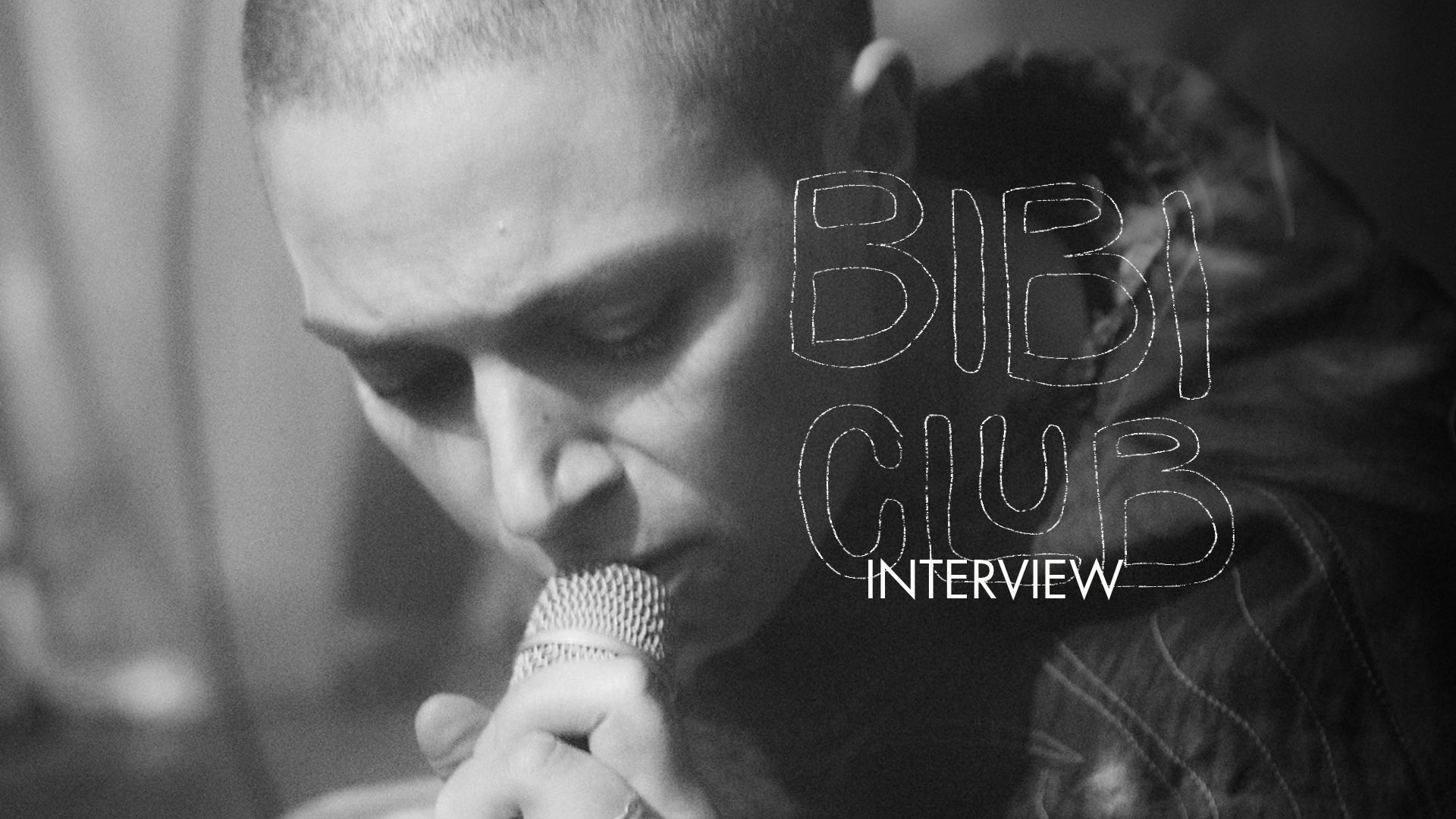
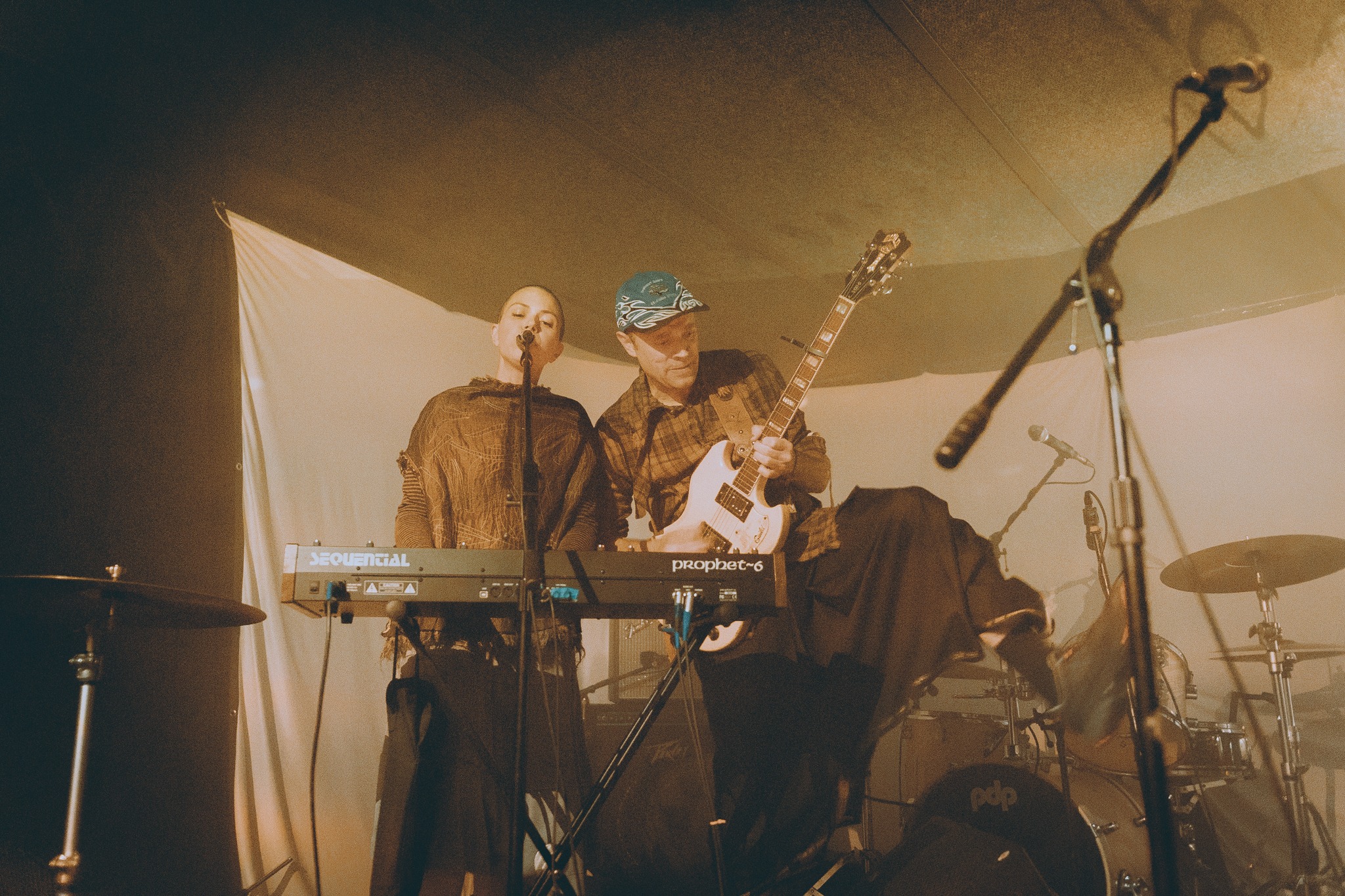
Bibi Club at the Baby G, by Weadee
Bibi Club's Toronto stop for Project Nowhere 2026 was a quick one, so we caught up with Adèle Trottier-Rivard and Nicolas Basque by computer to go through Amaro, their third album, track by track.
We talk about movement as a way through grief, the medieval tapestry that shaped the world of this record, Helena Deland's guest vocal on "A Different Light," and why Nicolas came to see playing live as a kind of empathy. They also describe the sound they're chasing next: tension without violence, something that tastes a little like dirt.
Project Nowhere is Toronto's artist-run, non-profit, multi-venue festival. Its fourth edition ran October 1 to 3, 2026 across the city's west end, and Absent Sounds was there covering it.
Absent Sounds: Thank you, Bibi Club, for joining us on the show today. One of the things I wanted to start with, before we dive into the granular parts, is how on Amaro you're both so vulnerable, but in a way where there's still a separation between what we as listeners are privy to and what you're sharing with us. Where does that tension sit for you, without giving everybody unrestricted access to what you're going through?
Nicolas: I think vulnerability is a way to connect with people. If people see that you're vulnerable, they feel that they can be vulnerable too, and maybe have more empathy in their lives. We don't put details of our lives on the recording, we don't give all the details, but it's still us making music. It talks about, among other things, grief, and the fact that we lost two close people. That's what triggered the writing of that record, in a way. It was almost therapeutic for us, cathartic, to write this. So it's quite upfront, but we also try to keep it open so people can connect with their own story, or invent their own story, when they listen to the album.
Absent Sounds: Even though the record is very heavily about grief, there's so much movement in it, in the rhythm, the danceability, even the physicality of your live shows. Is movement also a way for you both to process grief? What does that look like for you?
Adèle: I think movement is something, for sure. You have to keep moving, whatever happens. On this record there's a lot of movement, a lot of dynamics as well. It's part of the journey: you have to move with your body, and we've been discovering that over the past few years of playing live together. Whatever songs we're performing, the movement helps us get to specific emotions. It's quite a release for us to be moving while playing, and on this record we really wanted to translate that energy into the songs. Hopefully it makes people move when they listen to it.
Absent Sounds: I love how the movement also comes through in the opening, with the gong. When you hear a gong, it almost sounds like someone's calling you, like you're supposed to come forward. What are you calling, or is there a grander direction you're headed toward when you start the record?
Nicolas: We always thought of the first song as a bit like an overture. We build a record instinctively, like a puzzle, and once we had a few other songs we realized, oh, this is kind of the introduction. The themes are exposed, even musically: there's stuff that comes back later, like a language that returns on the record. And we liked that Adèle names things that are just basic needs, everyday life: you need to sleep, you need to walk, your family is important. Fundamentals, fundamental needs for everyone. So maybe that's how we saw it. But yes, it's true, there's a kind of movement.
Absent Sounds: What's so interesting is that the fundamental things you have to do to stay alive come up again and again over the album, almost like a circle. When you mentioned everyday life, I was thinking about 'Washing Machine,' how these small, very domestic objects end up holding so much memory and meaning. Is that how you normally navigate the world, always looking for the minute details?
Adèle: Maybe, yeah, probably. I've been dealing with panic attacks since I was young, and one of my little tricks when I get panicky is to look around me and name the things I see. It's a classic trick that everyone knows. But maybe there's a link there to the lyrics we write, because sometimes, maybe unconsciously, the fact that we name things in our songs a lot is a way to contemplate, and to reassure ourselves and feel grounded.
Nicolas: Maybe there was something too, on that record especially, almost a medieval subtext. We were inspired by medieval music, and by a medieval tapestry that we saw in France. Sometimes even the lyrics are almost like a folk song. So naming things is a way to bring it back to now, to not just make it medieval or magical, but to have something from now in the music too.
Absent Sounds: I think these topics, death, life, love, grief, are really wide, and they can feel so far away and abstract, so I appreciate how you bring it back down to the present. It's not even a new thing, but the way you interpret it makes it feel new, and recreates that medieval feeling in a different way. As we go through this journey through the record, I was thinking about track two. There's a lot of repetition, but specifically "Le cœur est un lieu qui ne meurt jamais" there a lot of truth to it, but it also sometimes feels so far away. I wanted to know if there are ways to push through resistance to get to the heart of it. What does one have to do to get there?
Nicolas: Yeah. I think when this came up, we were thinking that if someone you love dies, you still love them. The love is still there. It doesn't disappear with the person, and that can follow you forever. You could apply that to someone in your life who's not present anymore, not necessarily dead. When you build love, it's not something physical: you can have twelve children and love them all equally, it's not like they're taking energy from each other. So if you're touched by someone, even if they're not there, you'll still be moved by them, and you might do things in your life or make decisions connected to that person who's not around anymore, just because they influenced you, or moved you, or connected with you on a deeper level.
Absent Sounds: It's hard. I remember when someone was no longer in my life, the love I felt for them, what remained of it, often felt like it had nowhere to go. We're also wondering what it looks like to push beyond yourself when you're grieving.
Nicolas: Just keep going. We learned about those two people while we were on tour, both times on separate tours, which is kind of post-traumatic for us each time we go on tour, because it's pretty intense. But you're lucky to do what we do, because we're musicians, so we can express emotion live and connect with people however we feel. We kept doing shows because we were on tour and there was nothing else to do, and there's something in that. It's not necessarily magical, but in the moment you're doing the show, you can connect with people. Once you're on stage with your instrument, playing together, there's something about the community that helps push yourself, basically.
Adèle: A big part of touring is the people we meet. It's very important for us to have time after the shows to connect with people and have little conversations. It's very special to be able to live that.
Nicolas: When you push a bit, whatever it is, for us it's playing shows or doing music, things happen. I always remember one show we did a few days after we learned that a friend had died, once we'd had time to ground ourselves. We had a show in London, and the night before, I kept making mistakes everywhere, in songs I never make mistakes in. We played London, and at the end of one of the songs, Adèle's bottle of water ended up on her synth, and the synth stopped working. Obviously it worked again later, but at that moment it didn't.
Adèle: But that was very weird, because it felt like a glitch.
Nicolas: Almost like the ghost of our friends shook us, and we were like, don't take it seriously. It's just life.
Adèle: You can't do that. You could break your instrument. So that was a very weird moment. But we kept playing the show, and it got us to this very special place, because it was very intense, and cathartic in a way.
Nicolas: And it's almost like, that's it. It doesn't matter. Go fry your synth, and just shake it up. That's how we saw it. And since then, each time we do a show, I always see him in the corner watching us, like our guardian angel.
Absent Sounds: What I love is that the memories aren't just 'this happened, and then this happened.' They're a thread that's still woven into your lives. The people are still present, even if it's in different ways, through your shows or the work. When you lose somebody, what do you end up remembering, what stays with you the longest? I'll say that first about losing someone to death, and then more abstractly, when someone's not in your life or not in the room with you, for a few days or a year.
Absent Sounds: What stays with you the longest?
Adèle: I do remember when our friend passed away, and I still miss his smile. It was a big challenge for me not to have access, in my daily life, to his beautiful smile, because his smile was like medicine for me.
Nicolas: Sometimes it's almost like symbols. Because we processed some of the grief into a record, it became something that's not even ours anymore. There are things in there that we know are symbolic, that might represent something else to someone else, but I know what they represent to me. And I find it amazing that it rings something else in someone else's mind, because it makes it a bit more universal.
Absent Sounds: The best thing about music is how something can mean so many different things, like a kaleidoscope: one little light reflecting in so many different ways to other people. You mentioned the community of people at your shows, but also the artists you work with. On 'A Different Light,' Helena Deland, who is also a wonderful musician in Montreal, recites a poem. Can you tell us how that poem found its way onto the album?
Adèle: Well, it's actually some lyrics from another song.
Absent Sounds: Is that from 'Le château'?
Adèle: Yeah. We translated the lyrics with Helena, who's a good friend. We have a few things on the record with lyrics in both French and English. These words are from that other song, and since that song was written in English, it made sense. And Helena has that deep, low voice, and we thought it would be beautiful to have her on that song, so it felt pretty natural to ask her to participate. It was fun.
Nicolas: And it opened doors on that song, which was really personal, so it became something a bit wider. It made it less like one thing.
Absent Sounds: That's exactly what you mentioned about it. I wanted to ask quickly about the decision between French and English, because it can be an interesting divide to cross. How did you know which songs wanted to be in which language, or maybe which words?
Nicolas: Yeah, it's strange. We're in Montreal, so there's a lot of English and French. It's happened once or twice that we struggled and didn't know if it would be English or French, but usually it's pretty natural. It feels less derivative of something you've heard before, so that can sometimes help with the decision, but it's not usually a big decision. It just happens: oh, this is it. Right at the beginning of this project we were wondering if it should be just French or just English. We had songs in both, and we spoke with a friend, who did all of our record cover, and she said, it doesn't matter, you're from Montreal, just do both. You could even do more, do whatever language feels right. Strangely, it gave us permission to do whatever we wanted after that.
Absent Sounds: I was thinking about the voice too, Adèle, how you sing, even your enunciation. The voice is an instrument, but it carries so much power in a lot of the tracks. It could be in English or in French, and you can still tell what emotion the track is meant to evoke.
Adèle: Thank you for saying that, because I do hope that whatever the language is, people get to feel emotions, whatever they're hearing. We're aiming for a universal feeling. It's always quite a compliment coming from you, so thank you so much. We want the music and the voice to send a message, whatever the language is.
Absent Sounds: I think a lot of the tracks also carry a hypnotic state, by the time we reach track three into four, five and six. It's really beautiful how you use the music to flow into each other, along with the themes and the words. One of the things we were stuck on, getting to track five, was that there's a lot of child imagery. Is that one specific child, or something grander?
Adèle: We have children in our lives, we're parents. It's always interesting to think of the perspective of a child looking at all this mess. On this record we also wanted to bring in that theme: what did the child think of all this? What does the child see in all of this?
Nicolas: It could almost represent something more pure, more naive, but in a positive way. Like, why are you doing all this when you can stop the madness and the chaos? A figure who's maybe smarter.
Adèle: Children ask the good questions all the time. They have this way of just asking why.
Nicolas: It's almost a mythological aspect. That character became someone in 'Washing Machine' who disappeared, and in another song it's a strong figure, almost mystical, mythical. There are characters on this record that come back in different songs, and we cite a tapestry sometimes, a medieval tapestry where you have an image of a beast fighting a child and a mother protecting them, and then in another scene they're doing other things. I think that's how we started, a bit.
Absent Sounds: Sometimes I think about how I couldn't do what a parent does, I wouldn't do it for myself. It's the selfishness of it, but I suppose it's really the selflessness, something in your brain that clicks when you have children. I was also thinking about love, and how many of the tracks evoke that love remains after death or loss. In 'Ceremony' you sing 'I want to love, I want to live,' and it feels more like a proclamation or a decision. And there's a subtle shift: first it's 'I want to love, to live,' and then it changes slightly.
Adèle: It's almost trippy to hear.
Nicolas: I think we made it on purpose, but I'm not sure it was that planned out. I don't think we sat down and said, okay, the next song we're going to do this. But both existed, and they made sense once it was time to sequence the record. You make a decision, maybe wanting something earlier on, and eventually you say, I'm going to love, and live. It can be to yourself or to whoever. Because that's what we do as humans: we keep going.
Nicolas: The song was called Ceremony, and it had a bit of a ceremonial aspect. It's almost like saying goodbye to someone: I'm going to take the strength that was given to me when you were present, and I'm going to make something out of it.
Absent Sounds: I was going to ask if that comes naturally to you, or if you had to bring yourself to that place.
Adèle: That person we love, who passed away, was joyful and full of life. So it felt natural, in respect for that person, to keep going and bite into life.
Absent Sounds: I often think about how wanting to live can be hard, because a lot of the time it feels like you're not supposed to want, or the wanting gets suppressed. What we feel we're allowed to have can be distorted by the society we live in. And I think the next track touches on that: nature is for everybody, the forest, the water. We're allowed to want to enjoy those things. That's what I was thinking about when I listened. Where do you sit with that, and what connection were you trying to express?
Adèle: I think the connection to nature is quite important. You don't have access to nature all the time, depending on where you live. But when I think about nature, it's a special place where I get to feel alive and grounded. That song was a way to express an urgent feeling, the desire to live. The connection to nature expresses that life is short, and we wanted to express that with the rhythm and the different textures. It feels like you don't have much time, but it's also very positive. We wanted to share that positive desire to live.
Absent Sounds: I always love the percussive sounds, the rhythm, the pulsing you just mentioned. It always feels like it's driving us forward. There's so much that you put into the record, and I've been playing it on repeat ever since it came out.
Absent Sounds: I know we already mentioned 'Washing Machine' a little. It isn't a song where you were dancing in the crowd, but it's one I'd be dancing to at home. It's the way your music lets you express something, or let it go, or free. What does it look like to share that experience with other people?
Nicolas: It feels natural, somehow, and at the same time it feels unique. Sometimes I question it. It happened especially two or three years ago, I guess. October 7th, three years ago, was the beginning of the Palestinian genocide, and we were touring in November. I just remember we were playing in Toronto, so it was the beginning of all the madness, and I remember being in the room before the show thinking, why are we doing this? This is crazy. People are being killed every day. Then I remember Blonde Redhead were playing after us. They're in their sixties, not super young musicians, but really committed. At some point in the show the singer, Kazu, started dancing on stage and just moving. And somehow I started looking at the crowd, looking at her. Nobody was on their phone. Everybody was just mesmerized by the movement, by the music. It was cathartic. And suddenly it clicked in my head: maybe when we're on stage, when we're sharing music, we bring a bit more empathy to people, a human connection. And when they go back home and look at what's happening to other people in the world, tragedies on their phones, maybe they have a sense of human connection and empathy for those people that didn't exist before. I think about that now when we play live. Sometimes you're more tired, but it feels natural to go all the way when you perform, or even when you're making a record in the studio together, to commit and be as real and vulnerable as you can. Maybe that can help someone go through their day, have their own cathartic experience. So it feels natural, but it also feels more important to me now than it did at a certain point, when I was questioning what we were doing with our lives.
Absent Sounds: That's a question I've asked in conversation with other musicians too. I don't make music, but I wonder: is it enough to just make music, and not take concrete steps? Allowing yourself to go fully through it, to let music pull you somewhere fully joyful or fully full of grief, is needed more than people can articulate just by talking. And that's part of the next track too, where it feels like there's a lot of anger, an emotion I'm personally afraid to express and be with. Can you tell us a little about that track?
Adèle: The child who asks questions is the character of the song. It's the honesty of a child. The world is falling apart, and the child asks fundamental questions about what's going on.
Nicolas: And basically says: you could just stop the madness. But you don't. There was something about it that felt like an old folk song to us, and we thought, okay, let's go there, let's ask the question. The beast comes from an image from a tapestry again, a beast and fire and everything. We thought, the beast could be what's happening in the States, or someone, or it could also be chaos, what's happening in the world. So there's a certain anger, but again, it's just stating things that seem really obvious.
Adèle: And it feels like we brought a certain temporality to the song because of the ancient elements, and the way the song is constructed. Maybe that brings a deeper meaning, because in my head it could have been a folk song from long ago, or something played in a hundred years. I like that it could be from any period of time.
Absent Sounds: I love how that outside-of-time quality also shows in the things you're drawn to, like the pine on the corner photograph. I was looking on Reddit and people were sending photos of what the street looks like now. It existed then and still exists now, in a different form. To end, I noticed that the record ends almost like we're waiting for the next breath. You keep repeating 'people fall, people go, people die,' and then it ends without finishing the phrase. What comes after for you? What's the next breath that's unstated, what do you leave space for?
Adèle: Crying.
Adèle: It's a very interesting question. I've never thought of it.
Nicolas: When we wrote it, the lyrics of that song were connected to how a friend of ours died, so that was the first spark. Then, bigger picture, it also comes from all the photos we'd see on our phones of young Palestinian children in the street, and maybe that's where it went. The feel isn't a dark feeling, it's like a drum going, you could shake your head, and maybe there's something hopeful in it, but at the same time, in French we'd say about the situation: people die, but nothing changes. But if I think literally about what comes after, because we're working on music now, we were working on new songs today, maybe the answer is that you find peace, or we find a solution through community and love. I think that's where we're going, though I'm not fully sure, as a musical project. As people, we're aiming to connect with our little community, maybe try to change things on a smaller scale, and keep moving and trying to touch people.
Absent Sounds: It's beautiful, and you're right, it feels so light sonically. I love how it comes together.
Adèle: Sorry, cat. That's just under here.
Absent Sounds: No, you said it beautifully. Pulling back outside yourself toward community feels important: not only sitting with the grief and the loss, but coming into the world, in communion with each other. Is there anything else you'd like to touch on about the album that we didn't cover?
Adèle: It was so interesting to go deeper into the themes with you, and into all of the songs. It was really interesting to go back to that. Do you have something else you want to add?
Nicolas: No, I think it's to listen now, and the live experience is also different. We've kept moving since then. With that record, on a personal level, or at least if I talk about it, but I know we've both talked about it, we found something we want to pursue. Not necessarily the grief theme, but just the sound. It feels good.
Adèle: Like trying to create a tension, but without violence.
Nicolas: And it's something we talked about with the person who did the mix. I finally pushed the grain of the record without it ever being harsh. It's not harsh in your ears, not aggressive in that sense.
Adèle: We wanted it to taste like you're eating dirt, basically.
Absent Sounds: Like you have dirt in your mouth.
Nicolas: But I think it's like that idea you mentioned, that the record is a bit like dancing on ancient ruins. And I think that's a direction we're going: dancing on ancient ruins with your friends, or whoever's there with you, and we communicate. That's the direction.
Absent Sounds: That is such a perfect image. Truly. Thank you so much for going through it. I love the record, and I love the music you put together, this project, the previous one, everything you do. It's so inspiring, and we're so glad you keep putting out work. Thank you.
Adèle: Thank you so much.
Nicolas: Thank you.
