
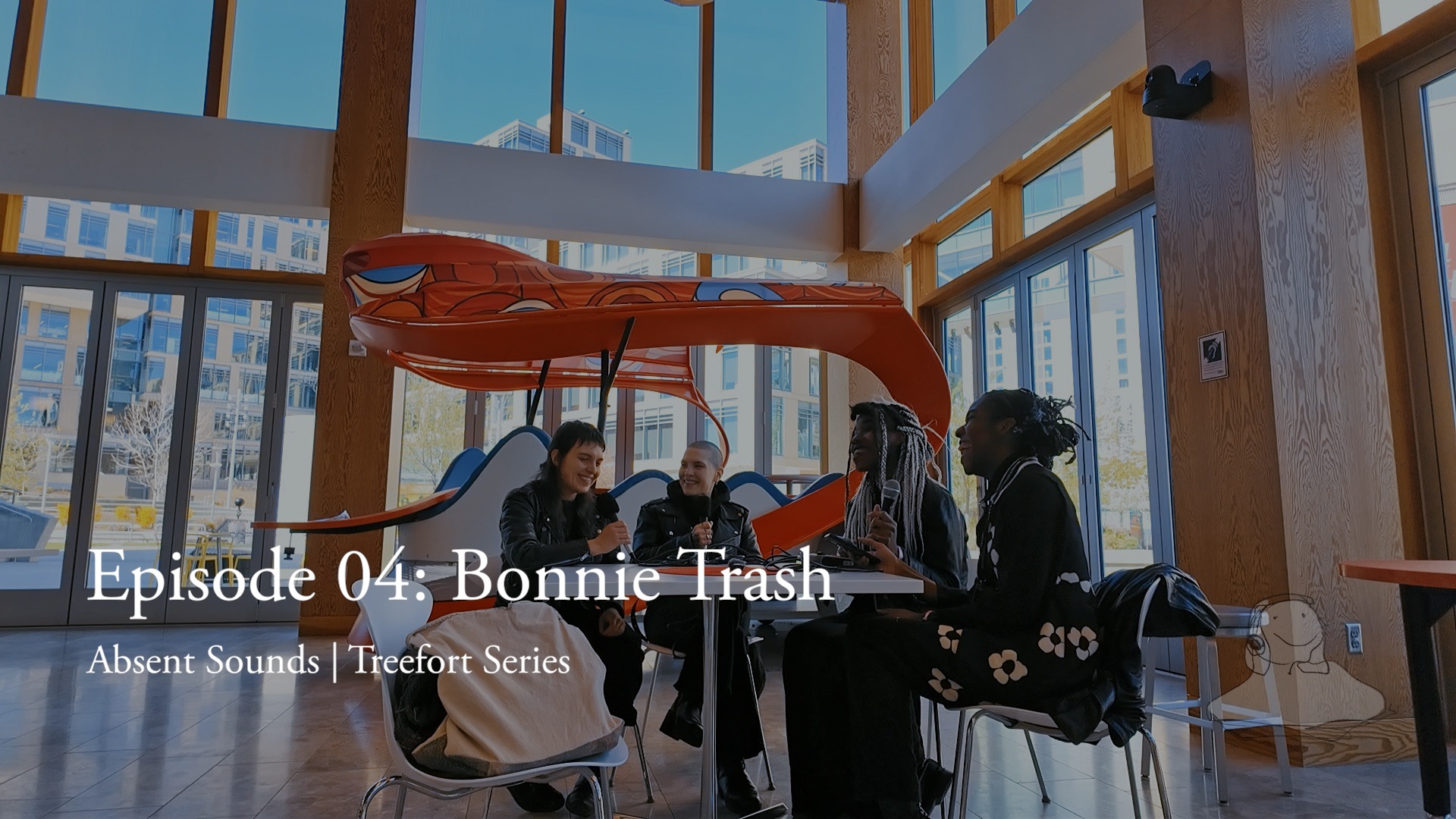
Bonnie Trash at Treefort Music Fest 2026
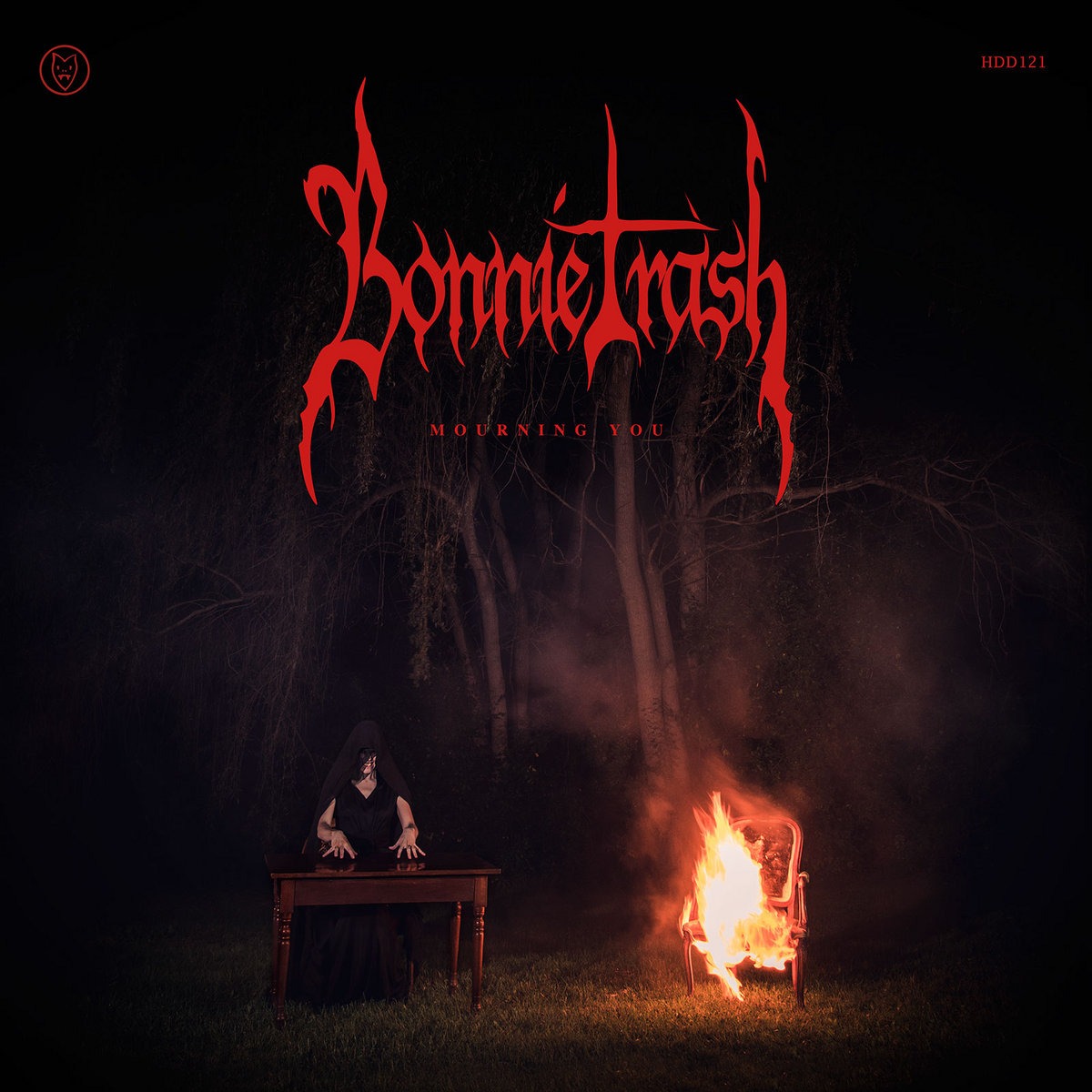
Emmalia and Sarafina Bortolon-Vettor are twin sisters and the co-creators of Bonnie Trash. Their latest record, Mourning You, was written in the wake of losing their Nona Maria — a collaborator, a storyteller, and a woman who had survived things they only came to understand later.
As we sat together at Treefort, we talk about grief being a co-creator. About the cloaked figure that appears in their music videos. About their Nona's stories from Bassano del Grappa in 1946, and what it feels like to finally understand the weight of them. About what it means to be a lifelong witness to another person — as a twin and musician. Does that translate to codependence or something rarer?
Emmalia: Hi. My name is Emmalia, a.k.a. Emma. I am the guitarist for Bonnie Trash, and I co-write the songs with my twin sister Sarah.
Sarafina: Hi, I'm Sarah, also known as Sarafina — both are totally fine. I am the singer and co-composer of Bonnie Trash. And yes, we are twin sisters.
Absent Sounds: This is our first interview with twins, I think. I always find it interesting looking at how trust evolves, not only between sisters or twins, but translating to other people outside of that. Because it feels like for us there's such an inherent trust that is formed. And it's hard, because we assume that's going to automatically translate to others. And when it doesn't — when they don't show up in the same way — the bar feels too high. How does that translate into trusting your bandmates, your producer, other people who help you make music?
Emmalia: I very much feel what you're saying about the bar being set high on trust. And I think the difference is in that level of forgiveness. In knowing that you're in a state of being with somebody, and your state of being isn't fixed. By having such a close relationship, it's understanding that you're going to be a different person in five minutes, in ten minutes. And there's space to reconnect, especially after conflict. If you're disagreeing on ideas, there's a sense of trust in knowing that you're going to be okay again. That's where I'm at with that.
Sarafina: Trust is such an important thing you've brought up. And giving each other grace is super important. But also — Emma has seen me at my worst moments. My absolute worst. To myself, to others, to my sister. And vice versa. But has also seen me at my best. That inherent trust comes from being able to be next to that person and say, I'm here for you through the good times and the bad. When you have been the worst, but also the best. It's a special connection that can be really hard to explain to others who don't share the twin experience. And when it comes to our bandmates — they're just the absolute best. Wonderful friends, incredibly supportive. We've even seen each other at our worst moments and we're all like, actually, I love that about you. So it's not only acceptance, but just having a lot of love and being kind to each other through the good and the bad.
Absent Sounds: Music is also witnessing you at your worst and your best moments. There's such a love give-and-take with it. Even though it holds space, it's taking something from you at every point. What was it taking from you to make Mourning You?
Emmalia: I think what was being taken — or accepted, really — was sounds and moments of rumination where I truly missed my Nona Maria, who was this major pillar in our family. And our collaborator too. What was being taken was that sense of grief. But I don't feel a loss from it. I feel like something was accepting my intense feelings without judgment. Sonically, the recordings were places for me to express really intense moments, with no judgment and no set capacity.
Sarafina: Grief is such a difficult but necessary thing in our lives. Mourning You — the lyrical content, the compositions, the stories and concepts behind the songs — it was a way to use the horror genre to not only confront grief, but accept it as something that can be very beautiful. Out of grief comes love. And although Mourning You is a heavy, dark record, at the heart of all of it is love. It's about loving someone so much and wishing they were there, wondering where they are. It was a really wonderful time to make that record. It was also incredibly difficult. But I know it was necessary.
Absent Sounds: We have such a love for music that goes into those places and doesn't look away.
Sarafina: I love that. Thank you.
Absent Sounds: Did you recognize what you were working through while you were making it? And I'll also add — there's something interesting about writing a record full of grief for someone who won't be able to receive it. How was that for you?
Sarafina: I think maybe she has been able to hear it in certain ways. Our Nona was such a pillar and collaborator on our first two records. The first record, Occhio, was very much a summation and archive of her dialect — her Trevisan dialect — and a way to preserve her horror stories, both real and supernatural. Mourning You is the grieving of her. But I think she lives on within those stories. I can hear her voice saying, this is very scary, why did you do this — but also, I like it. I think she has heard it in some sort of way.
Emmalia: Sonically, I knew what I wanted to do from a process standpoint. I wanted to process my thoughts not with words, and have specific noisy sessions with my guitar and layer them. But in retrospect I keep thinking about this character Sarah and I created in a lot of our music videos — this cloaked figure. Who is at the table and waiting. Who we're running away from. For a period of time I thought, okay, this is a connecting point. Something or someone that can bring us to another dimension, but you have to give something up for it. But I'm also realizing this figure was the receiver of our thoughts. The retrospective of the creatures you create and realizing there's so much more nuance to it. The processing of grief was a desire for this humanoid form — a gatekeeper of this space, this dimension — to be able to accept our thoughts, our grief.
Absent Sounds: It almost sounds like grief was a co-creator of the work, along with your Nona and everyone else who had a hand in it. Were there other intangible things that really shaped how you put it together?
Sarafina: A grief co-creator. I really didn't think about it in that context, but you're so right.
Emmalia: I'm going to be thinking about that for quite some time. It's the replaying of conversations with family. Trying to piece together an understanding of someone when you didn't know them. Trying to think about how their choices and decisions were sometimes the heaviest decisions they had to make. I keep thinking about why our Nona left Italy, and why she was upset when she had to come back. In 1946, 44 people were hanged from the trees in Bassano del Grappa as part of a campaign to intimidate anti-fascist movements. When you go there now it's called the Street of Martyrs, the Path of Martyrs. It looks beautiful. But I only realized after the fact, in writing this record, that when she was 16 years old, that is what happened. Her parents told her to stay up in the hills with her siblings and don't come back until we tell you it's safe. That story seemed like small lore when I was younger. And then you realize — no, this woman lived a significantly different life. And the stories she told us had so much more weight than we had imagined.
Sarafina: And looking at how I was moving through grief as well. How I was acting, how I was being around my sister, my bandmates, friends, family. Reflecting on yourself and how you move through grief is also one of those intangible elements. And there's a lyric on the record — I wish I knew you better. I wish I had more moments. I wish I knew my Nona better. Maybe I missed out on some story or some advice that could have brought me more insight into her life. Our Nona also encountered supernatural situations — stories she believed, and that were hers to believe. Those moments of horror in her own life. Those stories are as real as any other kind of history.
Absent Sounds: What you're describing about visiting a place and finally understanding the stories you'd been told — we went to Liberia for the first time last year, where our parents are from. And it's not until you actually go there and see it — and realize, oh, there are people who are amputees from the war — that the stories become real. And you wonder: do I really know my parents if I've never known this whole part of them?
Absent Sounds: When you meet a new friend — what would they have to know before you're okay with them saying, I know Sarah, I know Emma?
Sarafina: To know me is to understand that although we write heavy, dark music and delve into dark subject matter — at the end of the day, I like to be a pretty positive person and act with kindness as much as I can. There's a stage persona, and I very much understand that. But that's one part of who I am. I would hope that if somebody said they know me, they would know that I care. And I'm pretty positive, even though I love heavy dark music.
Emmalia: I think it's levels of comfort in the amount of vulnerability you want to give to somebody. And as you work through things with people over time, your vulnerability, your choices of how you can share yourself — that tends to expand.
Absent Sounds: You know what's funny? Every time people meet me and don't meet my sister, I automatically feel like you don't really know me.
Emmalia: Yes. I used to think that was codependence. But part of me just thinks — do you know how amazing it is to have a lifelong witness with you? I've witnessed that person from square one. There's no hierarchy of age other than a few minutes.
Absent Sounds: I want to tie back to the album. Is there a moment on Mourning You that feels like you're figuring things out?
Sarafina: Someone answered this for me recently — an incredible artist and musician from Toronto named R Flex. She said, Haunt Me, What Have You Become is the thesis statement. It ties everything together. And I was like, yeah, you're absolutely right. That song is the North Star. The lyrics are very simple, but there's so much weight: What have you become? Where are you? Will I get to see you again? But also the comfort of knowing you'll be connected in some sort of way.
Emmalia: I still see it as a question. And a question always gives time for a response. You can continuously ask the same question and the response is going to be different. That's where I'm at with it.
Absent Sounds: Does it end with a period, a comma, a question mark? Or do you keep digging?
Sarafina: I think What Have You Become is very much more of a statement than a question. It's a very simple line but there's a lot of weight to it. I hope it brings comfort. Helps people bring themselves some sort of peace or love and self-reflection.
Emmalia: I still see it as a question. A question always gives time for a response. You can continuously ask the same question and the answer will be different every time. That's where I'm at with it.
Absent Sounds: As you go on stage and leave everything for us to pick up the pieces of — is there something you want to leave as a resounding final thought?
Sarafina: Stage persona can be so different from who you are in real life. Someone once told me I should be the same person on stage as off stage. And I was very taken aback by that. That energy will stay at the stage. On stage, I really want people to feel empowered. Feel powerful. Especially femme and queer people. You can feel this powerful too if you want. Walk away and do some kickass shit. You don't have to smile.
Emmalia: Heavy music is catharsis. It's such an honor to be on stage and for people to feel that through the music we make. That is the magic of creativity. And a show is about everybody — not just the band. The audience, the bartenders, the sound tech. Everybody is resonating. It takes an entire team. And what an honor it is to be in the same moment in time together.
Sarafina: Yeah. It's neat.
Emmalia: It's neat.
Emmalia: Oh, I forgot to answer the first question — what am I working through right now. I've been processing tyranny, death, and the sound of tectonic plates as the hospice that is needed to transform this world. That's what I'm really thinking about lately.
