
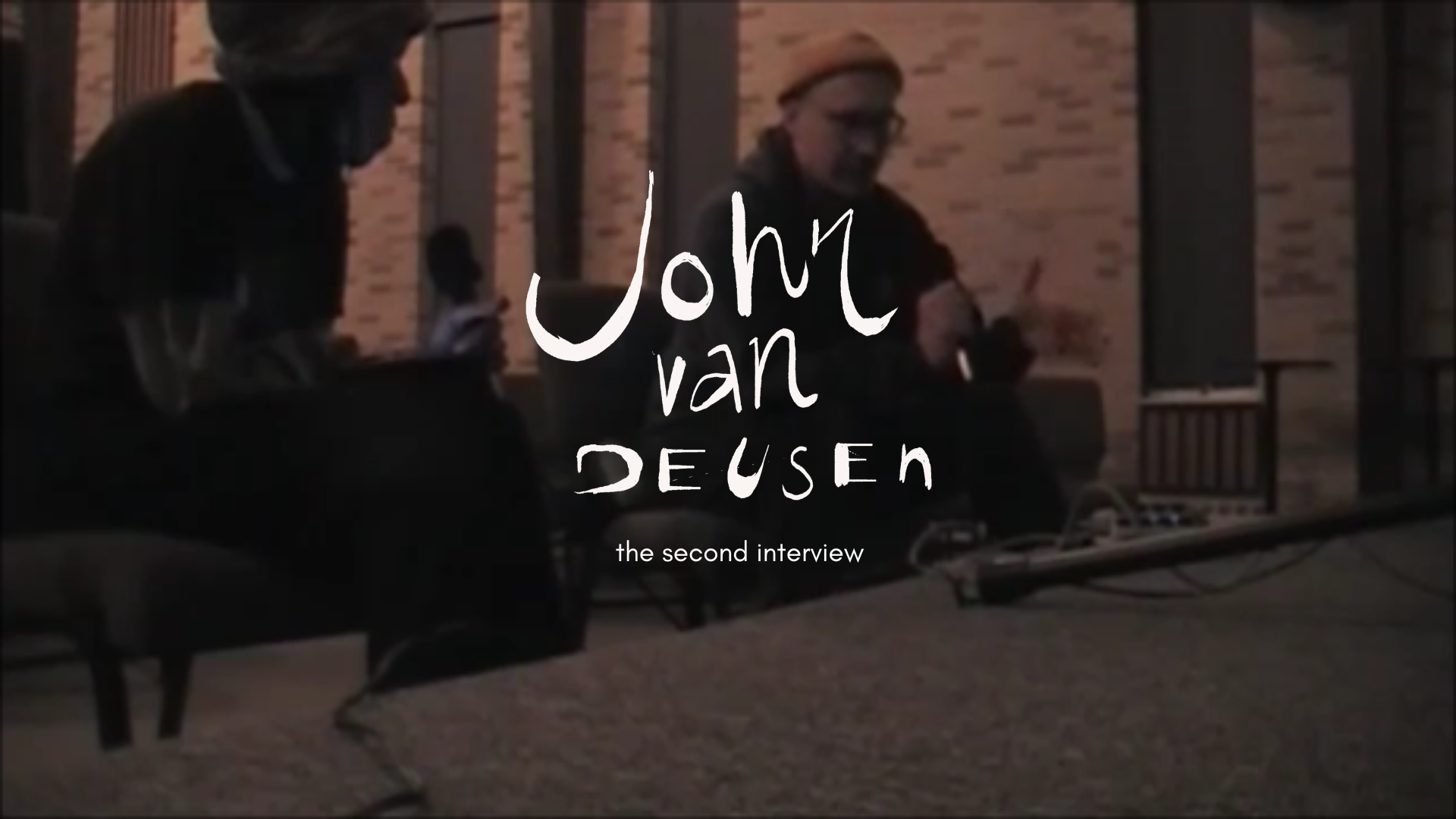
It's been four years since our first conversation with John, and this time we catch him in person during his stop in Madison Heights, MI for his Midwest tour supporting his new record. A lot has changed in four years, but the comfort his music brings his listeners has not. Unlike his other records, Joyful Noise is his most explicitly worship-focused project—yet it was the one that almost killed him to make. We talked about creative exhaustion and surrender. About the "embarrassment" of being a Christian artist. About bringing your anger and sorrow to God and a suffering savior who knows.
Absent Sounds: Welcome back John. It's been four years since the last interview we did with you.
John Van Deusen: Wow. Has it really been four years?
Absent Sounds: 2022 was when we did that one.
John Van Deusen: That's amazing. It's good to talk to you again. This time in person.
Absent Sounds: Yeah, we're live and in person — well, not live, but in person. So I guess the first question jumps off of that. How have things changed for you within those four years — three big points?
John Van Deusen: I had a second child. So I have two kids now. That was a big change. I left the job I was in at one church and I didn't think I would continue doing church work, but then another church offered me a job. So now I'm a music and arts director at another church. And I just think, at my age — I'm 38 — from 34 to 38, it feels like a long time. A lot has changed. I definitely feel more mature and aged, like in a good way maybe. More patient and kind, maybe.
Absent Sounds: That's interesting. I was going to say, I don't know how much more kind you could be.
John Van Deusen: When you're a parent and you're married, those relationships can draw out the best in you and the worst in you. I've been married 15 years. Having the second kid — that's what I mean, like more patient, more kind. In those situations that draw the worst out of me, I think I'm beginning to mature in ways that I've been wanting to mature, which is really cool to see. And I don't really take credit for it, but I do think with age it gets a little easier, I hope.
Absent Sounds: Yeah. I appreciate that you said that. Things feel fast — at least 21 to 24 seems like it went by really fast, which is scary because I'm like, oh, now I'm going to be 30 next. That always feels like you're spiraling towards the light.
John Van Deusen: I do think that as you get older, your perception of time changes. When you're young, when you're in your early twenties, especially if you're busy and ambitious and creative, it makes sense that it would feel like a blur. But life feels like a year goes by quicker as we get older. Maybe you'll have a recalibration at some point in your mid-twenties where the clock will slow down a little bit for you. Do you like life being fast?
Absent Sounds: No, I don't at all. I feel like everything is gelled together. I can't remember the difference between this year and three years ago. It really hit me when my brother turned 21 in December and my sister showed me a picture of us when we were 21. I was like — but that was like, everything was happening, and I felt like I'd been that age forever. So it feels like everything is just one big jumble.
John Van Deusen: That's really interesting. For me, my twenties feel like another life. I can look back and think about the things that I did and what I experienced — it really does feel like a lifetime ago. Maybe we'll do an interview in four more years and you can tell me how you feel. I'll be over 40.
Absent Sounds: Oh gosh.
John Van Deusen: I don't think I'll be touring. The US will have annexed Canada by then.
Absent Sounds: One thing that has changed since then is you have been releasing new music, which is always a blessing. But you put out like three different albums since then. The one I wanted to pick at today — this one is definitely the most worship-focused, it is worship music.
John Van Deusen: Yeah.
Absent Sounds: I remember in our first interview, one of the interesting things was — whenever I introduce people to you as an artist, especially Christian friends, I'll be like, oh but yeah, he's Christian, but also this other stuff too. And I think part of that is not embarrassment on your part, it's embarrassment on my part sometimes. Like I can be almost embarrassed to say, listen to this Christian artist. And I guess I was thinking about the self-consciousness — you mentioned it in your Bandcamp description for the album — about making Christian music, especially growing up in the indie scene or being surrounded by other musicians. So how do you let yourself sit in the embarrassment or sit with this self-consciousness and not try to escape it?
John Van Deusen: Wow, that's a really good question. When I was younger, like when I was your age, I was really embarrassed by Christian stuff. And I wasn't really a Christian in a lot of ways — I distanced myself from it culturally especially. But the love of Jesus has meant so much to me, it's been such a visceral thing in my life. It's like a friendship. And there's this feeling of — when I first started releasing Christian music, I was so scared I was shaking. Because I knew what would happen. I knew my peers wouldn't like it. I knew that they would talk shit about me and I knew that they wouldn't wanna play shows with me anymore. Work with me.
Absent Sounds: Yeah.
John Van Deusen: And it's true. Not all of them, but a lot of them very politely distanced themselves. And at first it really hurt and sometimes it still does. Because even if I release just a standard indie rock record, they don't listen. Even if it's not Christian, they don't give it the time. And that's just because our culture is really bad at seeing nuance. Things can be true.
Absent Sounds: Nuance.
John Van Deusen: Yeah, exactly. There's no nuance. And I think now, at this age, it's just — yeah. Basically for me, it's not embarrassment anymore. I just get a little sad. So maybe with age that's changed. I do get a little embarrassed if I'm sitting on a plane next to somebody who's wearing like a Cure t-shirt or some punk band I love. I'm gonna talk to them about it. And inevitably they're gonna ask me what I do. And then I'm gonna have to tell them I write songs and play music. What type of music do you play? And I always pause, because I don't really wanna say — yeah, I make indie rock and bedroom records about Jesus, I guess sometimes. It's really hard to explain. So I still do get a little embarrassed, and it's usually when it's somebody I don't know who likes the type of music I like.
Absent Sounds: You know what they'll think.
John Van Deusen: Yeah. And you can probably relate to this because I know you have really good music taste and you listen to a lot of secular music. And I think I just don't listen to Christian music. So when I do get to connect with someone over the music I love, it's whatever — punk music, lo-fi music — and I just do get a little embarrassed. Especially because in our culture right now, it's not a great time to be a Christian.
Absent Sounds: Yeah, I guess it's like never a great time.
John Van Deusen: When the Roman Catholic Church ruled the world, it was a great time to be a Christian — it was actually a really bad time to be a pagan. The Conquistadors were landing on South American shores and annihilating indigenous people in the name of God.
Absent Sounds: This conversation took a dark turn.
John Van Deusen: This conversation took a dark turn.
Absent Sounds: I really relate to that. I notice myself doing it a lot too. The way that I articulate myself about the music I listen to, or the reasons I'm drawn to certain things — if I talk about Sufjan to someone, I'm not gonna talk about why Illinois is my favorite record because of the themes I love so much about it. There are certain things you shy away from even when you're connecting with someone over something, which is a bit sad.
John Van Deusen: But you know what? It's really good when you find moments where you're not embarrassed and you just talk about it because it's just who you are. And those are really good moments. I actually tend to have those moments more with my non-Christian friends. I feel safer with them than I do with strangers.
Absent Sounds: Strangers, or like acquaintances — I find that difficult too.
John Van Deusen: You know what? It's actually a bad time to be an American. Because of Trump and because of the way that our government is treating the world. I was talking with my good friend who runs an international distribution service for a lot of really amazing indie artists. And he was saying in the last few weeks he can tell that people are just annoyed with him because he's American. And that sucks. It sucks when you're guilty by association.
Absent Sounds: Jumping off of that — you mentioned stepping away from social media. But there was a post your team made asking people to talk about how the album has affected them. And what struck me is that it's hard to ask people to encourage you or pour into you when you need it. What kind of life-giving things are you trying to put into your heart lately? How have those encouragements from other people been filling you?
John Van Deusen: Yeah, that's really interesting. Actually — wait, is it hard for you to ask for help or encouragement?
Absent Sounds: Before that — is it hard for you to ask?
John Van Deusen: No. Maybe for encouragement specifically. I don't know if I ask for encouragement. But it is not hard for me to ask for help — I was raised in a family that's very straightforward, just say what we need. My wife was not, so we clash a little bit. But when people come to my shows and tell me really sincerely what the music means to them, I've been really encouraged lately. Because I've been hearing a lot of people say, I can't find Christian music I like and I've just been trying to hold onto my faith, and I've been going through a really hard time, and for whatever reason your music has been the through line. When people say that type of thing to me, I feel so sincerely honored and encouraged. Because it feels like I'm making a difference, even if it's in these little ways. I guess the term coworking comes to mind — if the God I believe in is real, and I believe he is, I've had this extreme privilege of coworking with him. And so when people share their stories with me, it's just astonishing. When I was younger it didn't mean as much to me because I was really prideful and my music was just a vehicle for my own ambition. But now it means a lot to me. And then just little tangible life things — like when my daughter lets me put her to sleep, even though she prefers her mom. That encourages me in a way I can't even explain.
Absent Sounds: Little things. Yeah. Weajue went to Audiofeed and she saw you and Champagne earlier this summer. One thing she noted that you mentioned during your show is that writing the album almost killed you — it almost felt like you were a mad man piecing things together.
John Van Deusen: You want me to talk about that?
Absent Sounds: Yeah. What was it like? And also, how is your experience working on part two?
John Van Deusen: It's not an exaggeration that this project — the Joyful Noise project — has cost a lot. It's been really taxing, taken a lot of time and thought, and I've spent so much of myself trying to piece it together. I have struggled a lot with my mental health while doing it. There were times where I was wondering if I was approaching some manic episode. It really has felt like a weight. Even the visual art has taken me so much time. My wife would tell you that pretty much anytime I have any creative energy I would be sitting there collaging, and she'd look at it and the kids would be running around. And I would usually say out loud, I really am ready for this to be done. I don't know why it took so much from me other than that it's just a big project. There's a lot of songs and a lot of mixes and parts to fix — it's a heavy lift. That's actually probably one of the reasons why I want my next record to just be me and a guitar. It needed to be a lighter lift. And also, the songs I wrote during that time, a lot of them are about being depressed while recording this one. So I just needed it to be over quicker. It's such an honor to make art that people care about. And even if my audience is smaller, the people who do pay attention seem to be really keyed in. But yeah — I'm wondering if one day I'm gonna finish a project and just know that's the last one.
Absent Sounds: Wow.
John Van Deusen: I'm hoping I'll know — okay, I'm done. I'll do something else.
Absent Sounds: That reminds me of Ocean Vuong. I was listening to an interview and he said he's just looking forward to the day where he won't be a writer anymore. He's like, I'm just looking forward to not writing. It's crazy.
John Van Deusen: I love that. It's very Daniel Day-Lewis. I just love that he said okay, I'm done. And he came back for one film with his son or whatever, but I really respect it when people know themselves well enough to say, oh, I'm done.
Absent Sounds: Even just you talking about the whole process reminds me of this quote — I feel like I'm running my tongue over the socket of a rotten tooth. Going over the same ache again and again. I need to be released from it.
John Van Deusen: That's a wild image.
Absent Sounds: I loved it. Because I feel like that's what I do sometimes when I keep going back to the same spot, trying to explore it more. But I did wanna jump in — we won't have time to play the whole album, so I'm going to jump through three songs. Can I ask you about them? I want to start with "Answer Me God," because I feel like all the lyrics could have been pulled straight out of my journal. I used to think I could forgive a God who did not see the pain that I was in more than a God that was watching me be in pain and not doing anything about it. And in the song, you're still wrestling with the idea — how long, oh Lord, till you restore? What's behind that?
John Van Deusen: So I think what I'm saying there — I'm speaking to my God who, for reasons I don't really understand, decided to go through a lot of pain and suffering. Which is just a really wild idea if you stop and think about it. And I think the humanity of Christ comforts me. The fact that he was probably made fun of when he was younger, or bullied, or hurt physically and betrayed by friends. He's a man of sorrows. I love that title for Christ. So in the song I'm speaking to the Father — answer me God, what will it take for you to listen to me and speak to me — and then I'm changing my focus from the Father to Christ, who is interceding on our behalf. And I don't think Christ, when he went to heaven, lost his humanity. So I find a lot of comfort in Christ being somebody who understands my pain.
Absent Sounds: Ohhh.
John Van Deusen: My friend and helper. I know that — you know how I feel, what it's like to be sad or angry. Even his prayer in the garden — this genuine human moment of I don't wanna do this. And that's how I've felt in moments of deep depression. I don't wanna do this. I really want you to heal me and I know you can. And that really pisses me off. But I feel enough comfort with God that I can tell him that. I wanna honor him and I wanna fear him, but I also know that he's not afraid of my anger. I'm not intimidating him. So I just try to remember those things and it liberates me to be able to speak that way to him. If this reality was made with purpose and the God who purposefully allowed pain — I don't know if there's ever really a way around it, but part of me wonders if we're not supposed to understand it, and we're always supposed to be struggling with it.
Absent Sounds: I guess I'm curious what verses you go to when you're wrestling.
John Van Deusen: I go to the Psalms. A lot. My Bible is underlined in the Psalms to such an extent that every page has something. What I do habitually now is just open to the Psalms and read what I've underlined, then go to the next thing and read what I've underlined — and usually that does the trick. I take a lot of comfort in the Psalms. I take comfort in Ezekiel. I take comfort in prophets who are kind of angry that they're a prophet.
Absent Sounds: Even just you mentioning Jesus being in pain — it brings it so close. It's a strange thing to wrap your head around, a deity being in pain. But what I think is powerful about it is that no matter how deep the pain we're experiencing, it's like Christ's is deeper still. The idea that I will never have to experience pain at that level because of his sacrifice. That brings me comfort. And the closeness — where does that closeness come from for you in that song?
John Van Deusen: I think in order to get close to someone, there's a vulnerability — you're at risk and you have to open yourself up to it. And I probably don't do it enough, but meditating upon what Christ went through and who he is, and coming close even in the aspects of his story that are uncomfortable, that I don't understand. I was trying to find language that would explain how miraculous it is that there would be a God who would want to be that close to us — so close that I can hear him whisper, so close that I can lean my head upon his shoulder. You don't rest your head on just anybody. And that's what I want more than anything, to be close to him and to be his friend. I can't hide from what he went through. I don't meditate upon the cross as much as I should. But yeah — that song originally had a different chorus.
Absent Sounds: What was it?
John Van Deusen: It was something about coming boldly into the Father's presence. And I ditched it. I didn't like it. And then I wrote this song with David Leonard — do you know David Leonard?
Absent Sounds: Yeah.
John Van Deusen: He's the one who wrote the chorus. He wrote it so fast. He just heard me play the verse and then he said, how about this? It was really special. So I didn't even come up with "there's peace like a river and healing in your eyes." I like that — healing in Christ's eyes. But I'm so tired right now I don't even remember what you asked me. I'm just remembering what it was like being with David Leonard that day. He bought me barbecue. He was nice.
Absent Sounds: You know what's so funny? The next question we have for you is about exhaustion. It's for "The Prayer of Surrender." When you're exhausted with yourself or by yourself — what does surrender look like? Is it active or passive? Is it a fight, or a collapse, or giving up?
John Van Deusen: Wow, that's a good question. For me, surrender is acceptance. Accepting things about my reality that I wish were different and finding a different perspective on what I'm going through. It's like a holy indifference. Surrender is like — I'm so tired of managing my sin, I'm so tired of trying to change things for myself. I'm exhausted, I can't carry it anymore. And there's just this —
Absent Sounds: I don't wanna say resignation, but —
John Van Deusen: Yeah. It is a collapse for me. Not a total collapse, but just — I don't care anymore to try on my own. But I love that place. Like in the making of my record I got to that place where I was just like, Lord, I can't. I actually don't have what it takes to finish this. So you're just gonna have to make it happen. I think it's a really good place to be. It doesn't mean I don't care or I'm apathetic. What it does is — I'm so tired, I'm forced to trust him.
Absent Sounds: Yeah. And it's not in your strength anymore either.
John Van Deusen: Yeah. And then I'm really happy to pass it off. That's a really interesting question — active or passive. When it comes to surrendering, it seems like it's both, is it not?
Absent Sounds: Yeah. I think about passively doing things — the connotation is always bad, like you have to be active in every part of your walk. But honestly I do feel like sometimes a lot of the work comes when you're not working. It's what it's doing to you rather than what you're doing to it.
John Van Deusen: That's really interesting. Spiritual formation — we're being shaped and formed by everything. Maybe it's just a spiritual paradox. Sanctification is an active and passive thing at the same time.
Absent Sounds: The last thing I'll ask is about "Never Let Me Go." I love the end, when you say — you never let me go, you never — but the more I let go —
John Van Deusen: The more of your heart I see.
Absent Sounds: Yeah. So I'll end by asking — what are you letting go of in this season of your life? What does letting go look like right now for you?
John Van Deusen: I'm letting go of a lot right now. I'm letting go of my music needing to be what makes me money. And I'm letting go of forever wondering if it's finally going to work. Because I'm very satisfied as an artist and have been for a long time, but I've not been satisfied as an artist who needs money to keep going and feed my family. I'd much rather just be satisfied as a creative than somebody who's making money from their art. So I think I'm just letting go of that. I've been making music for 20 years and I've had a lot of near success, but not a lot of true success. And I'm just finally, after so many years, letting go of wondering if something might happen to make my music known by more people. And you gotta understand — I've been playing shows for a long time. Usually when I play shows, people say really nice things to me. And I'm always like, how is it that people say these things to me and I'm still such an unknown? But I genuinely think I've been letting go of that in a good way. I'm so tired of wondering. Letting go of my hope to move and live somewhere else has been really hard for me too. I've lived in the same place for 37 years. It holds a lot of triggers for me. And I've so desperately wanted to go somewhere else and it's just never worked. So letting go of that and saying to the Lord, I wanna leave — and then reframing my life where I'm at. Trying to think of how beautiful it is. Those are two things I'm letting go of. But I do like that lyric. You never let go of me, and the more I let go, the more of your heart I see. It's basically the paradox we were just talking about. There's a CS Lewis quote — I think it's, the more we surrender, the more truly ourselves we become.
Absent Sounds: Yeah. The idea that you're not losing yourself, but finding yourself. You're not really free until you are tied to God. It's not true freedom until then. People will say that you lose your personality when you become a Christian, but it's like — you become more fully who God made you to be when you fully surrender.
John Van Deusen: Yeah. I think I'm in a lot of ways a Christian mystic. And I actually think I can tell when someone is surrendered to Christ — I think it even shows up in the way they look, their demeanor. Have you ever been around somebody and you can just tell they're not living into who they're made to be?
Absent Sounds: I feel like it's — I think my eyes aren't as clear. I think a lot of times I notice when people are not living — I don't wanna say it's judgmental, but I think when you can see there's something that someone's being called to do but they're not doing it — that's what I can see sometimes.
John Van Deusen: I know what you're saying. Okay — I just have this crazy memory, we should end the interview on this. When I was younger there were certain circles I ran in, and some of them were into harder drugs. And I have this weird memory — some of my harder drug friends were saying that they'd seen somebody who knew them when they were younger, and that older person said to them: your eyes used to sparkle. Your eyes used to sparkle. And that's stayed in my brain. And I actually think there's something to it. When you're high all the time, it changes how you look in your eyes. But yeah — maybe when you're surrendering to God, who made you, and you're becoming more of your true self, you're sparkling a little bit more.
