
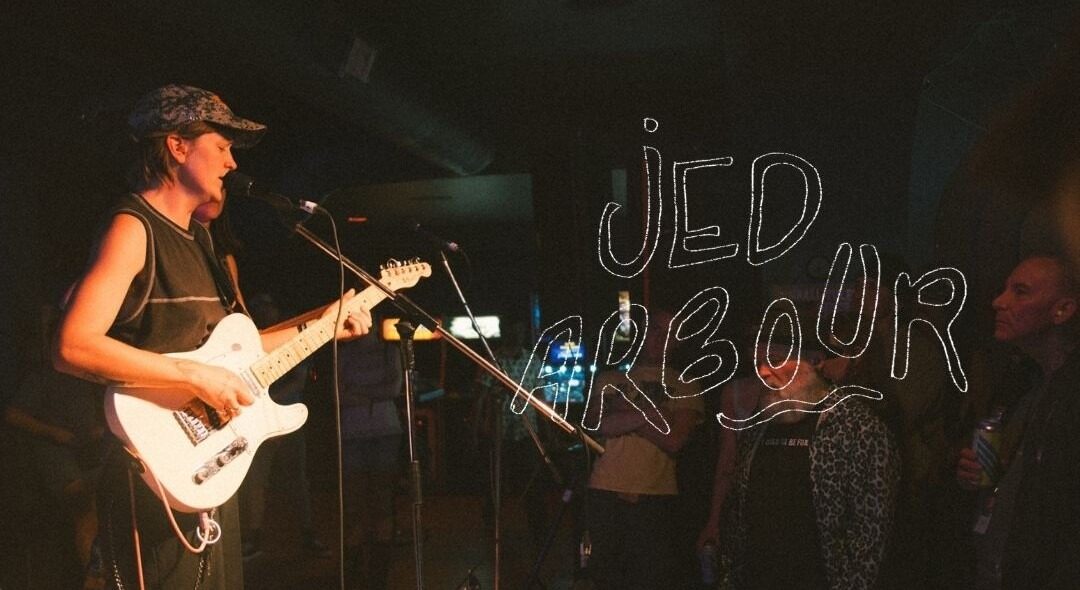
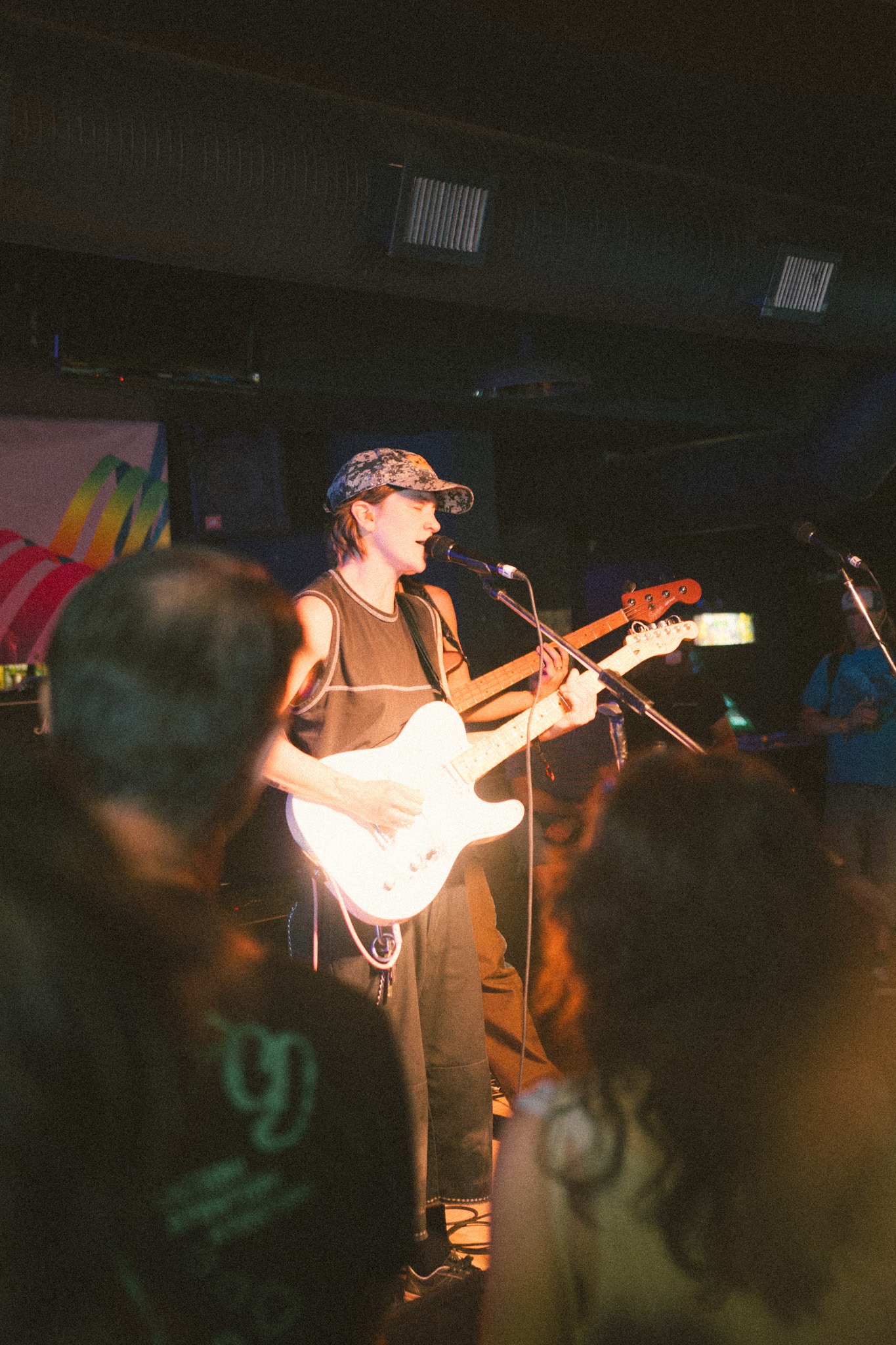
Jed Arbour at Sled Island 2026
Jed Arbour is a force to be reckoned with. We caught them in Calgary during Sled Island, a day after they played a set concussed — bucked in the face by their neighbour's horse, yet soaking in the magic from their favourite festival of the year.
Jed talks about their work as a therapist and what it means to walk toward pain instead of around it, moving to an unincorporated hamlet in BC, the naming of Disappointing Dog Park, a stolen clarinet that has turned into a kind of medicine for their concussion (give it to the horn!), and the unreleased album they wrote from two years on the frontline of Calgary's opioid crisis.
Absent Sounds: Welcome, Jed Arbour. We're here live in Calgary, talking to you at Sled Island. You already played a set here, and you're playing again on Friday.
Jed Arbour: Yeah.
Absent Sounds: I'll start off with general vibes — how are you doing out here?
Jed Arbour: Pretty good. I'm a little concussed, honestly — I got bucked in the face by a horse.
Absent Sounds: Oh my gosh.
Jed Arbour: So Sled Island — this is my favorite festival of the entire year, and I'm really trying to pull through. But I feel really dreamy and weird.
Absent Sounds: Stress. Coming out here when you're healthy is already hard.
Jed Arbour: I know. Real.
Absent Sounds: I'm excited for this conversation because we're going to talk about your self-titled record, but also Disappointing Dog Park, which — when I first heard it, the tone reminded me of a lot of stuff I love. I know you've talked about Slint before, and other post-hardcore adjacent stuff. But it also reminded me a little of Sister Ray. I don't know if you're a fan.
Jed Arbour: I've actually never listened to them, to be honest.
Absent Sounds: Oh my gosh, well, that's my recommendation for you.
Jed Arbour: Okay, perfect.
Absent Sounds: You've described your work as honest, filling, mathy, emptying music — there's such an interesting dichotomy living in that. How does your music fill and empty at the same time?
Jed Arbour: I feel like, as a person, I really walk toward the scariest thing possible. I like walking toward pain. If there's pain, I'm like, "okay, let's fucking deal with it." I'm a really direct, head-on person. So in my music I want to talk about the things that are really hard to think about, hard to talk about. And in that sense it fills you with a lot of feeling, but it also makes you feel kind of gutted. You can feel empty and full of a feeling at the same time — that's how I'd describe it.
Absent Sounds: I love that. I feel like that's such a hard place — when I feel empty and full at the same time, or full of an emotion, I want to escape it as fast as I can. But you seem to find comfort there, or settle into it.
Jed Arbour: Oh, yeah. I'm also a therapist, and one of the things I've realized in this world is that suffering mostly comes from avoiding a feeling. So I'm just trying, as much as I can, to sit with that feeling of empty, or full of stress, or whatever it is. Just sitting with it. And I think my music reflects that ethos — trying to witness something. I don't know.
Absent Sounds: Sitting in the seat as the witness. I want to know — beyond you being a therapist, because I'll ask a few questions about that too — has this always been how you are? Have you always been comfortable doing that?
Jed Arbour: Yeah, I've been giving fake therapy to my friends since grade nine. People would come to me and I'd be like, "yeah, let's do a therapy appointment." It was a fun thing for me. I've always been really interested in learning about addiction, mental health — I love that work. It makes me feel really alive. I've always walked toward that pain, for some reason.
Absent Sounds: You took some time off — school, in between now and your last release. What's the thing you feel like is going to come through your work now that you've returned?
Jed Arbour: I think I took that time off because the music industry right now is so hard to penetrate. It can feel like a rat race — like you have to produce, keep up with the grind and the hustle of putting out music. It's just so intense. And I was writing really complicated music at the time, and I got so burnt out on the hustle. I was like, "what am I doing this for? I'm not having fun anymore." So I paused for a good while. Coming back, I think I'm mostly prioritizing joy. It's so much fun to play music with the current setup of my band — it's just four best friends having the time of our fricking life every rehearsal. And if it ever stops being fun, we just say, "let's not do this part." It's a lot more based in joy, which is funny, because my music isn't very joyful. We're producing way more music now that we're just relaxed and not thinking about outcomes — just enjoying hanging out with each other.
Absent Sounds: Is that what you're nurturing for yourself these days — joy?
Jed Arbour: Joy, yeah.
Absent Sounds: I imagine work that comes from a deep, empathic place needs time to be nurtured. So I was wondering if being around your friends helps nurture the project — and you, personally.
Jed Arbour: Oh, so much. The band makes every bit of difference. If you have a good, fun band, that's basically all it is — it's so worth it if the band is fun. And for nurturing more generally — I recently moved to a small town in BC. It's not even a town, it's an unincorporated hamlet called Spillimacheen. I pretty much spend all my time alone — kayaking, laying in the grass, planting plants, hanging out with my chickens. I'm really chilling lately.
Absent Sounds: I've been talking a lot lately about wanting to move somewhere in the middle of nowhere — I'm tired of living in the city. Though I feel a little delusional assuming it'll be a lot better out there.
Jed Arbour: No, you're onto something. I lived in Montreal for ten years, and I got so burnt out with the city — in parallel with the music industry burnout. Living in a city all the time is so intense, and your priorities get so misaligned with your actual values. You romanticize living alone in the bush, and honestly, it is romantic — it's super beautiful. But it's lonely. There's not a queer person anywhere. It's just you, and a bunch of old, crotchety white people.
Absent Sounds: You're holding down the population.
Jed Arbour: Yeah, it's pretty weird. But you can come to my ranch anytime. Honestly — I'm trying to make a queer commune. If anyone hears this, hit me up.
Absent Sounds: No, that's incredible. Genuinely.
Jed Arbour: Okay, my brain is so fried right now, I don't even remember what's on that album.
Absent Sounds: Okay, I've got some of the songs written down. The two that relate to what you're talking about — earthy, grounded — are "Dirt" and "Bug." And "Reservoir" too. Is that a common theme for you?
Jed Arbour: Yeah, real, real. Definitely a common theme — I've been told I write about the body a lot. And definitely earth. "Dirt" — I remember writing that. It was pouring rain in Montreal one day, and I went for a run, and I was like, "I need to contemporary dance." So I went to this park and just danced for two hours in the rain, then went home and wrote "Dirt." That's amazing, I remember that about that song.
Absent Sounds: Did you get sick?
Jed Arbour: No. I don't know — probably.
Absent Sounds: I always feel like I'm innately drawn to water. Is there a reason you're always drawn to the ground?
Jed Arbour: Water is so obsessive for me too. I love swimming more than anything in the world — you catch me near any body of water, I'm in it. My biggest motto in life is: you never regret a swim.
Absent Sounds: Oh my — I've actually not gone swimming in a few summers.
Jed Arbour: What? Get your body in the water. The river here is so fun to swim in.
Absent Sounds: Can you actually go in?
Jed Arbour: Oh, yeah. That's basically all you do in Calgary — river swim.
Absent Sounds: Okay, I'm learning the Calgary lifestyle. What else should I do here?
Jed Arbour: In Calgary, Alberta, Canada — honestly, swim in the river, that's my biggest tip. Get a coffee at Beano, then go sit by the side of the river with a bunch of friends. You can meet homies here — Sled Island's the perfect time for it, everybody just wants to drink a beer by the river.
Absent Sounds: I've been here alone, kind of wandering around, bumbling.
Jed Arbour: No, straight up, come hang out with us. We've got no friends either.
Absent Sounds: I feel that. Thank you. Back to Disappointing Dog Park — what kind of disappointments were you carrying? Is disappointment a common sentiment for you? For me it's something I avoid as much as I can, almost like avoiding anger — I don't want to be disappointed about anything, so the title stuck with me.
Jed Arbour: I've actually never thought about this. I don't think I'm that disappointed as a person — I'm pretty forward-headed, I just charge forward. If I'm disappointed, I'll just change course. What happened is — when we lived in Montreal, Ripley and I walked by this dog park in Jarry Park. It's the worst dog park on earth. This tiny little square, all these sad little Mile End dogs trying to have the best time. I was like, "let's go to the dog park," and then we got there and I was like, "this is a disappointing dog park." I was pissed. And that's how we named the album.
Absent Sounds: Rightly so — they should rename that park.
Jed Arbour: Honestly, it's a dog hell.
Absent Sounds: Dog purgatory.
Jed Arbour: The record's also — I think that's the first time I really paid attention and thought, "oh, I hear a clarinet, and I love the clarinet." What's your relationship to the clarinet?
Jed Arbour: Oh, it's such a good relationship. A professional saxophone player told me yesterday that he loves the way I play clarinet because — he said, "you give it to the horn." And I was like, "oh my god." I'm actually really bad at clarinet, for reference. I found one at Value Village — stole one, actually — about four years ago, and got psychotically obsessed. When I get obsessed with something, you can't get me off it. I played it every day, everywhere, in the car — annoyed the shit out of people. Then I got over it for a while, and now I'm getting back into it.
Absent Sounds: I used to play clarinet in high school. Now I want to pick it back up.
Jed Arbour: Do it. It's so nice, it's like meditating — you're breathing so heavily, you're literally making love to the horn. I'm giving it to the horn daily. It's really nice.
Absent Sounds: When you're playing, are you conscious of what you're doing? I've heard people describe being on stage and having no idea what's happening — they come back to themselves after and go, "oh, I guess that's over." Are you really present when you play?
Jed Arbour: I'm so present. Honestly, it feels like chasing a high. I like performing so much, it makes me intensely present in a way I can't achieve anywhere else. A lot of our music is cued just by looking at each other, so sometimes I'll hold a riff for way too long because it feels so good. It really enthralls me. Crazy thing — I've been concussed for nine weeks, and last night I performed. I was so scared, I had to meditate all day because I felt like, "I have to perform tonight or I'm going to die." I hadn't been able to do anything. And then I performed, and it felt like it unlocked something in my brain — I felt like myself for the first time in nine weeks. I woke up today and I feel okay. I think performing is magical.
Absent Sounds: Maybe that's the key. I saw something once about a musician — I don't think it was a concussion, more some kind of brain damage — who was playing keys while they did surgery on his brain, and it calmed him. Something like that. I think music has that quality.
Jed Arbour: Also clarinet — my concussion specialist told me clarinet might be the best thing I can do for my brain, because you breathe so much, it brings so much oxygen to your brain. I could feel it. Playing every day was the only thing that gave me relief. It's crazy.
Absent Sounds: I'm glad you're — not just alive, but not permanently anything.
Jed Arbour: Yeah, not permanently — it was insane. Full back leg, bucked in the face by a horse. Pretty evil.
Absent Sounds: Is the horse still around?
Jed Arbour: It's around. Not my horse — my neighbor's. Evil little guy. Love him.
Absent Sounds: I like doing stupid segues, so — the horse sounds like a parasite, and you have a track called "Parasite." What, in your life, qualifies as a parasite? What are the requirements for something to earn that title?
Jed Arbour: Parasitic vibes. Great question. For this song, at least, it's something recurring — it sticks inside you. An emotion you cannot unstick. No matter how much you sit with it, it won't change. Or the emotions you're so afraid to look at that they have to stay stuck — because if you look at them, they do end up changing, but if you don't, they stick. That's the framing of the song: an emotion that can't leave my body, and how your body holds onto a story. If something touches you in a way that reminds you of the memory, you can literally feel it. I don't remember the lyrics off the top of my head, but it's about how the body holds onto a story.
Absent Sounds: I love the way you phrased that. What's a story you've recently had to let go of? You don't have to go deep — as general as you'd like.
Jed Arbour: I'm a therapist, so I'm going to go trauma-dark with you right now — what do you want?
Absent Sounds: I'm ready. I love it personally, but I know not everyone wants to go there.
Jed Arbour: Okay — what's hard to let go of. This one's actually kind of funny. The recent hurdle in my mental health journey has been realizing I'm actually bisexual, and not just a lesbian.
Absent Sounds: Do you feel ashamed?
Jed Arbour: This is crazy — ashamed? I might like a man. Kind of freaks me out. Anyway, that's my recent hurdle. Not trauma-dark, just kind of funny.
Absent Sounds: I feel like that's a big thing — I've heard people say it's scary.
Jed Arbour: Yeah. In the lesbian community, there are people who are like, "oh, we lost one." Honestly, I've felt that too — when you see a beautiful lesbian woman with a man, you're like, "come on, come back to us." I think there's a fair bit of biphobia, but I don't think it's some huge problem I need to make a statement about. I'm just, unfortunately, bisexual for sure.
Absent Sounds: And that's life. Moving on. I feel like the ability to just say "well, that's what it is, everyone else can suck it" —
Jed Arbour: Yeah. Shoot.
Absent Sounds: You talk about community a lot — is music an active part of community-building for you? How?
Jed Arbour: I think music can be the antithesis of community in a lot of ways, if you treat it as a competition — the Montreal music scene was very "scrap your way to the top, only one of us will survive." That energy is not for community-building at all. I wanted to learn how to not be part of that anymore, and lean into building something instead. Community is so challenging — everybody has such different views of what it means. I think my shows are where I try to build the most community — putting together bills that feature queer and BIPOC artists, really trying to bring the crowd in. I want it to feel like a gift of an experience, not "watch me perform" — let's all experience this moment together. What really inspires me is the hardcore scene — if you watch a crowd of hardcore kids, it's the most energy you can possibly summon in a room. Just witnessing a bunch of nineteen-year-olds freak out is exactly what I want all our shows to feel like — you go there to experience live art, and that's really hard to find in music.
Absent Sounds: It actually is.
Jed Arbour: It's so cool when everybody just lets loose — I only see that at hardcore shows, and I'm really trying to bring that into mine.
Absent Sounds: Your music feels like it could definitely do that. I'll end with one last question — what can we look forward to from Jed?
Jed Arbour: We recently wrote an album, last year — I was working as a frontline worker at shelters in Calgary, right at the front of the opioid crisis here. It was pretty fricking crazy — so many deaths, all the time — and there was this tension of working frontline in a province that's so anti–harm reduction. It was so much pain and horror. It felt like living in a horror movie for two years. So we wrote an album about that. It's honestly the most evil possible thing you could listen to — one forty-five-minute song, really explicit lyrics. I talked to my homie who works as a paramedic recently, and he said, "at your show, I had to cry, then leave, then go home and have a panic attack." I told him I was so sorry, first of all — but also, you know how painful that work is. The music tries to reflect the sensation of working in that tension — long, meditative songs that can get so evil-loud and then really quiet and introspective. It has a lot of range, but it's uncomfortable to listen to. We applied for a grant — if we get it, we'll record it properly and put it out. Since then we've also started a new album, maybe four tracks deep, that's way less evil — more back to the regular evil of Jed Arbour.
Absent Sounds: That's incredible. I can't wait to hear the evil vibes. It sounds like — not a good time, but a needed one.
Jed Arbour: A needed time. I think that comes back to the community question, too — so many people carry this feeling of how evil and painful it is to live through the opioid crisis. Having a piece of art to reflect that feels important for this moment. Not saying mine is the most important thing out there, but I think we need to start making art about it.
Absent Sounds: Yeah — all the pieces add up to something. Thank you so much.
Jed Arbour: My pleasure. Oh — look at this little doggy. Hi.
Absent Sounds: That was a good vibe dog.
Jed Arbour: That was a great vibe dog.
