
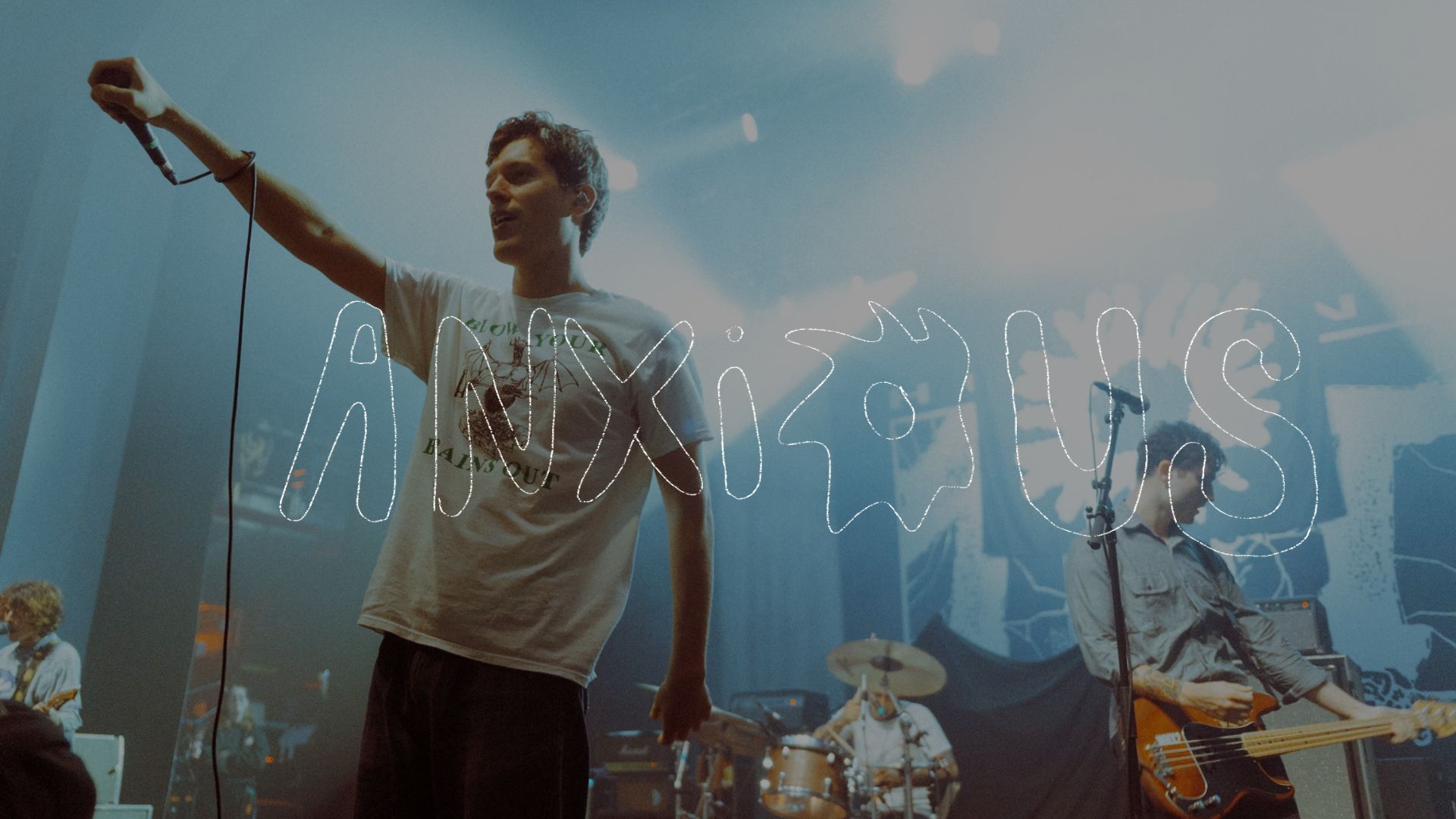
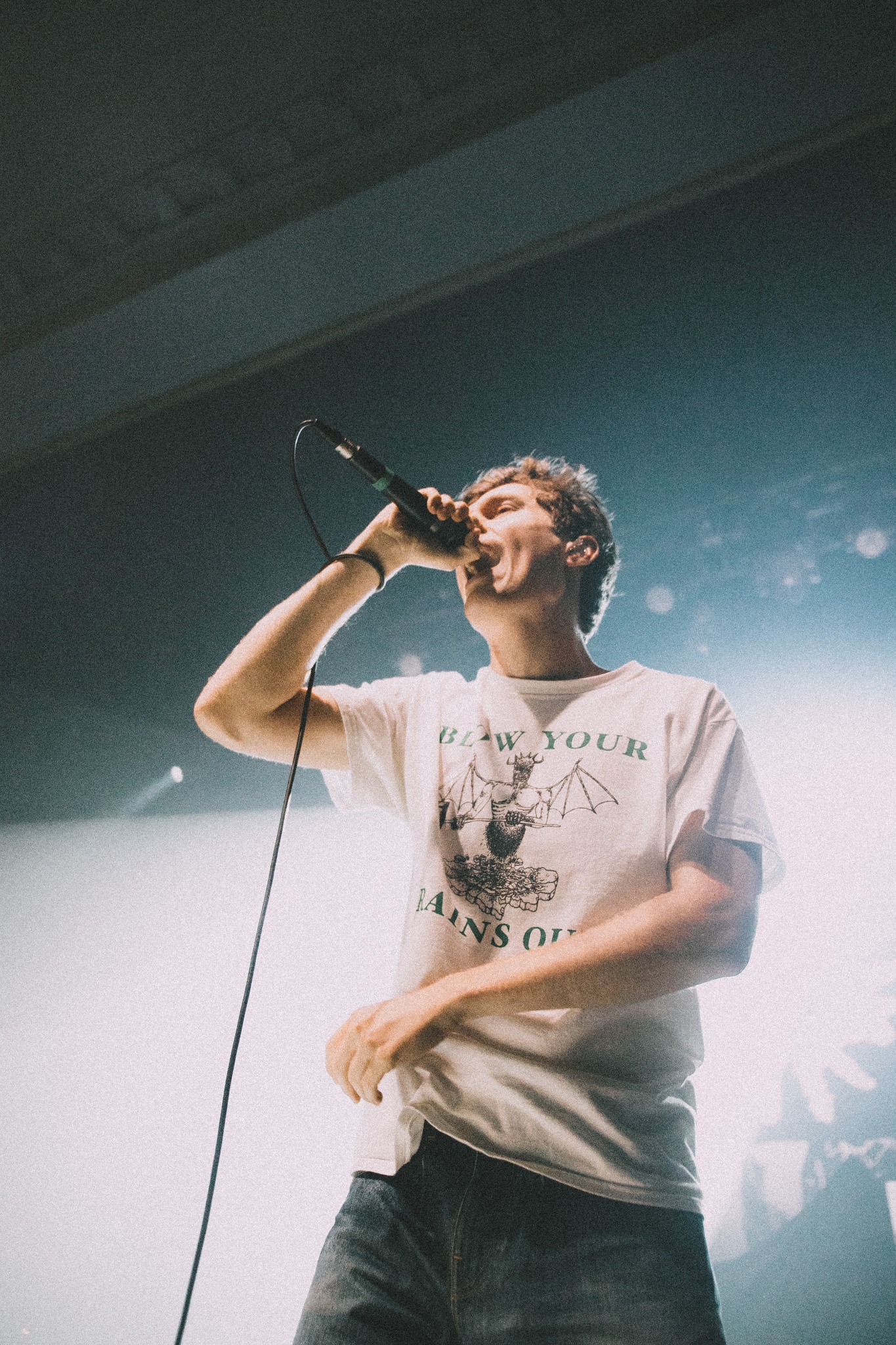
Photo of Grady Allen at the Danforth Music Hall by Weadee Mombo
This week, Grady Allen of Anxious joins to talk through Bambi, the band's energetic and grippingly expansive 2025 record. We get into optimism versus cynicism, the shame we carry and try to drown, our collective quarter-life crises and repair that run underneath songs like "Never Said," "Some Girls," "Head and Spine," "Sunder," and "I'll Be Around."
Absent Sounds: Hey. Hi, I'm Weadee. And I'm Weajue.
Grady: And I'm Grady.
Absent Sounds: And this is Absent Sounds on CJAM 91.1 FM and CJTM 1280 AM in Toronto.
Grady: Awesome.
Absent Sounds: Each week, we play through albums that we love. And sometimes we are lucky enough to be joined by the bands that make those albums themselves. Today is another special day, because we are joined by Grady from Anxious. Wow, sorry, blank, I was about to say Citizen. Anxious.
Grady: That would be cool too, if I was in Citizen.
Absent Sounds: He released one of our favorite records from 2025, called Bambi, and we are gonna be playing through it today. But I guess speaking about Citizen, a lot of the record sits between Little Greenhouses and Bambi. I was reading about how a lot of it was the difficulties of being a touring band and being away from people you love, but also kind of figuring that whole thing out. When you're with bands like Citizen, who have been in the game for so long, does it help you feel like this is sustainable? Is there any kind of knowledge transfer?
Grady: Yeah, I don't know. I think for a while maybe I thought a lot about the sustainability question, like bands as a business model, or something sustainable that you can do, and I try really not to think about that very much at this point. What I've felt very conscious of, being on tour with Citizen, is that they've been a band for a long time, and Anxious, last spring, turned ten years old. I think being in a band, in the way that we are a band, is a creative endeavor that's long-term, with at least right now no discernible end in sight, or an end goal. We're continuing to make music and to tour. There's not really some point of "okay, and we're gonna be done here." So I find myself really moved that Citizen is, you know, probably fifteen, maybe closer to twenty years into their career, and they are constantly creating things that are so different, constantly reinventing themselves. That's a group of people who have managed to stay focused and engaged and in love with the process of creating art, and I think that's actually a really hard thing to do. So I think that's really cool.
Absent Sounds: Yeah, and I also kind of love how the well doesn't run dry. It's encouraging to see that you can put your best work out and not feel afraid that you'll run out of ideas.
Grady: Yeah, no, I totally. I truly believe the record they just released, Halcyon Blues, is one of the very best records they've ever written. So yeah, they've certainly proved to be a band that keeps going.
Absent Sounds: For me, that makes me start thinking about the fact that there's so many different versions of yourself that are also growing along with the band, since it's been in your life for so long. Do you feel like you've found a way to not abandon those versions of yourself? Because there's that idea that the other paths you don't take, while you're on this one right now, maybe they're dying off, or the weeds are growing over there. How do you not abandon those versions of yourself along the way?
Grady: Abandon the versions of myself that have been documented, or the versions that haven't?
Absent Sounds: That haven't.
Grady: That's a good question. I think, well, in some ways, everyone in Anxious is also pursuing things outside of this one specific endeavor with music. So in a lot of ways it feels like we haven't had to totally choose. I went back to school and recently graduated, and was able to pursue that while doing this. Our drummer Jonny works very hard on a clothing brand with another person from Connecticut. Tommy's also in school. Dante and Sam, two other members, have consistent other musical outlets. I have a little bit of the privilege of being young, being twenty-five, I haven't been faced too much yet with the thing where because you choose one thing, other options close. I haven't been faced with that quite yet, in the way that maybe when you're thirty, or thirty-five, or forty, or start having children. I try not to spend a lot of time fretting over what the alternative could look like, and I just try to actively disengage with that at this point, and have faith in what I'm doing. So I don't know, I gave you a whole bunch of different answers.
Absent Sounds: There's so many things to pull from that too. Likewise, being twenty-five, quarter-life crisis, I guess. Not really, but if you did have a quarter-life crisis, do you know what kind of shape it would take?
Grady: Yeah, I definitely had a quarter-life crisis, from about twenty-three to about twenty-five.
Absent Sounds: It's an ongoing crisis.
Grady: So the quarter-life crisis, which I think I've made peace with now, started from the moment I was thirteen or fourteen. I was obsessed entirely with punk and hardcore music, in this very absolute way of "this is everything, and everything else is nothing." Hardcore has a lot of absolutist pieces to it. Things that have had positive impacts on my life, but they can sometimes be pretty black and white, whether that's what your involvement in this culture and world is supposed to look like, whether it's straight edge, or veganism, or vegetarianism. There are a lot of ideas within hardcore that are very "you're all the way in, or you're all the way out." As a young person, that was really appealing, and I really embraced it. From thirteen until about twenty-three, this was the only thing that mattered in my life. And I think the world is a lot broader than this one little corner of music. Around the time I was twenty-three, I had this "oh my gosh, am I about to arrive at fully formed adulthood, and the only thing that will have informed my understanding of life is spending seven months out of the year in a van, playing music." Because I loved all those things in such an absolute way, I thought the only way to course-correct was to drop everything. So I spent probably about two years being very disengaged with music, very unhappy with the idea of touring and creating art, because I thought I wasn't experiencing life to the fullest, existing on this one avenue of subculture.
Absent Sounds: Mm-hmm.
Grady: So I think that was the quarter-life crisis I had. But I've come to peace with that now, and I can see that it was a pretty incomplete assessment.
Absent Sounds: I appreciate that. We're still in the process of falling apart. I don't think there's any land after you fall.
First track, Never Said. We really love that title, for multiple reasons, but what I think connects mostly to what you're saying now is that it feels like an unending conversation. We're dropped in the middle of it. As your life is unfurling, there's so many different, I don't know, it seems interesting because the song itself feels like a conversation, but the title is things you would never say, or didn't end up saying. So I'm curious, when you're communicating things with other people, is it a contradiction a lot of the time, or does it feel emblematic of your relationship to that?
Grady: Honestly, that's not a song we play live a ton, so I'm rolling through the lyrics really quick, like, wait, what is this song about. People always forget the tabs. I think in that song, at the time I was dealing with feeling like there was a lot of cynicism and judgment in the little space of hardcore that we occupied. I felt like there was a pretty big discrepancy between what I would hear that people would say about us, or how they would feel about me, and what would actually be communicated to me. Dealing with the heaviness of that. But I think towards the end of the song it unfurls into this broader frustration, where a certain level of cynicism and nihilism that's present in our music scene had really choked the love out of it for me, and I felt like I was being scrutinized and assessed in a way that was really difficult. So it does start as a conversation, and by the end, I'm not sure it was by design, but it's talking about something broader. I'm just so burnt and frustrated by a certain cynicism and nihilism that feels present in our world.
Absent Sounds: I was gonna ask if you're a cynic, or if you're kind of optimistic about things.
Grady: I try really hard not to be cynical. What I'll say is this, cynicism is really easy, because if you assume that everything is wrong, that everything is broken, you don't have to do anything. You get to opt out. But to be optimistic requires your own ingenuity, you have to try and dream of something better. So I honestly think cynicism and nihilism is a really lazy outlook, and it's also very absolute, in a way that being optimistic is to think that things could maybe be different. Cynicism is all-knowing, in a way that I just think is impossible.
Absent Sounds: Yeah, and I think it's interesting too, that people say when you're optimistic about something you're acting naive, but you're just making a judgment off the same information that somebody else has. You're not more naive than someone who's not optimistic about something.
Grady: There's a willingness to engage with different perspectives, or to see something as more than what's just presented in front of you, in the way that cynicism is seeing something for less than it is, I guess. Again, I just think it's sort of lazy.
Absent Sounds: For me, the temptation is always there, especially not even in terms of nihilism that can come from existing in the world, but just about your own life. I can be very deterministic sometimes, "okay, this is how it's gonna end up, and I can't do anything about it," and opt out of my own life. When Weadee and I were listening to Some Girls and thinking about it together, we were kind of caught in this tension between some satisfaction, or maybe dissatisfaction, and also being young and wanting to be remade, which I think comes up a lot in the record. Tell us a little about how you're sitting with that tension too.
Grady: It's hard for me to speak about Some Girls specifically, because Dante, our guitarist, who also sings a lot in the band, wrote a lot of the lyrics on the record, including that one, so I can't speak to that directly. But I think the desire to be remade, or to reinvent yourself, is just a very prevalent part of being the age that we are.
Absent Sounds: I was just gonna ask if you think it's a worthwhile urge, to keep trying to change yourself, or if it's all frivolous.
Grady: I think it matters a certain amount why you're drawn to wanting to reinvent yourself. If there's something about yourself that you're unsatisfied with, to just accept "well, this is who I am, this is just how I have to be," that feels like disengaging a little bit with life. But the other side of that is, to always long for something else, or to long to be something else, is to look at who you are, or what you are, a little bit in an incomplete way. Around the time we were making Bambi, I wanted to be outside of subculture and music, and feel like I was doing different things. I think while some of that was valid, it was coming from an overtly very negative place.
Absent Sounds: Yeah, it's like either looksmaxing or the other part of it. We had jaw surgery in April, and, well, we survived double jaw surgery. Part of it's like, if you go on the subreddit for jaw surgery, everybody's like, "am I recessed, am I retreated," and I'm like, half of the people here don't even need surgery, they need a therapist. I think at one point, yes, there's a desire to fix yourself, or get better, but there's a very thin line between needing something, or doing something, because it's actually going to help or benefit your life, and-
Grady: Choosing to live life on this one very narrow avenue. I think there was a lot of really negative self-talk of, how could you be so stupid to think that life is just this. I think a certain amount of that thinking did push me towards things that were really positive, but I also embraced a very negative, probably very cynical outlook. And then the flip of that is, how couldn't I have seen it more objectively, and tried to be a little bit more balanced in making change. I think also, for a long time, I would get asked a lot if Anxious was some sort of commentary. "Do you have anxiety, are you anxious?" That's everybody's favorite way of messing with us, at least a couple times a tour some drunk person is like "are you guys feeling anxious?" That sucks, but we do get asked. For a while I was like, no, I just thought it was a good name, this has been our band name since I was fifteen. But I do stress a lot over interactions and perceptions from other people, way more than I would care to admit. Something I'm trying to work on right now is, even in the small moments, my life feels very defined by shame. I hung out with a guy twice, forgot his name the other week when I saw him, and then for the next five days it was just playing in my head, how could you have forgotten his name.
Absent Sounds: Did you ask for his name again, or?
Grady: No, I just called him the wrong name, and he was like, "that's not my name, man, we've hung out a couple times."
Absent Sounds: Props to him for saying that, because I wouldn't have said it very nicely.
Grady: It was much cooler that he was just like, "no dude, you just got my name wrong." But I feel like I'm rambling at this point. It does feel like shame has guided a certain amount of my desire to change.
Absent Sounds: Mm-hmm.
Grady: And I don't know if that's inherently bad, a certain amount of it is, but shame also guides a pretty consistent amount of my day-to-day interactions, and I think that's really negative.
Absent Sounds: I think everything you're saying here always makes me feel like you're so open with being almost the villain of this story, in a way. And maybe it doesn't have to be a negative connotation of a villain, but a lot of people, when they're describing themselves, we're the heroes, the main character of our own thing. So it's hard to make yourself be the antagonist.
Grady: I'm wrong sometimes, or maybe I'm the antagonist. I wanted to bring that into the track, though, which is Rodrigo Again.
Absent Sounds: And I think the villainous aspect of it was coming up for me as well, mainly in being able to be so brazen about your faults, in a way.
Grady: Again, I can't speak on it, because I didn't write it. Dante writes about half the lyrics on this record. There's a certain amount that this was all Dante, I'm just not the person to speak on it.
Absent Sounds: How do you feel about the track in general?
Grady: I think it's a great song. We haven't played it live at all. On the record, I think Dante was talking about a relationship that he was in, sort of taking free fall, and there's several songs on the record that I'm writing that are also about my relationship being in free fall. Dante is always very good about writing about relationship failure in a way that is so respectful. When I think about that song, I have an admiration that he's talking about something so emotionally fraught and disastrous, and it feels like he always manages to be respectful.
Absent Sounds: Even the idea of relationships being in free fall, or kind of spiraling, I was thinking about it a while ago, like if you knew from the beginning exactly how everything would end, including the painful parts and the good parts, are you the type of person who would still choose to go through it?
Grady: I don't know, that's a hard thing to say. I think something that's unfortunate is, how things end can tend to really define the whole experience, and I think that's pretty incomplete. Anxious has been writing a lot lately, and I've been writing a lot, and I dated this person for a really long time, over four years, and it ended really horribly.
Absent Sounds: Oh my gosh. My condolences. I would not... you wouldn't see me for the next five years, I'd be in a hospital.
Grady: Yeah, it ended really horribly, due to things that I did not contribute to. There were some very poor decisions made on the part of someone else, and for a while I had a lot of anger and frustration, and on some level I'm still very angry. But I think I'm probably an advocate of the experience still. I still got to experience a lot of beautiful things with that person. I learned a lot about what it means to be in a relationship, and I also learned a lot about what it means for something to end so explosively. Ultimately it had way more to say about that person than anything about me, and so it feels easier to forgive and to understand, and to still be able to celebrate the experience, in a way that maybe if I felt like it had somehow turned me into something bad, that had been harmful to me or another person, maybe I'd feel differently. Maybe that's a selfish way to look at it. But I didn't turn into a bastard, so it's fine. I think it's all right.
Grady: So much of the record feels very relationship focused, and a lot of things falling apart. Head and Spine is about, I'm trying to think of the right word, behaving explosively on the internet about me and my friends, and none of it was being taken seriously, but it still placed such an incredible hold on me, in a way that was so destructive to my mental health. I think that song is about something being so deeply out of touch but still having such a very real impact. I think Sunder is about me falling out of love with music, and the toll that placed on my bandmates, that I was creating cacophony and disaster, and yet they still chose to embrace me and let me be a part of it. So I think that song is a lot about shame, to the extent that we're talking about shame, there's a lot of "I can't believe I did this to my four closest friends." And to make things short, I'll Be Around is a good note to end on, because it's about me and Dante. There was a lot of friction on this record about him wanting to have a deeper creative role, over writing and lyrics and everything, and there was a lot of tension and fighting that wasn't really resolved until after the record. But that song is about wanting to be persistent and faithful to our relationship and our partnership, that communicating is a path forward.
Absent Sounds: I always think about when I see people in creative partnerships, because I know it's not necessarily that you had a big falling out and that was the end of it, but it still feels really cool to watch people who are able to come back and repair things, or at least transform and work through creative partnerships, in a way that Weadee and I, since it almost feels so innate to us to be codependent, I don't know how to operate around that. What's your advice, if you could give advice to us lowly people who have never had to figure out a relationship ourselves?
Grady: I think something I really enjoy about being in a band is that it's an exercise in subservience and trust to other people. Any creative endeavor that isn't entirely your own is a really good exercise in seeing something outside of yourself, and trusting something outside of yourself, and embracing things you might not totally understand or have faith in, at least at the outset. I think they're also just naturally destined to be a little bit more frustrating and intense. But advice, I don't know, I think communication...
Absent Sounds: Sorry, there's a bee.
Grady: Oh, we have some bee action going.
Absent Sounds: I swat and then they sting.
Grady: I know, and then they sting. Okay, I think he's gone. I guess something our band has historically done a bad job with is we don't really talk with one another. I think when something doesn't go someone's way, maybe we don't talk about it, and it festers, and then you sort of start to operate with a "this for that" sort of mindset. You got this piece, and I didn't say anything about it, so now I should be able to have absolute power over this. I think that's really fracturing from an interpersonal standpoint, because there's so much resentment and frustration, but it also makes it really hard to create something cohesive, in a way that, well, you were able to do this and I didn't say anything about it, so yeah. I guess communication is the best path forward.
